Functional Sensory Play At Home
What if the most ‘educational’ toy in your house is actually your kitchen sink? You don’t need a $200 sensory table to build a resilient brain. The most integrated sensory experience is right in your kitchen. Washing potatoes provides weight, temperature, texture, and a sense of purpose that no plastic toy can mimic. Move sensory play from the corner of the room to the heart of the home.
Children are natural explorers. They don’t want a miniature, plastic version of your life. They want your real life. The kitchen sink represents a portal to functional mastery. It is where science, math, and motor coordination collide.
Traditional play often isolates skills. A puzzle works on visual-spatial skills. A stuffed animal works on empathy. But the sink? The sink works on everything at once. It is the ultimate multi-tool for development.
Stop looking for the next “must-have” gadget. Look at the basin where you wash your dishes. It is a laboratory. It is a gym. It is a classroom.
Functional Sensory Play At Home
Functional sensory play is the bridge between exploration and contribution. It involves using real-world objects and tasks to stimulate a child’s senses while accomplishing a meaningful goal. This isn’t just about “keeping them busy.” It is about integrating them into the ecosystem of the home.
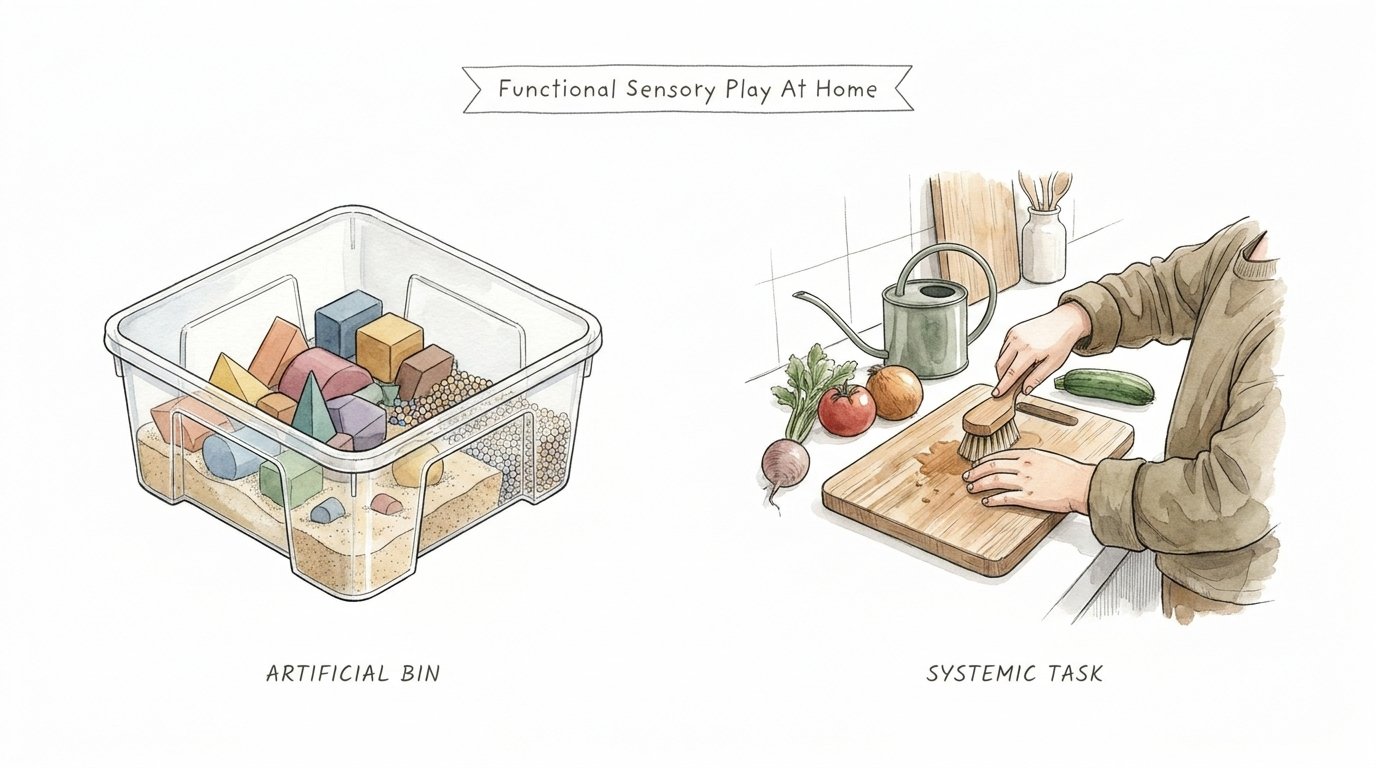
In a traditional sensory bin, a child might scoop dyed rice. It feels interesting and looks pretty. However, functional play swaps that rice for something like a muddy potato. Now, the play has a result. The potato becomes clean and ready for dinner.
This shift changes the child’s internal narrative. They aren’t just “playing.” They are working. This sense of “Practical Life” is a cornerstone of Montessori philosophy. It builds self-esteem through genuine competence.
Functional play happens in the kitchen, the garden, and the laundry room. It utilizes the resistance of water, the weight of groceries, and the scent of fresh herbs. It is grounded in reality. This grounding helps children organize their nervous systems more effectively than abstract play.
We see this in action when a toddler stands on a stool to help. They aren’t just splashing. They are observing fluid dynamics. They are feeling the temperature change from cold to warm. They are learning the limits of their own physical strength.
How It Works: The Potato Lab
Washing a potato is a masterclass in sensory integration. To do it correctly, you need a few basic tools. A sturdy step stool, a vegetable brush, a few dirty potatoes, and a basin of water are all it takes.
Start by letting the child feel the dry, dusty skin of the potato. This is the first tactile input. It is rough and earthy. Then, introduce the water. The transition from dry to wet provides a massive sensory shift.
The child must use proprioceptive force to scrub the dirt away. This means their brain has to tell their muscles how much pressure to apply. Too little pressure and the dirt stays. Too much pressure and they might bruise the potato. This “grading of force” is a sophisticated neurological skill.
Bilateral coordination is the next layer. One hand holds the potato while the other hand moves the brush. The brain has to manage both sides of the body simultaneously. This is a foundational skill for later tasks like writing or riding a bike.
Temperature also plays a role. Using slightly cool water provides a different neurological “ping” than lukewarm water. You can even talk about the “weight” of the potato. A wet potato feels different than a dry one. These are the building blocks of physics.
Finally, there is the sequence. Pick up the potato. Dip it in water. Scrub the surface. Rinse. Place in the clean bowl. This teaches logical sequencing and executive function. It is a complete cycle of work.
Benefits of the Functional Approach
The neurological benefits of functional play are measurable. When a child engages in a “heavy work” task like lifting a water-filled pot, they activate their proprioceptive system. This system provides deep pressure to joints and muscles.
This deep pressure has a calming effect. It organizes the nervous system. Occupational therapists often recommend “heavy work” for children who struggle with focus or high energy. The kitchen sink is the easiest place to find this input.
Beyond the physical, there are massive cognitive gains. Water play is early math. A child learns about volume as they fill different containers. They learn about displacement when they drop a heavy potato into a full sink.
Language development happens naturally here. You aren’t using flashcards. You are using real objects. Words like “gritty,” “buoyant,” “overflow,” and “saturated” become part of their vocabulary through direct experience.
There is also a profound psychological benefit. Children who contribute to the household develop a sense of belonging. They see themselves as capable members of the family. This is the root of true confidence.
Finally, functional play is a gateway to healthy eating. A child who has scrubbed a potato, watched it get chopped, and helped put it in the oven is far more likely to eat it. They have “skin in the game.” The kitchen becomes a place of curiosity rather than a battleground over vegetables.
Challenges and Common Mistakes
The biggest challenge is usually the mess. Parents often avoid the sink because they fear a flooded kitchen. This is a valid concern, but it can be managed. A large towel on the floor or a “water stays in the sink” rule is essential.
Another mistake is over-interfering. We want the potato to be perfectly clean, so we take the brush and “show” them how. This kills the engagement. Let them do a “good enough” job. The goal is the process, not the product.
Speed is also a hurdle. We are usually in a rush to get dinner on the table. Functional play requires a “slow-down” mindset. If you are stressed, it won’t be a therapeutic experience for the child. Pick a time when you aren’t under a deadline.
Using tools that are too big is a common pitfall. A giant, heavy scrub brush is hard for a two-year-old to manage. Look for child-sized versions of real tools. A small nail brush or a dedicated vegetable brush makes a huge difference.
Finally, don’t turn it into a forced chore. If the child is tired or disinterested, let them walk away. Functional play should be an invitation, not a mandate. The “magic” of the sink only works when the child is intrinsically motivated.
Limitations: When the Sink Isn’t Ideal
Functional sensory play isn’t a silver bullet for every situation. If a child is experiencing extreme sensory avoidance, the cold water and rough potato skin might be overwhelming. You have to respect their “sensory threshold.”
Environmental constraints also matter. If your kitchen is cramped or your sink is dangerously high, it might not be the right time. Safety is always the priority. A slippery floor is a real hazard for a toddler on a stool.
Some children may have physical limitations that make bilateral coordination difficult. In these cases, you may need to adapt the task. For example, you could suction a brush to the side of the sink so the child only needs to move the potato.
There are also times when the “mess factor” outweighs the benefit. If you are already overwhelmed or the kitchen is a disaster, adding a splashing toddler might lead to parent burnout. It is okay to say, “The sink is closed today.”
Lastly, remember that the sink is a high-supervision zone. You cannot set a toddler up at the kitchen sink and walk into the other room. If you need a “hands-off” activity so you can work, a dry sensory bin in a gated area might actually be the better choice.
Comparing Sensory Environments
It is helpful to look at how different play styles impact development. While all play has value, the depth of the experience varies.
| Feature | Artificial Sensory Bin | Systemic Kitchen Task |
|---|---|---|
| Primary Goal | Exploration and Entertainment | Contribution and Skill Mastery |
| Sensory Input | Focused (usually Tactile/Visual) | Integrated (Proprioceptive/Olfactory/Tactile) |
| Cost | Medium (Bin, Filler, Themed Toys) | Zero (Existing Kitchen Supplies) |
| Cognitive Load | Low (Open-ended play) | High (Sequencing and Result-oriented) |
| Cleanup | Variable (Rice/Sand can be difficult) | Built-in (Cleaning up is part of the task) |
Artificial bins are wonderful for rainy days or specific therapeutic goals. However, Systemic Tasks offer a higher “return on investment” for the brain. They ground the child in the rhythms of the home.
Practical Tips for Your Sink Station
To make this successful, you need a system. Start with a high-quality helper tower. This keeps the child safe and at the correct height. A standard chair is often too unstable for vigorous scrubbing.
Keep a “sink kit” under the sink. This should include a small apron, a few different types of brushes, and a collection of non-breakable containers. Having these ready to go reduces the barrier to entry for you.
Use a “pre-wash” bowl. Instead of letting the water run the whole time, fill a bowl or the sink basin. This teaches resource management and prevents the “Niagara Falls” effect in your kitchen.
Manage the floor. Place a thick, absorbent mat or a large bath towel directly under the stool. This catches the inevitable splashes and prevents slips when the child climbs down.
Rotate the tasks. One day it might be washing potatoes. The next day it could be “rescuing” plastic animals from “mud” (dish soap bubbles). The variety keeps the interest high.
Teach the “Dry Off” phase. This is just as important as the washing. Give the child a clean tea towel and show them how to pat each item dry. This provides a final tactile experience and completes the cycle of work.
Advanced Considerations for Integration
Once your child is comfortable with basic washing, you can scale the complexity. Introduce different densities. Have them wash a heavy potato and then a light apple. Ask them which one “pushes” back more in the water.
You can also introduce temperature gradients. Give them a bowl of “snow” (crushed ice) and a bowl of warm water. Let them experiment with how the ice disappears. This is early chemistry and thermodynamics.
Consider the auditory aspect. The sound of a sprayer vs. a steady stream. The “thunk” of a potato hitting the bottom of the sink vs. the “splash” of a spoon. These auditory cues help the brain map the environment.
For older children, you can introduce volume measurements. Give them a 1-cup measure and a 4-cup bowl. Ask them to predict how many “scoops” it will take to fill the bowl. This is foundational division and multiplication.
Think about the “Proprioceptive Heavy Work.” If you have a double sink, have the child move heavy, wet items from one side to the other. Crossing the midline of the body is a critical neurological milestone that supports reading and writing readiness.
Scenario: The Saturday Morning Routine
Imagine a typical Saturday morning. Instead of turning on the TV while you prep breakfast, you invite your toddler to the sink. You have a bag of potatoes that need to be prepped for a tray of home fries.
You set up the helper tower. Your child puts on their apron with a sense of ceremony. You fill the sink with two inches of cool water. You drop three potatoes in.
The child reaches in. Their hands are cold, and they laugh. They pick up the brush. You see them concentrating, their tongue peeking out as they scrub the “brown” off the potato. They are working their finger muscles, their shoulder stability, and their focus.
They finish one potato and proudly place it on the “clean” towel. You acknowledge it: “You worked hard on that one. It looks ready for the oven.”
By the time you are ready to cook, the potatoes are clean. Your child has spent 20 minutes in deep, focused “flow.” Their nervous system is regulated from the heavy work and the water. You haven’t just made breakfast; you’ve built a brain.
Final Thoughts
The kitchen sink is more than a plumbing fixture. It is a developmental powerhouse. By shifting our perspective from “making a mess” to “building a brain,” we unlock a world of learning that costs nothing.
Washing potatoes, scrubbing carrots, or simply pouring water are not distractions from the “real” world. They are the most important parts of it. These tasks provide the sensory integration that children crave and the practical skills they need.
Move away from the artificial and toward the systemic. Let your child get their hands wet. Let them feel the weight of a potato. Let them be a part of the heart of your home.
Experiment with this today. Clear a spot at the sink. Grab a vegetable and a brush. Invite your child in. You might be surprised at how much “education” can happen in a few inches of water.
Sources
1 cresthillacademy.com | 2 thedefaultcook.com | 3 howweelearn.com | 4 lumierechild.com | 5 montessoribymom.com | 6 whitbyschool.org | 7 lovevery.com | 8 seedsforspecialneeds.com | 9 piccalio.com | 10 kerensnursery.com | 11 montessorifamilycenter.com | 12 montessoribase.com | 13 otogether.org | 14 bridgingthegap.com.sg | 15 gowriensw.com.au | 16 indiana.edu | 17 theottoolbox.com | 18 montessoriinreallife.com | 19 theottoolbox.com