How To Set Up Invitations To Play
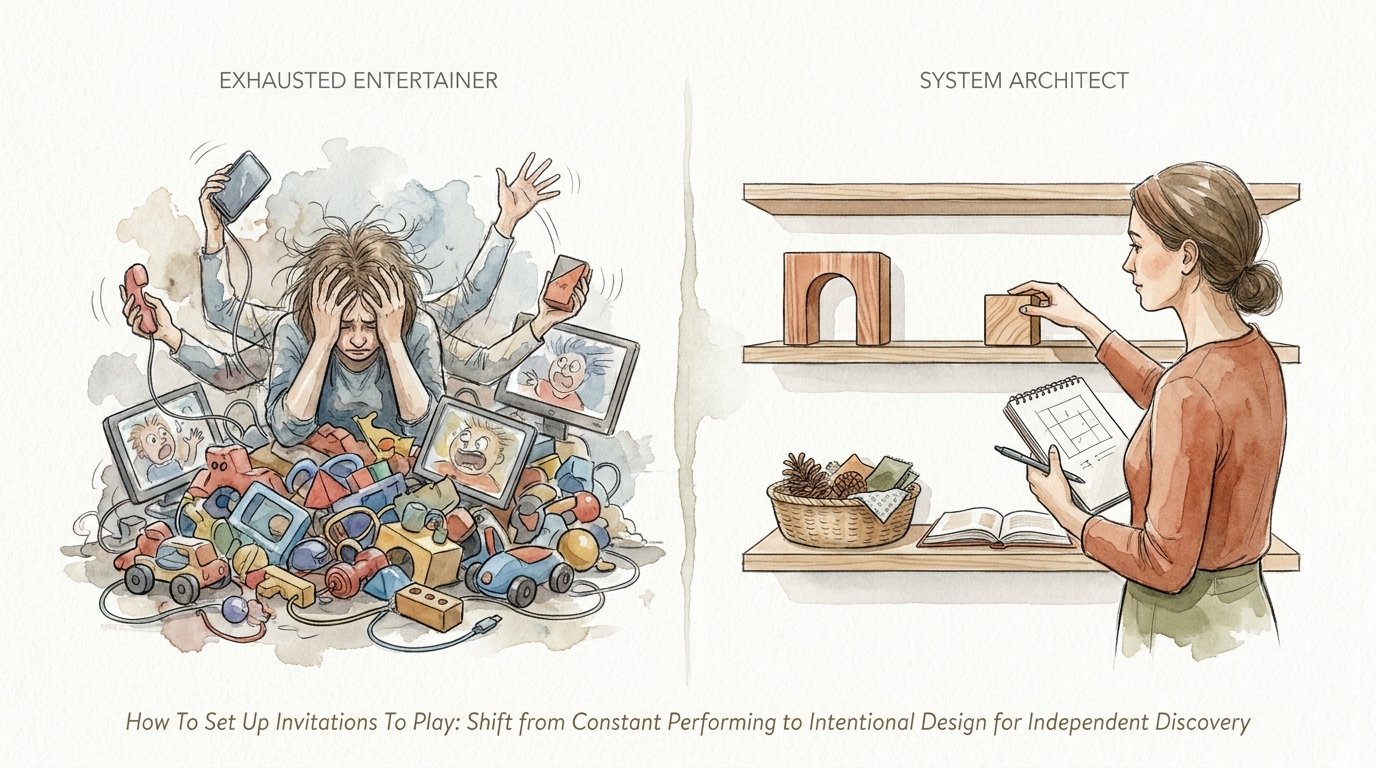
Stop being your child’s Chief Entertainment Officer and start being the architect of their curiosity. Manual parenting means you are the engine of their play—if you stop, they get bored. Strategic parenting uses “Invitations to Play.” Setting up a single, high-interest prompt the night before triggers their natural investigative drive. You don’t have to work harder; the environment does the work for you.
Transitioning from being the primary entertainer to a system architect allows your child to develop the essential skills of self-direction and focus. This method moves away from the “Exhausted Entertainer” model where every moment of boredom requires parental intervention. Instead, it creates a sustainable ecosystem within your home where discovery happens organically.
Modern research from late 2025 emphasizes that child-led play is foundational to healthy development, building critical capacities in cognitive and social domains. An expanding body of interdisciplinary work confirms that when children lead their own learning, they develop stronger executive functions such as working memory and impulse control.
How To Set Up Invitations To Play
An invitation to play is a purposeful arrangement of materials designed to “invite” a child to explore, investigate, and create independently. This concept draws heavily from the Reggio Emilia approach, which views the physical environment as the “third teacher” in a child’s life. Rather than handing a child a finished toy with a single function, you present a curated set of objects that spark a question or a story.
These invitations usually appear in a designated “yes space”—an area where children are free to touch, move, and manipulate everything they see without constant redirection. Real-world applications range from simple trays of kinetic sand and plastic dinosaurs to complex “small worlds” involving water, natural materials, and loose parts.
The goal is not to provide a set of instructions. You are simply setting the stage. A successful invitation looks like a “provocation”—it provokes thought. For example, placing three different-sized bowls next to a basket of acorns invites a toddler to sort, count, or transfer, all without you saying a word.
How It Works: The Strategy of the Night-Before Setup
The most effective invitations are prepared when the child is asleep. This creates a “discovery moment” the next morning, allowing the child to encounter the materials with fresh eyes. Success depends on three core principles: curation, presentation, and withdrawal.
Curation involves selecting materials based on your child’s current interests or “schemas” (patterns of repeated behavior). If your child is currently obsessed with “transporting” items, you might curate a set of small baskets and colorful glass gems. If they are into “positioning,” you might set out a line of wooden blocks and felt squares.
Presentation is the visual hook. Materials should be arranged neatly on a tray, a low table, or a rug. Visual order reduces cognitive overwhelm. Seeing a chaotic pile of toys often leads to “toy dumping,” but seeing five specific items arranged in a circle invites careful touch.
Withdrawal is the hardest part for the parent. Once the child engages, you must step back. Observing from a distance allows the child to enter a state of “flow,” a deep level of concentration where the most significant learning occurs. Research from 2024 confirms that even five minutes of deep, child-led play can strengthen cognitive flexibility and problem-solving skills more effectively than hours of adult-directed activity.
The Measurable Benefits of Strategic Play
Strategic parenting through invitations offers practical, measurable advantages for both the child and the parent. This approach transforms the daily rhythm of the home from one of constant demand to one of collaborative independence.
- Increased Attention Span: Children who regularly engage with open-ended invitations learn to sustain focus. Because there is no “right way” to play, they don’t get frustrated by failure, leading to longer periods of engagement.
- Executive Function Development: Planning how to use materials, remembering the purpose of a setup, and adjusting their strategy mid-play builds the prefrontal cortex. This is the brain’s “control center.”
- Emotional Regulation: Independent play serves as a safe space for children to process emotions. A 2025 study highlighted that play helps regulate stress and protects against early childhood anxiety by giving children a sense of agency over their environment.
- Reduced Parental Burnout: When the environment becomes the primary driver of play, the parent is no longer the sole source of entertainment. This frees up mental bandwidth and reduces the “mental load” of daily caregiving.
Recent studies in the Journal of Intelligence (2025) found that “loose parts play”—a key component of invitations—significantly enhances divergent thinking and academic readiness. Children learn to see one object as having multiple possibilities, which is the hallmark of creative genius.
Common Mistakes and Pitfalls
Many parents start with high enthusiasm but quickly feel discouraged when their child ignores the setup or makes a massive mess in seconds. These outcomes usually stem from a few common misunderstandings of the system.
One frequent error is overcomplicating the setup. Scrolling through social media can lead you to believe an invitation must be a Pinterest-perfect masterpiece. In reality, too many items cause “choice paralysis.” A child faced with 20 different materials may simply swipe them all off the table. Start simple: two or three items are often enough for a toddler.
Another pitfall is the “Hovering Instructor” syndrome. If you immediately start explaining how to use the materials, you kill the curiosity. The invitation is for the child, not for your vision of how they should play. If they use the “dinosaur rescue” setup to practice “soup making” with the dinosaurs, let them. The goal is engagement, not compliance.
Finally, ignoring developmental norms can lead to frustration. Expecting a two-year-old to sit quietly with a complex beading invitation is unrealistic. Ensure the materials match their fine motor capabilities. Use larger items for younger children and save the “loose parts” like small stones or buttons for when they are past the mouthing stage.
Realistic Limitations and Constraints
While powerful, invitations to play are not a “set it and forget it” solution for every situation. Environmental limitations and the child’s unique temperament play significant roles in how well this method works.
Space is a common constraint. Not every family has a dedicated playroom or a large table for permanent setups. In smaller homes, you may need to use “portable invitations” stored in shallow bins that can be brought out and put away daily. This requires more management from the parent but still provides the child with a high-interest prompt.
Time is another factor. Although the “night-before” setup only takes three to five minutes, it requires consistency. If the parent is too exhausted to curate the environment, the system breaks down. This method also may not work well during periods of high transition, such as moving house or starting a new school, when children often require more direct parental “re-fueling” and proximity.
Temperament also matters. Some children are naturally more “high-energy” and may find sedentary invitations boring. For these children, the invitations need to be movement-based—perhaps an indoor “obstacle course” invitation using cushions and painter’s tape on the floor.
Strategic Parenting vs. Manual Parenting
Understanding the difference between these two approaches helps you decide where to spend your energy. Manual parenting is reactive; strategic parenting is proactive.
| Feature | Manual Parenting (Entertainer) | Strategic Parenting (Architect) |
|---|---|---|
| Primary Driver | The Parent’s energy and ideas. | The Environment and curated materials. |
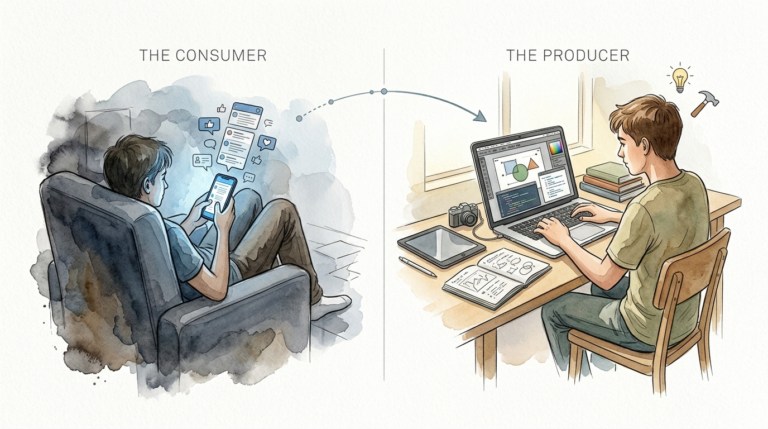
| Child’s Role | Consumer of entertainment. | Producer of ideas and play. |
| Sustainability | Low; leads to parental burnout. | High; fosters independent habits. |
| Setup Complexity | Ad-hoc and often chaotic. | Intentional and curated. |
| Boredom Response | “I’m bored” equals parent intervention. | “I’m bored” equals environmental search. |
Strategic parenting aligns with the “authoritative” style, which balances high warmth with clear structure. This combination is consistently linked to the best long-term outcomes for children, including higher self-esteem and better academic performance.
Practical Tips for Implementation
Starting your journey as an architect of curiosity doesn’t require a shopping spree. Most of the best materials are already in your home or your backyard.
- Adopt a “Loose Parts” Mentality: Collect items that don’t have a fixed purpose. Cardboard tubes, bottle caps, smooth stones, shells, and fabric scraps are gold mines for a child’s imagination. A stick can be a wand, a bridge, or a spoon.
- Use Trays and Baskets: Defining the boundaries of the play makes it more approachable. A tray says, “the experiment happens here.” This also makes cleanup much faster.
- Rotate Your Toys: Hide 70% of your toys in the closet. When you bring one out for an invitation, it feels brand new. Novelty is a powerful trigger for investigative drive.
- Follow the Interest, Not the Trend: If your child is obsessed with “dumping” things, give them a “Dumping Station” with beans and measuring cups. Don’t force a “Space Theme” just because it looks good on social media.
- Keep a “Play Journal”: Jot down what your child actually did with the invitation. Did they ignore the blocks but spend 20 minutes with the empty box? This observation tells you exactly what to set up next time.
Focusing on the process rather than the product ensures that play remains joyful. Your role is to observe their decision-making and problem-solving without correcting their “errors.”
Advanced Considerations: Schema Theory and Scaffolding
Serious practitioners of invitations to play often study “Schema Theory.” Developed by educators like Chris Athey, schemas are repetitive patterns of behavior that children use to explore the world. Recognizing these patterns allows you to create highly effective “super-invitations.”
Common schemas include Trajectory (throwing, dropping), Rotation (turning taps, spinning), Enveloping (wrapping things up, hiding), and Connecting (joining things together). If a child is in a Trajectory schema, an invitation involving a ramp and different weights of balls will keep them engaged for hours. Matching the invitation to the schema is like “hacking” their concentration.
Another advanced concept is Scaffolding. This involves providing just enough support to help a child reach the next level of complexity without doing the work for them. If a child is struggling to build a tower, you might place a flat board nearby. You don’t build the tower; you provide the tool they need to solve the problem themselves.
Examples of Invitations in Practice
Translating theory into reality is easier with concrete examples. These setups range in complexity but all follow the principle of the “Environmental Prompt.”
The “Dinosaur Rescue” (Preschooler Level)
Set out a large tray filled with “mud” (cocoa powder and water) or kinetic sand. Half-bury several plastic dinosaurs. Place a small bowl of “clean water” and an old toothbrush nearby.
The Prompt: The dinosaurs are stuck in the mud. How can we get them clean?
The Result: The child engages in sensory exploration, fine motor practice (scrubbing), and imaginative storytelling.
The “Rainbow Bridge” (Toddler Level)
Place a stack of colorful magnetic tiles on one side of a rug and a few wooden peg people on the other. Use a piece of blue felt or paper to represent a “river” between them.
The Prompt: The people need to cross the water.
The Result: The child experiments with balance, spatial awareness, and color matching.
The “Transient Art Station” (School-Age Level)
Provide a picture frame with the glass removed, sitting on a flat surface. Next to it, place small bowls containing “loose parts” like buttons, dried pasta, pebbles, and pinecones.
The Prompt: Can you make a face (or a forest, or a pattern) inside the frame?
The Result: This encourages artistic expression and mathematical thinking through symmetry and pattern-making without the permanence of glue or paint.
Final Thoughts
Embracing the role of “System Architect” changes the energy of your household. Instead of feeling like you must constantly fuel your child’s happiness with your own effort, you are building a world that fuels itself. This shift requires trust—trust in the environment you have built and trust in your child’s innate ability to learn.
The night-before invitation is more than a parenting hack; it is a commitment to fostering independence. Watching your child wake up and dive into a world of their own creation is one of the most rewarding experiences of parenting. It shows that you have successfully moved from the engine of their play to the architect of their growth.
Start tonight with something small. A single basket of blocks and a few toy cars on a rug can be the beginning of a new way of living. Experiment with different materials and observe how your child responds. Over time, you will find that the less you do, the more they discover.
Sources
1 nurturedfirst.com | 2 littletoytribe.com.au | 3 vivvi.com | 4 momentsenriched.com | 5 habausa.com | 6 waldorfeducation.org | 7 childmind.org | 8 harvard.edu | 9 appetitetoplay.com | 10 thechildunplugged.com | 11 prekprintablefun.com | 12 themontessoriroom.com | 13 gowriensw.com.au | 14 barrkinderplay.com | 15 myteachingcupboard.com | 16 childrenscolorado.org | 17 nih.gov