How To Cook With Toddlers Without The Mess
You don’t hate cooking with your kids; you hate the lack of a system. Most parents think cooking with kids is a manual labor nightmare. Most parents think cooking with kids is a manual labor nightmare. By applying the ‘Mise en Place’ strategy used by professional chefs, you turn a chaotic mess into a logic puzzle. The secret isn’t more patience; it’s better preparation.
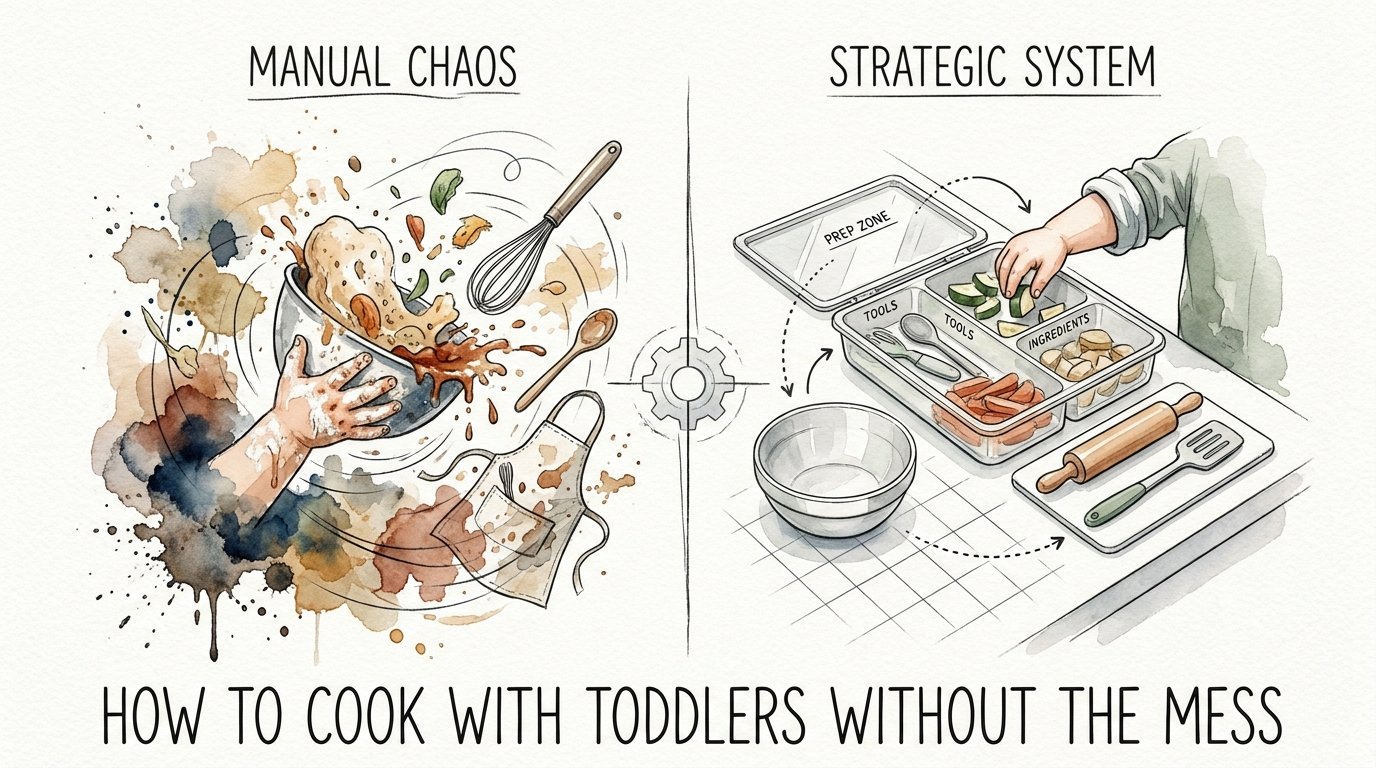
The kitchen often feels like a battlefield when a toddler is involved. Flour coats the floor. Eggs smash on the counter. You find yourself hovering and barking orders to “be careful” every three seconds. This isn’t fun for you, and it certainly isn’t fun for them. It feels like manual chaos because you are trying to manage a recipe and a small human at the same time.
Professional chefs never walk into a kitchen without a plan. They use a system called ‘Mise en Place,’ which literally means “everything in its place.” This strategy ensures that every ingredient is prepped, every tool is ready, and the workflow is mapped out before the heat even touches the pan. When you bring this mindset into your home, the chaos disappears. You stop being a stressed-out supervisor and start being a guide.
Transitioning from a reactive cooking style to a proactive system changes the entire family dynamic. You are no longer just making dinner; you are building skills, confidence, and memories. This guide will show you exactly how to implement a professional-grade system in your home kitchen, specifically designed for the unique challenges of cooking with toddlers.
How To Cook With Toddlers Without The Mess
Cooking with toddlers without the mess is a matter of containment and preparation. Most messes occur because ingredients are out of reach, tools are too large, or the child is left waiting with nothing to do. A mess-free environment is a controlled environment. You are creating a “logic puzzle” where every piece has a designated spot and every movement has a purpose.
This approach exists to bridge the gap between “helping” and “hindering.” In the real world, parents often avoid the kitchen because the cleanup takes twice as long as the cooking. When you apply a strategic system, you eliminate the friction. You use tools like deep-sided mixing bowls and pre-measured containers to keep everything inside the “work zone.”
Imagine your kitchen island as a professional assembly line. Your toddler has a specific station. They have specific tasks. The environment is “prepared,” a concept rooted in Montessori education, which suggests that a child’s success depends on the environment being tailored to their size and ability. If the environment is right, the mess stays at a minimum.
How the System Works: Step-by-Step Execution
The core of this system is the pre-game. You must do the heavy lifting before the toddler ever puts on an apron. If you are still chopping onions while your three-year-old is standing on a stool, you have already lost the battle. Follow these steps to ensure a smooth, logic-driven session.
1. Total Recipe Immersion
Read the entire recipe from start to finish. Identify every tool you need, from the smallest teaspoon to the largest stockpot. Professional chefs call this “mental cooking.” You need to know exactly where the hurdles are before you hit them. If the butter needs to be softened, do it an hour before. If the oven needs to be at 400 degrees, preheat it now.
2. The “Pre-Prep” Phase
Measure every single ingredient into small, easy-to-handle bowls. Use clear containers so the child can see the contents. For toddlers, the act of “dumping” is the most exciting part. If you have ten pre-measured bowls ready to go, they can dump for ten minutes straight without you needing to touch a measuring cup. This keeps them engaged and prevents them from wandering off while you fumble with a bag of flour.
3. Station Setup
Create a designated workspace. Use a stable step stool or a “learning tower” that brings them to counter height safely. Cover the immediate area with a large, washable mat or a vinyl tablecloth. This creates a psychological and physical boundary for the “work zone.” Everything inside the zone is fair game; everything outside is off-limits.
4. Tool Selection
Give your child tools that actually fit their hands. A standard whisk is often too heavy and long for a two-year-old. Use mini-whisks, child-safe nylon knives, and small silicone spatulas. Proper tools reduce frustration. When a child feels capable, they are less likely to act out or create “experimental” messes.
The Hidden Benefits of a Strategic Kitchen
Implementing a system isn’t just about keeping the floor clean. It offers massive developmental advantages that pay off for years. You are essentially running a high-speed laboratory for your child’s brain.
Math and Literacy: Even if they can’t read yet, you are introducing them to sequencing. First we do this, then we do that. You can count the bowls together. You can talk about “half” and “whole.” These are the foundations of early numeracy. You are teaching them that symbols on a page (the recipe) correspond to actions in the real world.
Fine Motor Skills: Stirring, pouring, and pinching require incredible coordination. A toddler who practices these tasks develops the “pincer grasp” and wrist stability needed for writing later on. Tearing lettuce or mashing bananas builds hand strength. These are “functional” exercises that beat any toy on the market.
Picky Eater Prevention: Research consistently shows that children who help prepare food are more likely to try it. They feel a sense of ownership. If they “made” the salad, the lettuce is no longer a scary green object; it is their creation. You are building a positive relationship with food through exposure and sensory play.
Common Challenges and How to Avoid Them
Even with a perfect system, hurdles will appear. Most parents fail because they make one of these three common mistakes. Recognizing these early allows you to pivot before the “manual chaos” takes over.
Mistake 1: Starting While Stressed
Never try to “teach” cooking when you are forty minutes behind on dinner and everyone is starving. Hunger and stress are the enemies of a system. Choose a “low-stakes” time, like Saturday morning pancakes or a rainy Tuesday afternoon snack. When there is no clock ticking, your patience remains intact.
Mistake 2: The “Hover-Parent” Trap
You will want to reach in and “fix” their stirring or “adjust” their pouring. Resist this urge. Constant correction kills the joy of the activity. If they spill a little flour, let it go. The goal is the process, not a Michelin-starred result. If you hover, they stop trying and wait for you to do it for them.
Mistake 3: Poor Tool Choice
Using a dull knife is more dangerous than using a sharp, child-appropriate one. Dull blades slip. Large spatulas are unwieldy. If the tools don’t work, the child gets frustrated and starts using their hands in ways that create a mess. Invest in a small set of “real” kitchen tools designed for small hands.
When This System May Not Be Ideal
Context is everything. There are specific times when the “Mise en Place” strategy with a toddler might not be the best use of your energy. Understanding these boundaries protects your sanity.
High-speed, high-heat recipes like stir-fry or searing steaks are generally poor choices for toddler involvement. These require split-second timing and involve hot oil splatters. The risk-to-reward ratio is too low. Stick to “cold prep” or slow-cook methods like baking, salads, or slow-cooker assembly.
Environmental limitations also matter. If you have a tiny galley kitchen with no counter space, trying to set up multiple “mise” stations can feel more crowded than helpful. In these cases, it is better to have the child work at the dining table while you stay at the counter. This physical separation keeps the system flowing without everyone tripping over each other.
Strategic System vs. Manual Chaos
The difference between these two approaches is the difference between a relaxing activity and a chore. One relies on willpower; the other relies on architecture.
| Factor | Manual Chaos | Strategic System |
|---|---|---|
| Prep Work | Done while the child is present. | Completed before the child enters. |
| Ingredient Access | Large bags and heavy containers. | Pre-measured, small clear bowls. |
| Cleanup | Massive “after-math” scrubbing. | Integrated “clean-as-you-go” stations. |
| Stress Level | High (reactive management). | Low (proactive guidance). |
| Success Rate | Inconsistent / Frustrating. | High / Repeatable. |
Practical Tips for Immediate Application
You can start using these techniques today. Small adjustments yield massive results in how much “chaos” actually reaches your floorboards.
- Use Deep Bowls: Always use a mixing bowl that is twice as large as the recipe requires. This provides a “buffer zone” for over-enthusiastic stirring.
- The “Done” Bowl: Keep one large empty bowl on the counter. As soon as a pre-measured container is empty, it goes into the “done” bowl. This keeps the workspace clear and prevents sticky containers from migrating across the kitchen.
- Soapy Water Station: Fill the sink with warm, soapy water before you start. Let the toddler “wash” plastic tools as you finish with them. It keeps them occupied and handles the cleanup simultaneously.
- The Trash Bowl: Place a small bowl on the work surface for eggshells, vegetable peels, and scraps. This prevents the toddler from needing to climb down or reach for a trash can, which is when most spills happen.
Advanced Considerations for the Serious Practitioner
Once you master basic “dump and stir” cooking, you can begin to introduce more complex skills. This is where the system truly begins to scale with your child’s development.
Knife skills are the ultimate milestone. Start with a wavy-blade chopper or a nylon knife and soft foods like bananas, cucumbers, or strawberries. Teach the “claw grip” where fingers are tucked away from the blade. This requires high-level focus and builds immense confidence. A child who can safely handle a knife is a child who feels respected and capable.
Sensory integration is another advanced layer. Encourage your toddler to smell every spice before it goes into the bowl. Let them touch the different textures of flour, sugar, and oats. Ask them to describe what they see. “Is the batter thick like mud or thin like water?” You are turning a simple recipe into a full-scale sensory processing session that aids in cognitive development.
Real-World Scenario: The 15-Minute Muffin System
Let’s look at how this works in practice with a simple muffin recipe. This is the difference between a 45-minute nightmare and a 15-minute win.
Step 0 (The Prep): While the toddler is napping or playing, you measure out the flour, sugar, and baking powder into three separate small bowls. You crack two eggs into a small ramekin. You melt the butter and let it cool. You line the muffin tin.
Step 1 (The Invite): You bring the toddler to their learning tower. The “work zone” is set. You explain the plan: “We are going to make muffins. We need to put all these bowls into the big red bowl.”
Step 2 (The Execution): The toddler dumps the flour. You count: “One!” They dump the sugar: “Two!” You hand them a whisk and let them stir the dry ingredients. Because you used a massive bowl, no flour escapes. You add the liquid. They stir again. They see the change from powder to batter—this is science in action.
Step 3 (The Finish): You use a large cookie scoop to portion the batter. They “help” by pushing the lever or just watching. The muffins go in the oven. The empty bowls go into the sink. The total “active” time for the toddler was 10 minutes of pure engagement with zero stress for you.
Final Thoughts
Systematizing your kitchen isn’t about being rigid or taking the fun out of cooking. It is about removing the barriers that make you say “no” to your children. When you have a system, you have the freedom to say “yes” more often. You can let them stir, let them pour, and even let them make small mistakes because the environment is designed to handle it.
Remember that you are not just making a meal; you are raising a future adult. The skills they learn at three years old—following a sequence, managing a workspace, and trying new things—are the same skills they will need at thirty. The ‘Mise en Place’ strategy gives them the structure they need to thrive and gives you the peace of mind you deserve.
Start small. Choose one recipe this weekend. Prep everything beforehand. Watch how the energy in your kitchen shifts from “manual labor nightmare” to a “logic puzzle” you solve together. You might find that you actually enjoy cooking with your kids after all.
Sources
1 all-clad.com | 2 imthecheftoo.com | 3 lilpinkiesup.com | 4 mylittleeater.com | 5 thebakermama.com | 6 baketivity.com | 7 lovevery.com | 8 usu.edu | 9 thescramble.com | 10 liftenrichment.com | 11 metroparent.com | 12 practicalbydefault.com | 13 mother.ly | 14 saskmilk.ca