How To Organize Kids Toys
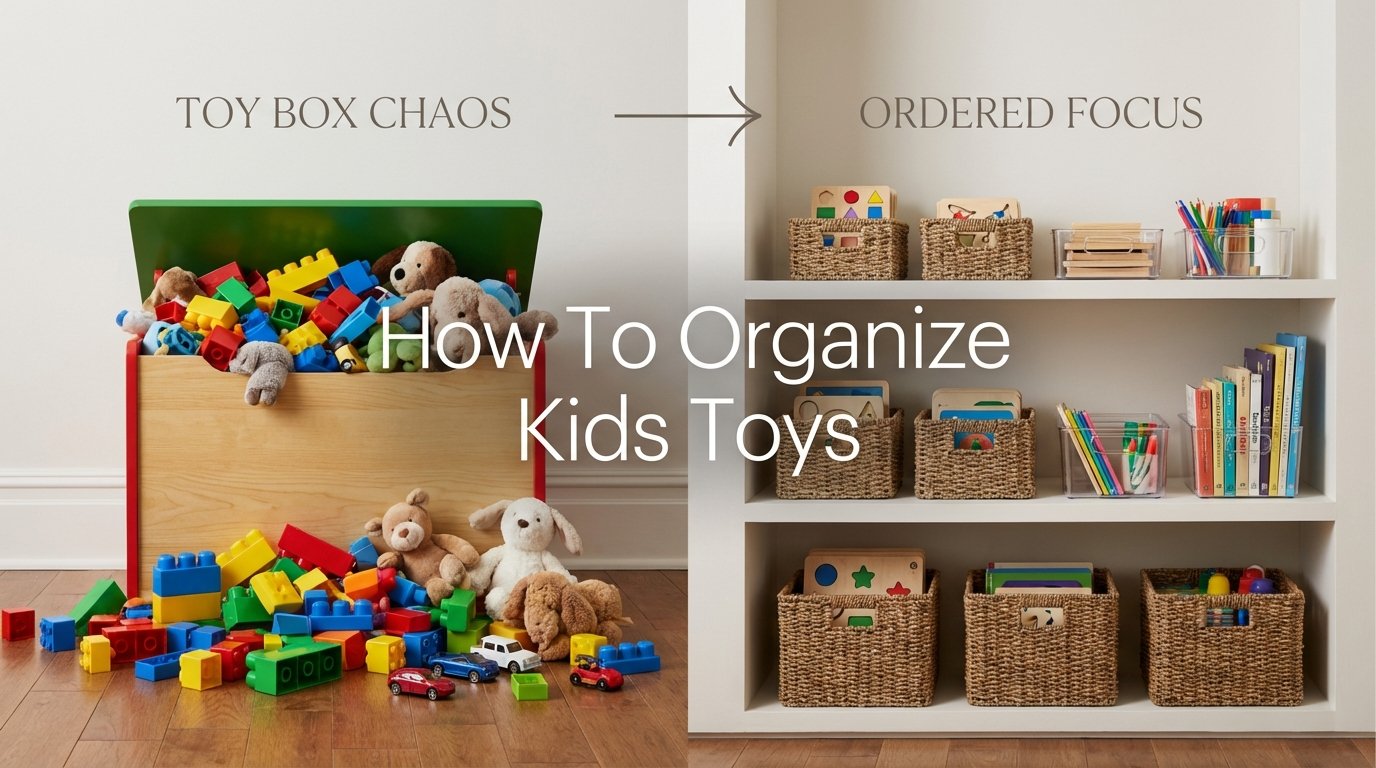
A cluttered room leads to a cluttered mind. See how subtraction creates focus. Overstimulation is the enemy of play. Limiting choices and creating visual order invites our children into a state of deep, calm focus.
Walk into almost any modern home and you will see it. Plastic mountains. Half-forgotten puzzles. Legos lurking in the carpet like tiny, jagged landmines. We call this TOY BOX CHAOS. It is a state where more toys actually lead to less play. Research shows that an abundance of toys reduces the quality of a toddler’s engagement. They flit from one thing to another. They never settle. They never dive deep.
True play requires a transition into ORDERED FOCUS. This isn’t just about tidying up at the end of the day. It is about a fundamental shift in how we curate the environment. Children need a stage, not a warehouse. They need a few high-quality tools that spark imagination rather than a bin of distractions that scream for attention.
Organization is a gift of mental clarity. When we remove the noise, we allow the child’s natural curiosity to take the lead. This guide will walk you through the process of reclaiming your space and your child’s attention.
How To Organize Kids Toys
Organizing kids’ toys is the practice of curating an environment that supports developmental growth and sustained attention. It is not merely a storage solution. It is a system of “curation and rotation” that treats toys as educational materials rather than clutter. In a well-organized space, every item has a specific home, and only a limited number of items are available at any given time.
This concept exists because children possess a limited capacity for executive function. Too many choices lead to decision fatigue. When a child sees 50 toys, their brain struggles to choose one. They end up dumping the bin and walking away. This is often mistaken for a short attention span, but it is actually a reaction to an overwhelming environment.
Real-world applications of these methods are found in Montessori and Reggio Emilia classrooms. These environments use low, open shelving where toys are displayed individually. This allows the child to see exactly what is available. It empowers them to choose, use, and return an item independently. The focus is on quality over quantity and visibility over volume.
The Subtraction System: How to Create a Toy Rotation
Creating a functional system starts with a hard reset. You cannot organize your way out of an overabundance of stuff. You must subtract before you can focus.
Step one is the Great Gathering. Collect every single toy from every corner of the house. Put them in one central location. This visual representation of the “toy mountain” is usually a wake-up call for parents.
Step two involves the First Pass. Discard anything broken. Donate anything your child has clearly outgrown. Be ruthless here. If it hasn’t been touched in six months, it doesn’t belong in the active rotation.
Step three is Categorization. Group toys by their function. Common categories include:
- Gross Motor: Balls, tunnels, or indoor climbers.
- Fine Motor: Puzzles, lacing beads, or pegboards.
- Imaginative Play: Dolls, kitchen sets, or dress-up clothes.
- Open-Ended Building: Blocks, magnetic tiles, or logs.
- Sensory & Art: Playdough, crayons, or sand trays.
Step four is the Curated Selection. Choose 8 to 10 items to stay out. Aim for one item from each category. This provides a balanced “diet” of play without the overwhelm.
Step five is the Storage Lockup. Place the remaining toys in clear, labeled bins. Hide these bins in a closet, attic, or garage. Out of sight means out of mind for the child, but easily accessible for you.
Step six is the Rotation Cycle. Every two to four weeks, swap the “active” toys for “stored” toys. Watch as your child reacts with the excitement of a birthday morning. Old toys feel brand new again because the child’s brain has had time to reset.
The Practical Benefits of Minimalism in Play
Reducing the toy count offers immediate, measurable advantages for the whole family. Focus is the most prominent benefit. A study from the University of Toledo found that toddlers with fewer toys played for longer periods and in more creative ways. They didn’t just “use” the toy; they explored its possibilities.
Independence is another major gain. When toys are displayed on low, open shelves in baskets or trays, a child can manage their own play. They don’t need to ask for help to get something down or find a missing piece. This builds confidence and self-reliance.
Cleanup becomes a five-minute task rather than a Saturday-morning marathon. Because there are only 10 items out, the mess is physically limited. Children as young as two can learn to return a single basket to its spot on a shelf. This teaches them to respect their environment and take care of their belongings.
Financial savings follow naturally. When you realize that 10 toys provide more value than 100, the urge to buy the next “must-have” gadget disappears. You start looking for high-quality, open-ended toys that will last through years of rotation rather than cheap plastic that breaks in a week.
Challenges and Common Pitfalls
The most frequent mistake is trying to organize a “toy mountain” without decluttering first. Buying more bins does not solve a volume problem. It just hides it. If you have too many toys, even the best system will eventually collapse under the weight of the excess.
Starting the process too late is another hurdle. Parents often wait until the playroom is a disaster zone to intervene. Maintenance is much easier than a total overhaul. Setting a monthly “rotation date” on your calendar ensures the system stays fresh and manageable.
Lacking a clear categorization strategy can lead to “junk drawer” bins. When blocks are mixed with doll accessories and puzzle pieces, the child loses interest. Order is essential for focus. Each toy or set should have its own dedicated container, whether it’s a small basket for cars or a tray for a specific puzzle.
Ignoring the child’s current developmental stage can also stall progress. A rotation that worked six months ago may be boring now. Observation is key. If you see your child ignoring a specific toy for a week straight, it is time to rotate it out, regardless of how “educational” you think it is.
Limitations: When This System May Not Be Ideal
Space constraints can make a large-alscale rotation system difficult. If you live in a small apartment without a closet or attic, finding a place to hide the “extra” toys is a challenge. Using under-bed storage or high shelves that are out of the child’s reach can help, but it requires more creative thinking.
Neurodivergent children may have different needs regarding their environment. Some children crave the comfort of seeing all their favorite things at once. Removing toys can cause anxiety for some. In these cases, a “soft” rotation—where items are categorized but remain visible in clear, high-level bins—might be more effective than a total disappearance.
Older children with complex hobbies present a different challenge. A teenager into tabletop gaming or complex model building cannot “rotate” their 5,000-piece setup easily. The system must evolve as the child grows. Older kids need dedicated “work-in-progress” zones where they can leave projects out without interfering with the rest of the home’s order.
Comparing Storage Philosophies
Different approaches to toy storage offer varying levels of success depending on your goals. Choosing the right one depends on your commitment to the ORDERED FOCUS mindset.
| Feature | Deep Toy Chests | Open Shelving | Clear Bins (Rotation) |
|---|---|---|---|
| Visibility | Low – Items get lost at the bottom. | High – Every item is invited into play. | Medium – Accessible for parents to swap. |
| Ease of Cleanup | Fast but chaotic (the “dump” method). | Moderate – Requires specific placement. | High – Prevents large messes from forming. |
| Focus Level | Low – Overstimulation is common. | Very High – Focus on one item at a time. | Very High – Novelty maintains interest. |
| Independence | Low – Kids dump everything to find one toy. | High – Kids choose and return on their own. | Moderate – Parent manages the “inventory.” |
Practical Tips for Immediate Playroom Impact
Start by lowering the visual noise. Replace bright, mismatched plastic bins with natural materials like wicker baskets or wooden trays. This creates a calmer aesthetic that invites play rather than shouting for attention.
Use “front-facing” book displays. Children are visual creatures. They choose books by the cover, not the spine. Displaying 3-5 books with the covers facing out is much more effective than a packed bookshelf where they can only see the edges.
Label everything with pictures. If your child cannot read yet, a text label means nothing. Use a small photo or a simple drawing of the toy that belongs in that specific basket. This creates a “map” for the child to follow during cleanup time.
Consider the “height of importance.” Place the toys that encourage the most independent or quiet play at the child’s eye level. Move more “active” or messy toys (like paint or playdough) to higher shelves where they require an adult’s permission to access.
Advanced Considerations for Serious Practitioners
Serious practitioners of environmental design look at the “flow” of the room. Create distinct zones for different types of play. A “Cozy Corner” with a rug and pillows is for reading. A “Building Zone” with a hard floor or low table is for blocks. Physical boundaries help the child understand what kind of energy is expected in each space.
Limit “passive” toys. These are toys that do the work for the child—toys with buttons, lights, and batteries. These often lead to a “spectator” mindset. Prioritize “active” toys like blocks, silks, or clay. These require the child to project their own imagination onto the object.
Lighting plays a massive role in focus. Harsh overhead fluorescent lights can increase agitation. Use floor lamps with warm bulbs or maximize natural light. A well-lit, warm space feels like an invitation to settle in for a long afternoon of deep play.
Manage the “toy entry point.” Every new toy that enters the home must have a designated category. If it doesn’t fit into your existing system, something else must leave. This “one in, one out” rule prevents the slow creep of clutter from overwhelming your system again.
Example Scenario: The Living Room Reset
Imagine a family with a four-year-old living in a small suburban home. The living room has become a graveyard for plastic trucks and stray puzzle pieces. The parents feel stressed, and the child is constantly “bored” despite the mess.
The parents implement a rotation. They move 75% of the toys to the garage. They purchase a low IKEA Kallax unit and place it against one wall. On the six shelves, they place:
- A wooden tray with a 12-piece puzzle.
- A basket of 10 high-quality animal figures.
- A stack of 20 magnetic tiles.
- A small basket of drawing supplies.
- A set of wooden blocks.
- A “mystery” bin that changes every three days.
Within one week, the child begins playing for 30 minutes at a time without asking for the TV. Cleanup takes exactly two minutes because each of the six items has a clearly defined home. The parents feel like they have reclaimed their living space, and the child feels like they have a “special” area just for them.
Final Thoughts
Transforming your child’s play area from a place of chaos to a sanctuary of focus is one of the most impactful changes you can make. It is an investment in their cognitive development and your own peace of mind. By choosing subtraction over addition, you provide the space necessary for deep, imaginative work.
Remember that this is a journey, not a one-time project. Your child’s interests will change, and the toy industry will continue to market abundance to you. Staying committed to the principles of order, visibility, and rotation will keep your home a place where play is respected and cherished.
Start small. Choose one shelf or one corner of a room today. Remove the excess, display what remains with care, and watch how your child’s play begins to change. The focus you cultivate now will serve them for a lifetime.
Sources
1 simpleintentional.com (https://www.simpleintentional.com/how-fewer-toys-means-more-play-give-them-less/) | 2 psychologytoday.com (https://www.psychologytoday.com/us/blog/singletons/201712/study-underscores-why-fewer-toys-is-the-better-option) | 3 babylist.com (https://www.babylist.com/hello-baby/montessori-toy-rotation) | 4 pitaya.kids (https://pitaya.kids/toy-rotation-101-how-to-keep-toddlers-engaged-and-tidy/) | 5 casahq.ae (https://casahq.ae/blogs/news/how-to-organize-montessori-toys-at-home) | 6 thissimplebalance.com (https://www.thissimplebalance.com/toy-rotation/) | 7 youtube.com (https://www.youtube.com/watch?v=EGuq6_gJknE) | 8 toycycle.co (https://toycycle.co/blogs/main/keep-kids-engaged-save-space-with-this-toy-rotation-system) | 9 playroomcollective.com (https://playroomcollective.com/blogs/our-blog/rotate-and-rejuvenate-how-a-toy-rotation-system-can-spark-new-interest-in-old-toys) | 10 kidodido.com (https://kidodido.com/blogs/news/how-to-create-the-perfect-montessori-inspired-toy-storage-system) | 11 aosom.com (https://www.aosom.com/blog-toy-storage-ideas-that-actually-work-for-real-homes.html) | 12 themovementmamablog.com (https://themovementmamablog.com/post/my-step-by-step-guide-to-toy-rotation) | 13 lovevery.com (https://blog.lovevery.com/child-development/rotating-toys-the-montessori-way-better-deeper-play/) | 14 getsuperspace.com (https://www.getsuperspace.com/blogs/play-magazine/too-many-toys-bad-for-kids) | 15 joyfulabode.com (https://joyfulabode.com/implement-toy-rotation-system/) | 16 dannicowoodworks.com (https://dannicowoodworks.com/blogs/dannico-woodworks-blog-1/how-to-store-montessori-toys-efficiently) | 17 consciouslyclearedandcontained.com (https://www.consciouslyclearedandcontained.com/blog/toy-rotation) | 18 collabforchildren.org (https://collabforchildren.org/who-we-are/news/toy-rotation-helps-children-focus-play-longer-and-learn-more-at-home/) | 19 thequalityedit.com (https://www.thequalityedit.com/articles/best-toy-storage) | 20 nymag.com (https://nymag.com/strategist/article/best-toy-organizer-ideas.html)