Blue Light Effects On Child Sleep Cycles
If your child’s brain thinks it’s midday at 9 PM, you’re not fighting their attitude—you’re fighting their biology. Overuse often shows up first in the sleep cycle. Synthetic blue light sends a signal to the brain that the sun is up, suppressing melatonin and creating a ‘second wind’ that shouldn’t exist. It’s time to return to natural rhythms.

Most parents assume that “bedtime resistance” is just a phase or a test of boundaries. In reality, modern homes are flooded with high-energy visible (HEV) light that rewires a child’s internal clock. When a tablet or a bright LED bulb hits a child’s eyes after sunset, it triggers a cascade of neurological events that tell the body to stay alert, sharp, and awake.

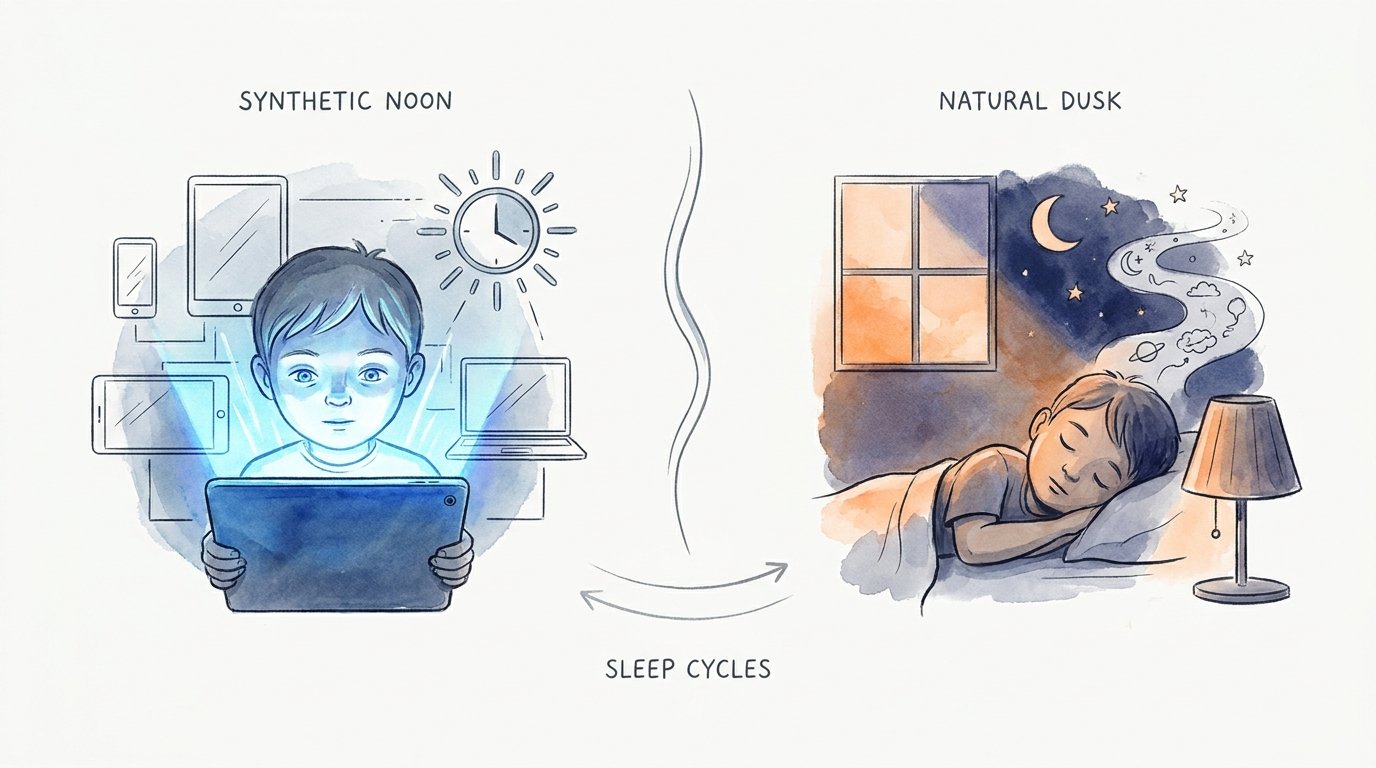
Understanding this biological hijack is the first step to fixing it. We live in an era of “Synthetic Noon,” where the brain receives midday signals long into the night. By making a few targeted adjustments, you can guide your child back to a “Natural Dusk” and restore the restorative sleep they need to grow, learn, and thrive.
Blue Light Effects On Child Sleep Cycles
Blue light is a short-wavelength, high-energy light that sits at the tail end of the visible spectrum. In nature, the primary source of blue light is the sun. It is a powerful tool used by the body to regulate the circadian rhythm, which is our internal 24-hour clock. During the day, blue light is beneficial because it boosts attention, reaction times, and mood.
The problem arises because children are not just “small adults” when it comes to light sensitivity. Their biology makes them significantly more vulnerable to artificial light. Research shows that children’s eyes have larger pupils and clearer crystalline lenses than those of adults. This allows approximately 25 times more 400-nm blue light to pass through to the retina compared to a 70-year-old.
When this light hits the retina, it interacts with specialized cells called intrinsically photosensitive retinal ganglion cells (ipRGCs). These cells contain a photopigment called melanopsin, which is specifically tuned to detect blue wavelengths. Once activated, these cells send a direct signal to the suprachiasmatic nucleus (SCN) in the brain, essentially shouting that it is still daytime.
For a child, even a few minutes of exposure to a bright screen or a cool-white LED bulb can suppress the production of melatonin—the “vampire hormone” that only comes out in the dark—for hours. Studies have found that evening light exposure suppresses melatonin twice as much in children as it does in adults. This creates a physiological state of alertness that makes falling asleep nearly impossible, even if the child is physically exhausted.
The Developmental Impact
Because children are in a constant state of neurodevelopment, sleep disruption hits them harder. Sleep is the primary time for memory consolidation. If the sleep cycle is pushed back by “Synthetic Noon,” the brain misses out on critical REM and deep-sleep stages where information learned during the day is moved into long-term storage.
Furthermore, chronic suppression of melatonin doesn’t just affect sleep. It can impact metabolic health, immune function, and even the timing of puberty. The “second wind” parents see at 9:00 PM isn’t extra energy; it’s a hormonal imbalance caused by the brain failing to recognize that the sun has set.
How the Biological Clock Is Hijacked
The process of falling asleep is governed by two main systems: the Circadian Rhythm (Process C) and Sleep Pressure (Process S). Blue light targets Process C with surgical precision. To understand how to fix your child’s sleep, you must understand the “Master Clock” and the “Melatonin Bridge.”
The Master Clock (SCN)
Deep inside the hypothalamus lies the suprachiasmatic nucleus. This is the body’s timekeeper. It relies on external cues, known as “Zeitgebers,” to know what time it is. Light is the most powerful Zeitgeber. When blue light enters a child’s eye, the SCN interprets this as “noon” and inhibits the pineal gland from releasing melatonin. This keeps the child’s body temperature high and their heart rate elevated, preventing the “wind-down” phase.
The Melatonin Bridge
Melatonin acts as a bridge between wakefulness and sleep. In a natural environment, as the sun sets and light shifts from blue to amber and red, melatonin levels begin to rise. This hormone lowers blood pressure and glucose levels, preparing the body for repair. When we introduce tablets or bright overhead lights, we “burn the bridge.” The brain stays in a state of high cortisol and low melatonin, leading to a delayed sleep phase.
Step-by-Step Breakdown of the Hijack
- Input: Blue light (460–480 nm) from a tablet screen hits the child’s retina.
- Detection: Melanopsin-containing ipRGCs detect the high-energy signal.
- Signal: A message travels via the retinohypothalamic tract to the SCN.
- Inhibition: The SCN tells the pineal gland to stop producing melatonin immediately.
- Arousal: Cortisol levels stay elevated, and the child experiences a “second wind.”
The Benefits of Restoring Natural Rhythms
Transitioning from a “Synthetic Noon” environment to one that mimics “Natural Dusk” provides immediate, measurable improvements in a child’s daily life. These aren’t just subtle changes; they are fundamental shifts in how the child functions at school and at home.
Faster Sleep Onset: When melatonin is allowed to rise naturally, the “struggle” at bedtime often vanishes. Children exposed to red-shifted light or no light in the hour before bed have been shown to fall asleep up to 15% faster. This reduces parental stress and ensures the child gets the full duration of sleep they require.
Improved Memory Retention: Sleep is when the brain “replays” the day’s lessons. By protecting the sleep cycle, you are directly supporting your child’s academic performance. Stable sleep cycles ensure that the prefrontal cortex can consolidate memories effectively, leading to better grades and higher cognitive function.
Emotional Regulation: We’ve all seen the “meltdown” that occurs when a child is overtired. Chronic blue light exposure leads to a state of permanent “social jetlag.” Restoring the natural rhythm stabilizes mood, reduces irritability, and improves impulse control. This is particularly beneficial for children who struggle with attention-related challenges.
Metabolic Health: Melatonin is a key player in regulating insulin sensitivity. Children with healthy sleep cycles have better-regulated hunger hormones (leptin and ghrelin). This reduces the risk of late-night cravings for sugary foods and supports a healthy Body Mass Index (BMI).
Challenges and Common Mistakes
The biggest challenge in the modern world is “Tech Creep.” Screens are everywhere—for homework, for socializing, and for entertainment. Cutting them out entirely is often unrealistic, but many parents make mistakes when trying to mitigate the damage.
The “Night Mode” Myth
Many parents believe that turning on “Night Shift” or “Dark Mode” on a tablet solves the problem. While these settings reduce some blue light, they rarely eliminate enough of the short-wavelength energy to protect a child’s sensitive eyes. The screen is still a concentrated light source held inches from the face, which provides enough stimulation to suppress melatonin regardless of the color shift.
The Homework Trap
Schools increasingly rely on digital portals. A child doing “just 20 minutes” of math on a laptop at 7:30 PM is enough to delay their sleep onset by an hour. Parents often overlook “educational” blue light, assuming only games or YouTube are the problem. The brain doesn’t distinguish between a math problem and a video game; it only sees the photons.
Inconsistent Weekends
The “Weekend Shift” is a common error. Allowing a child to stay up late on Friday and Saturday, exposed to screens, creates a “mini-jetlag.” By Sunday night, their brain is physically incapable of falling asleep at the weekday time, leading to a “Blue Monday” where they are groggy and unfocused at school.
Limitations and Realistic Constraints
While reducing blue light is vital, it is important to understand where this approach has limitations. Total darkness or “low light” isn’t always the solution for every situation throughout the day.
Daytime Necessity: Blue light is not the enemy during the day. In fact, a lack of blue light (sunlight) during the morning hours can actually make nighttime sleep worse. The body needs a high-contrast signal between “Bright Day” and “Dark Night” to calibrate the clock. If a child stays indoors in dim light all day, their circadian signal is “flat,” making them less sleepy at night.
The Myopia Nuance: Some recent research suggests that exposure to certain outdoor light frequencies (including blue-violet light) may actually help prevent myopia (nearsightedness) in developing eyes. This means we shouldn’t keep children in “amber-tinted” environments 24/7. The goal is timed exposure: high blue light in the morning, zero blue light at night.
Environmental Trade-offs: In a modern household, you may not be able to control every light source. Street lights, neighboring security lights, or even a digital clock can leak light into a room. While we aim for perfection, the goal is “significant reduction” rather than “absolute elimination.”
Comparison: Synthetic Noon vs. Natural Dusk
To visualize the impact, we can compare the typical modern evening (Synthetic Noon) with a biologically optimized evening (Natural Dusk).
| Factor | Synthetic Noon (Modern) | Natural Dusk (Optimized) |
|---|---|---|
| Primary Light Source | LED Overheads, Tablets, TVs | Amber/Red Lamps, Firelight tones |
| Melatonin Levels | Suppressed (Low) | Rising (High) |
| Body Temperature | Stays Elevated | Naturally Drops |
| Cognitive State | Hyper-alert / “Wired” | Relaxed / “Drowsy” |
| Sleep Onset | Delayed (45–90+ mins) | Rapid (15–20 mins) |
Practical Tips and Best Practices
Fixing your child’s sleep cycle requires a “Light Audit” of your home. You don’t need to live in a cave, but you do need to be intentional about the photons you allow into their environment after 6:00 PM.
Implement a Technology Curfew
The most effective strategy is a “Digital Sunset.” All screens—phones, tablets, and TVs—should be turned off at least 60 to 90 minutes before bedtime. This allows the brain’s “Melatonin Bridge” to begin building. If digital homework is required, try to move it to the early afternoon or use physical printouts when possible.
The Red-Bulb Swap
Swap the light bulbs in your child’s bedroom and the bathroom they use before bed. Standard “Soft White” LEDs often contain hidden blue peaks. Use dedicated “No Blue” amber bulbs or red LED nightlights. Red light has the longest wavelength and the lowest energy, meaning it has virtually zero impact on melatonin production.
Morning Sun Exposure
Help your child “reset” their clock every morning. Ten to fifteen minutes of natural sunlight in the morning (even on cloudy days) sends a strong “Start” signal to the brain. This helps clear out any residual melatonin and ensures the body is ready to begin the countdown to sleep 14 hours later.
Use High-Quality Blue Blockers
If evening screen use is absolutely unavoidable (such as for a late-night school project), high-quality blue-blocking glasses can help. Look for glasses with amber or orange lenses that are specifically tested to block wavelengths below 500 nm. Clear-lens “computer glasses” are often insufficient for nighttime protection.
The 20-20-20 Rule
To combat digital eye strain during the day, teach your child the 20-20-20 rule: every 20 minutes, look at something 20 feet away for 20 seconds. This relaxes the eye muscles and reduces the physical fatigue associated with HEV light exposure.
Advanced Considerations for Practitioners
For those looking to dive deeper into the science, we must look at the Spectral Power Distribution (SPD) of light. Not all “warm” lights are created equal. Some “warm white” LEDs are simply blue LEDs with a yellow phosphor coating, which may still leak significant blue light in the 450 nm range.
Lux vs. Wavelength: It isn’t just the color; it’s the intensity (Lux). A dim blue light can sometimes be less disruptive than an incredibly bright “warm” light. However, for children, the sensitivity to the *color* of the light is so high that wavelength should always be the priority. For true protection, look for lighting solutions that have been “flicker-free” and “blue-depleted” verified.
The Puberty Connection: Recent studies have begun investigating the link between excessive blue light exposure and early-onset puberty. Because the pineal gland and the SCN are closely tied to the endocrine system, chronic disruption of the light-dark cycle may signal the body to accelerate developmental milestones. This makes light hygiene not just a sleep issue, but a long-term health priority.
Example Scenario: The 9 PM Second Wind
Consider 7-year-old Leo. Leo finishes dinner at 6:30 PM and spends 45 minutes playing a game on his iPad. Although the room lights are dimmed, the iPad is emitting concentrated blue light directly into his large, clear pupils. His ipRGC cells signal his SCN that the sun is still up.
At 7:30 PM, Leo’s parents take the iPad away and begin the bedtime routine. They turn on a bright overhead LED in the bathroom for his bath. By 8:15 PM, Leo’s brain has effectively received a “noon” signal for nearly two hours. His pineal gland is dormant. When his parents put him in bed at 8:30 PM, Leo isn’t sleepy. He begins jumping on the bed and asking for water—the classic “second wind.”
The Fix: Leo’s parents implement a “Digital Sunset” at 6:30 PM. They swap the bathroom and bedroom bulbs for amber-tinted LEDs. Instead of the iPad, Leo listens to an audiobook or draws under a warm lamp. By 8:30 PM, his melatonin levels have been rising for two hours. He falls asleep within 10 minutes of his head hitting the pillow.
Final Thoughts
Your child’s sleep is a biological process, not a behavioral one. In the modern world, we have inadvertently created an environment that is hostile to the human circadian rhythm. By understanding the “Synthetic Noon” trap, you can take control of the light in your home and give your child the gift of a “Natural Dusk.”
The transition doesn’t require a total tech ban or a return to the stone age. It simply requires a shift in timing. Use the power of blue light in the morning to wake them up and the soothing nature of red and amber light in the evening to wind them down. These small changes in the light spectrum can lead to massive improvements in your child’s focus, mood, and health.
Start tonight by turning off the big overhead lights an hour before bed. Notice the difference in your child’s energy. When you align their environment with their biology, you stop fighting the “attitude” and start supporting the human being. Experiment with these rhythms and watch as the bedtime battles turn into a peaceful, natural transition to rest.
Sources
1 snottynoses.com.au | 2 rojolighttherapy.com.au | 3 bestqool.com | 4 ifpa-fitness.com | 5 sleepfoundation.org | 6 sciencedaily.com | 7 arvojournals.org | 8 drgreene.com | 9 yeditepehastaneleri.com | 10 babyshusher.com | 11 youtube.com