Child Screen Addiction Symptoms
If their emotional stability vanishes the moment the battery hits 0%, the device isn’t a tool—it’s a crutch. We want to raise children who can weather a storm, not children whose world ends when the Wi-Fi drops. When emotional regulation is outsourced to an algorithm, the child’s internal resilience withers. Real peace comes from within, not from a charging port.

Building a resilient mind requires more than just “cutting back” on technology. It involves a fundamental shift in how we view the relationship between our children and the digital world. In this guide, we will explore the science of digital dependency and provide actionable steps to reclaim your child’s emotional independence.

Child Screen Addiction Symptoms
Recognizing the signs of screen dependency is the first step toward intervention. While every child uses technology, addiction is marked by a shift from use to dependency. Experts note that when a child relies on a device to feel “normal” or “relaxed,” the boundary has been crossed.
Common symptoms often include:
- Tech Tantrums: Intense emotional reactions that are wildly out of proportion when a device is removed. This might include screaming, throwing objects, or physical aggression.
- Loss of Interest: A sudden or gradual abandonment of hobbies, sports, or social activities they once loved in favor of more screen time.
- Sneaking and Lying: Children may begin hiding devices under blankets or lying about how much time they have spent online.
- Physical Ailments: Frequent complaints of headaches, eye strain, and neck pain are common physical markers.
- Sleep Disruption: Difficulty falling asleep or waking up exhausted due to late-night use or blue light interference with melatonin.
These symptoms exist because the brain’s reward system has been hijacked by high-frequency dopamine hits. Research suggests that for some children, the surge of dopamine from a video game or social media feed feels more rewarding than facing real-world stressors. This leads to a cycle where the child turns to the screen as their primary coping mechanism.
How Digital Consumption Rewires the Brain
The human brain, particularly the prefrontal cortex, is under construction until the mid-20s. This region is responsible for executive functions like impulse control, focus, and emotional regulation. Excessive screen exposure during critical developmental windows can alter the structure of these neural pathways.
Studies have shown that high levels of screen time can impact the amygdala, the brain’s emotional processing center. This often leads to “diminished adaptive regulation,” meaning the child becomes less capable of managing frustration or sadness on their own.
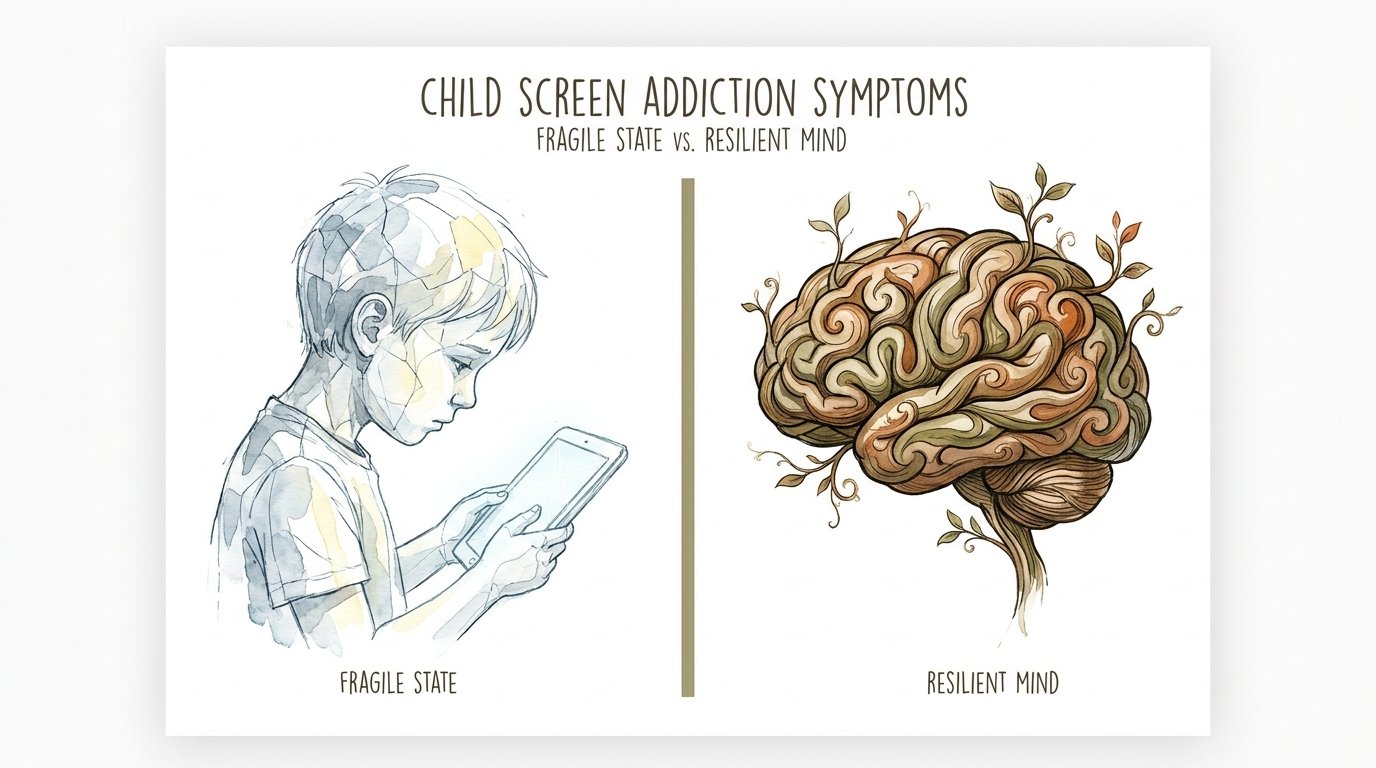
When parents use screens as “digital pacifiers” to soothe a child’s meltdown, the child misses the opportunity to learn internal self-soothing. Instead of building the “muscle” of emotional resilience, the child learns that an external device is the only way to feel calm. This creates a Fragile State where the individual is highly reactive to any lack of stimulation or minor inconvenience.
Benefits of Screen-Free Resilience
Choosing to limit screen dependency offers immediate and long-term advantages for a child’s development. A resilient mind is one that can handle boredom, navigate social complexity, and maintain focus without a constant stream of digital input.
Key benefits include:
- Improved Social Skills: Without a screen to hide behind, children are forced to navigate the nuances of eye contact, tone of voice, and empathy in real-time.
- Higher Frustration Tolerance: Children who play with physical toys or engage in outdoor sports learn that mastery takes time. This builds the patience needed to tackle difficult schoolwork later in life.
- Better Sleep Quality: Removing screens at least one hour before bed allows the brain to produce melatonin naturally, leading to deeper, more restorative rest.
- Increased Creativity: Boredom is often the “seed” of creativity. When a child isn’t constantly entertained by an algorithm, they are forced to use their imagination to occupy their time.
Investing in these “analog” experiences helps ground the child in reality. It ensures that their self-worth is tied to their actions and relationships rather than “likes” or high scores.
Common Pitfalls in Digital Parenting
Many parents find themselves in a “digital trap” without realizing it. Modern life is demanding, and the convenience of a tablet can be hard to resist. However, certain habits can unintentionally deepen a child’s dependency.
One major mistake is inconsistent boundaries. If a “no screens at dinner” rule is enforced one day but ignored the next, the child learns that persistence and whining will eventually break the parent down. This creates a “variable reinforcement” schedule, which is the same psychological principle that makes slot machines addictive.
Another pitfall is ignoring the “iPhone Effect.” Research suggests that the mere presence of a smartphone on a table, even if it is turned off, can diminish the quality of conversation and focus between people. If parents are constantly checking their own devices, they are modeling the exact behavior they are trying to curb in their children.
Using technology as a default reward is also problematic. When screen time is the only prize for good behavior, it elevates the device to a status of supreme importance in the child’s mind, making it even harder to detach from later.
When Technology is Truly Necessary
We must acknowledge that screens aren’t going away. Technology is a fundamental part of modern education and communication. Total abstinence is rarely a realistic or helpful goal for most families.
Situations where tech is beneficial include:
- Educational Requirements: Many schools use tablets for research, coding, and interactive learning modules.
- Long-Distance Connection: Video calls with grandparents or family members living abroad provide essential emotional bonds.
- Creative Production: There is a vast difference between “passive consumption” (scrolling) and “active creation” (digital art, music production, or programming).
The key is to distinguish between tool use and crutch use. A tool helps the child accomplish a specific goal; a crutch is used to escape reality or avoid difficult emotions.
Fragile State vs. Resilient Mind: A Comparison
To better understand the shift we are aiming for, it helps to compare the characteristics of a screen-dependent child versus a resilient one.
| Feature | Fragile State (Screen Dependent) | Resilient Mind (Self-Regulated) |
|---|---|---|
| Boredom Response | Anxiety, irritability, immediate demand for a device. | Curiosity, imaginative play, seeking a new activity. |
| Social Interaction | Avoids eye contact, prefers digital avatars over peers. | Engages in face-to-face play, understands social cues. |
| Frustration | Meltdowns at minor setbacks or “losses” in games. | Able to try again, asks for help when needed. |
| Focus | Fragmented; needs constant novelty and fast-paced edits. | Sustained; can engage with a book or puzzle for 30+ minutes. |
| Regulation | Outsourced to an algorithm or app to feel calm. | Internalized; uses breathing or play to self-soothe. |
Practical Strategies for Digital Detox
If you realize your child has shifted into a Fragile State, it is time to implement a structured “reset.” This does not have to be a traumatic experience. A gradual, supportive transition often works better than a “cold turkey” approach.
Follow these best practices to regain balance:
- Implement the 3-6-9-12 Rule: No screens under 3, no video games until 6, no internet until 9, and limited/supervised social media after 12.
- Establish Tech-Free Zones: Declare the dinner table and all bedrooms as “device-free” areas. This protects family connection and sleep hygiene.
- Use the “Gray-Scale” Trick: Turn the device’s display to black and white. This removes the “eye-candy” effect of bright colors, making the screen significantly less stimulating.
- The 60-Minute Wind-Down: All devices should be powered down and placed in a central charging station one hour before bed.
- Lead by Example: Parents must commit to their own digital detox. If you want your child to put down their phone, they need to see you doing the same.
Physical activity is another powerful tool. Movement releases endorphins that can help stabilize a child’s mood during the initial phases of a detox. Replacing 30 minutes of gaming with a bike ride or a game of catch can significantly reduce irritability.
Advanced Strategies for Long-Term Regulation
For families who have already established basic boundaries, advanced strategies can further deepen a child’s emotional intelligence. The goal is to move from “controlling” technology to “mastering” one’s internal state.
Teach “Metacognition”: Talk to your children about how they feel after using different types of media. Ask them, “Do you feel energized or tired after playing that game?” Helping them recognize the physical and emotional toll of excessive screen use builds their internal motivation to self-regulate.
The “Boredom Challenge”: Set aside 20 minutes a day where no entertainment is allowed—not even books. This “active waiting” teaches the nervous system that it is safe to be still. Over time, this practice expands the “window of tolerance” for low-stimulation environments.
Active Co-Regulation: Instead of letting a child watch a video alone, watch it with them. Ask questions about the characters’ choices. This turns a passive, isolating activity into a shared social experience that requires active thinking.
Real-World Application Scenarios
Let’s look at how these principles play out in everyday life.
Scenario A: The Restaurant Wait
Traditionally, a parent might hand over a phone the moment they sit down to keep the child quiet. In a resilience-focused approach, the parent brings a “Calm-Down Box” containing a small notebook, a few crayons, or a fidget tool. The child learns to wait and observe their surroundings rather than immediately “plugging in” to escape the situation.
Scenario B: The After-School Transition
After a long day of school, a child’s nervous system is often overstimulated. While they might ask for a video game to “relax,” this often leads to more dysregulation. Instead, the parent schedules 30 minutes of “Heavy Work” or outdoor play—such as helping carry groceries or jumping on a trampoline. This provides the sensory input the brain actually needs to settle down, making the eventual 30 minutes of screen time much safer for their mood.
Final Thoughts
Raising a resilient child in a digital world isn’t about fighting technology; it is about prioritizing the human spirit. We are training our children’s brains every single day. If we train them to rely on an algorithm for peace, we leave them vulnerable to every “system update” and Wi-Fi outage.
If we train them to find peace within themselves, we give them a superpower that lasts a lifetime. The transition may be difficult at first, and there will likely be resistance. But the reward—a child who is confident, focused, and emotionally stable—is worth every “tech-free” hour.
Start small today. Choose one tech-free zone or one hour of the day where the world slows down. Watch how your child’s natural curiosity and resilience begin to bloom when the screens finally go dark. Encourage them to explore the world with their own eyes, not through a lens. Your child’s future depends on the strength of their mind, not the speed of their internet connection.
Sources
1 strong4life.com | 2 copakids.com | 3 newportacademy.com | 4 artfulparent.com | 5 nyp.org | 6 nhahealth.com | 7 unc.edu | 8 childrenandscreens.org | 9 genmindful.com | 10 apa.org | 11 explodingtopics.com | 12 connecticutchildrens.org | 13 makeitcutekids.com | 14 nicklauschildrens.org | 15 additudemag.com | 16 luriechildrens.org | 17 sokolovelaw.com