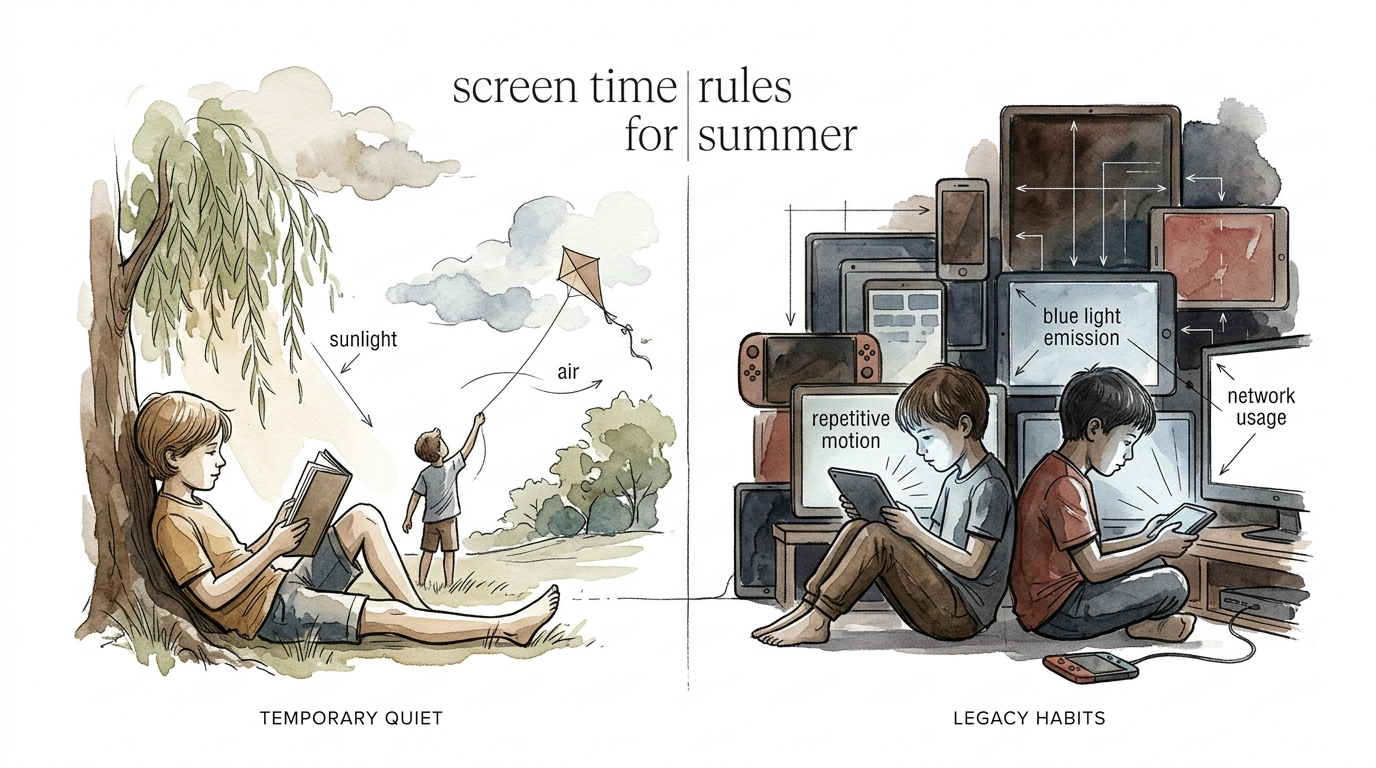
screen time rules for summer
Trade an hour of quiet today for a lifetime of healthy habits tomorrow. It’s easy to use screens as a summer babysitter, but those hours are gone forever. We’re sharing rules that prioritize legacy habits like creativity and hard work over temporary digital distraction.
Summer should be a season of exploration and sun-soaked memories. Instead, many modern households find themselves in a digital fog, where the hum of the air conditioner is drowned out by the glow of tablets. Breaking this cycle isn’t about being a “fun-killer”; it is about protecting the cognitive and emotional development of your children during their most formative years.
Managing these habits early creates a foundation for self-regulation that lasts a lifetime. We are moving beyond simple “time limits” and into a world of intentional engagement. This guide will show you how to navigate the heat of July without losing your kids to the endless scroll.
screen time rules for summer
Summer screen time rules are a set of intentional boundaries designed to prevent digital devices from displacing essential developmental activities. During the school year, structure is forced by the bell. In the summer, that structure vanishes, often leading to a 30% to 35% increase in daily screen use for children aged 7 to 12.
These rules exist because kids do not have the prefrontal cortex development required to self-regulate against apps designed to be addictive. While a tablet offers “temporary quiet” for a busy parent, it often comes at the cost of “legacy habits” like problem-solving and deep focus. By defining what is allowed and when, you transform screens from a default behavior into a deliberate choice.
In the real world, this looks like a shift from passive consumption to active creation. Instead of watching someone else play Minecraft on YouTube, the goal is for the child to build their own world or, better yet, build a fort in the backyard. These boundaries ensure that sleep, physical activity, and face-to-face social interactions remain the priority.
How to Implement a Summer Screen Rhythm
Effective management starts with a rhythm, not a rigid schedule. Rigid schedules often break under the pressure of summer spontaneity, leading to power struggles and frustration. Instead, focus on a “No Screens Until” policy that ensures basic human needs and responsibilities are met first.
Create a daily checklist that children must complete before they can request digital time. This list typically includes making the bed, reading for 30 minutes, spending an hour outside, and completing one household chore. This system teaches children that digital entertainment is a privilege earned through contribution and self-care.
Involving your children in the creation of these rules is a critical step for long-term success. When kids feel they have a voice in the process, they are more likely to respect the boundaries. Discuss the “why” behind the rules, focusing on how different types of screen time make them feel—such as the “post-gaming grumpiness” that often follows a long session.
The Benefits of Reclaiming Summer Freedom
Reducing digital noise leads to measurable improvements in a child’s mental and physical well-being. One of the most immediate benefits is the return of “creative boredom.” When a child is not constantly stimulated by a screen, their brain is forced to innovate, leading to imaginative play and self-discovery.
Physical health also sees a significant boost when devices are put away. Replacing sedentary screen time with outdoor play reduces the risk of obesity and improves motor skills. Furthermore, cutting out screens at least one hour before bed significantly improves sleep quality, which is essential for emotional regulation and brain development.
Socially, less screen time encourages higher-quality interactions. Children learn the nuances of non-verbal communication, conflict resolution, and empathy when they interact face-to-face. These “legacy habits” are the building blocks of strong relationships and professional success in adulthood.
Challenges and Common Mistakes
The biggest challenge parents face is the “Screen Time Creep.” This happens when rules are slowly relaxed until the tablet becomes the default solution for every “I’m bored” complaint. Parents often give in because they are exhausted or need to finish their own work, which reinforces the idea that whining leads to digital rewards.
Another common mistake is failing to model the behavior you expect. If you are telling your child to get off their phone while you are scrolling through social media, the message is lost. Children are highly attuned to hypocrisy; they will value what you do far more than what you say.
For parents of neurodivergent children, such as those with ADHD, the struggle is even more intense. These children may experience actual withdrawal symptoms or meltdowns when screens are removed because their brains crave the high-dopamine hits provided by gaming. In these cases, transitions must be handled with extra care and clear visual timers.
Limitations and Realistic Constraints
It is unrealistic to expect a 100% screen-free summer in a digital world. Screens are used for staying in touch with friends, learning new hobbies, and even reading. Trying to ban them entirely can lead to social isolation for teenagers or missed educational opportunities for younger children.
Environmental factors, such as extreme heat or poor air quality, may also limit outdoor time, making screens a more practical option for indoor entertainment. During these times, the focus should shift from “no screens” to “better screens.” Choosing high-quality, interactive, or educational content is a valid trade-off when physical activity is restricted.
Parental work demands are another real-world constraint. If you are working from home without childcare, there will be moments when a movie is the only way to get through a high-stakes meeting. The key is to view these moments as exceptions rather than the daily standard.
Temporary Quiet vs Legacy Habits
Understanding the difference between short-term ease and long-term growth is vital for maintaining your resolve.
| Feature | Temporary Quiet (Screens) | Legacy Habits (Offline) |
|---|---|---|
| Immediate Effort | Very Low | Moderate to High |
| Cognitive Impact | Passive / Low Stimulation | Active / High Engagement |
| Long-term Value | Minimal to Negative | High Life Skills |
| Social Connection | Isolated or Digital-Only | Deep / In-Person |
Practical Tips for a Balanced Summer
Start small by implementing 15-minute “digital-free” windows throughout the day. These small breaks help reset the brain’s dopamine levels and make larger transitions easier. Use a physical timer that kids can see so they know exactly how much time is left before the device must be turned off.
Create a “Boredom Jar” filled with slips of paper containing screen-free activities. When a child says they are bored, they can pull a suggestion from the jar. Ideas can include “draw a map of the neighborhood,” “build a LEGO tower taller than your knee,” or “host a 5-minute dance party.”
Utilize parental control tools like Apple’s Family Sharing or Google’s Family Link to automate your rules. These tools can set hard shut-off times at night and limit specific high-dopamine apps while leaving educational tools accessible. Automation removes the parent from the role of the “villain” and places the responsibility on the system.
Advanced Considerations for Digital Natives
As children enter their teenage years, the conversation must evolve from “control” to “mentorship.” Teens use screens for their primary social life, and cutting them off can feel like a social death sentence. Focus on teaching them about the “attention economy” and how apps are designed to keep them scrolling against their will.
Encourage “Active Tech” rather than “Passive Tech.” Active tech includes things like coding, digital art, music production, or video editing. These activities build valuable skills and require a high level of cognitive engagement, making them far superior to scrolling through TikTok or YouTube Shorts.
Discuss the 20-20-20 rule for physical health: every 20 minutes, look at something 20 feet away for at least 20 seconds. This simple habit prevents eye strain and forces a brief mental reset. These small adjustments help bridge the gap between being a tech-savvy youth and a healthy human being.
Real-World Scenarios
Imagine a Tuesday afternoon where the temperature hits 95 degrees. The kids are restless, and you have two hours of work left. Instead of handing over the tablets immediately, you set up a “sensory station” in the kitchen with ice cubes, water, and plastic animals. This buys you 45 minutes of quiet through active play.
In another scenario, a 14-year-old wants to spend the entire day gaming with friends. You negotiate a “movement tax”: for every hour of gaming, they must spend 20 minutes doing something physical—like shooting hoops, walking the dog, or even doing basic calisthenics. This ensures that their physical needs are met alongside their social ones.
By applying these rules, you turn a chaotic summer into a structured but flexible environment. The goal is not perfection, but progress. Each day that involves more “real life” than “screen life” is a win for your child’s future.
Final Thoughts
Managing summer screen time is one of the most challenging but rewarding aspects of modern parenting. It requires constant vigilance, a willingness to endure temporary complaints, and a commitment to modeling healthy behavior. The rewards—resilient, creative, and physically active children—are worth every ounce of effort.
Focus on building a rhythm that prioritizes the human experience over the digital one. Use the tools available to you, but remember that your presence and engagement are the best alternatives to any screen. Summer is short, and the opportunities to build legacy habits are fleeting.
Take the lead today and set the boundaries that will protect your family’s peace. By trading an hour of quiet for a lifetime of health, you are giving your children the greatest gift possible: the ability to live a full, present, and intentional life.
Sources
1 blog.google | 2 lookingglassoptical.com | 3 atriumhealth.org | 4 cbsnews.com | 5 cbsnews.com | 6 additudemag.com | 7 tanagerplace.org | 8 raisingkidswithpurpose.com | 9 thescreenguardians.com | 10 raisingkidswithpurpose.com | 11 stayfitmom.com | 12 digitalwellnesslab.org | 13 learningwithkelsey.com | 14 aap.org | 15 ftc.gov