summer screen time rules
The best summer memories don’t have a subscription fee. Digital entertainment is designed to be expensive and addictive. Real summer magic is free, wild, and offline. Here is how we set the rules to prioritize exploration over apps.
Summer break arrives with the promise of endless sunshine and freedom, but for many families, that freedom quickly turns into a digital vacuum. Without the structured guardrails of the school day, the average child’s screen use doesn’t just creep up—it spikes. Recent data indicates that 68% of children use technology significantly more during the summer months, with teens often averaging over eight hours of non-school screen media per day.
This seasonal surge, often called the “summer dip,” can lead to a cycle of sedentary behavior, disrupted sleep, and social isolation. By implementing intentional summer screen time rules, you can transform the “structural vacuum” into a season of high-energy exploration. This guide provides a step-by-step framework for reclaiming the summer, moving away from expensive inactivity and toward the free, wild magic of the offline world.
summer screen time rules
Summer screen time rules are a set of proactive boundaries designed to balance digital entertainment with real-world development. Unlike rigid school-year restrictions, these rules are often built around a “rhythm” rather than a strict schedule, allowing for the flexibility that summer demands while ensuring essential needs like sleep, physical activity, and social connection are met first.
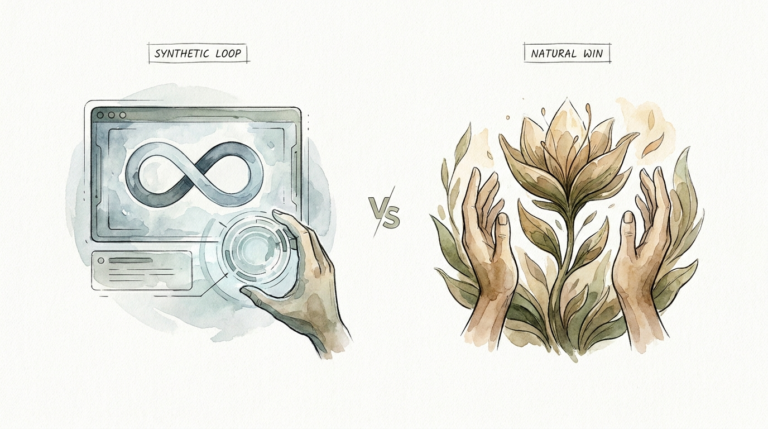
In a world where apps are engineered to keep eyes locked on glass, these rules serve as a necessary intervention. They exist to prevent the “dopamine loop”—a cycle where the brain becomes accustomed to the high-speed stimulation of short-form videos and gaming, making slower, more valuable activities like reading or hiking feel boring by comparison. By setting expectations early, you move screen time from being a default setting to an earned privilege.
Real-world examples of these rules include “Tech-Free Mornings,” where devices remain docked until lunch, or “Earn-it” checklists that require chores and outdoor play before any gaming begins. The goal is not to demonize technology, but to ensure it doesn’t crowd out the foundational experiences of childhood.
How to Implement a Summer Screen Time System
Successfully shifting a household’s digital habits requires a transition from being a “tech police” to a “culture builder.” Instead of launching summer with a list of prohibitions, start with a collaborative family meeting. Frame the conversation around what kind of summer everyone wants to create together—the “Summer Kickoff Summit”—and use a whiteboard to list “Must-Do” adventures.
Once the vision is set, choose a system that fits your child’s age and temperament. For younger children, a Screen Time Checklist is often the most effective. This is a simple daily list they must complete before the Wi-Fi password is handed over. Standard items include making their bed, reading for 20 minutes, playing outside for an hour, and completing one creative task. This teaches them to prioritize self-care and responsibility before diving into digital worlds.
For older children and teens, focus on Rhythms over Rules. Establish “Screen-Free Zones” (like the dining table) and “Blackout Hours” (such as 9:00 PM to 9:00 AM). Encourage them to participate in a “Screen-Free Menu”—a curated list of local hikes, community pools, or DIY projects they can choose from when boredom strikes. Involving teens in the creation of the plan reduces power struggles and fosters a sense of autonomy.
Consistency is the engine of any new system. Use parental control tools as the “neutral enforcer” rather than playing the bad cop yourself. Automated downtime settings on devices can signal the end of a session far more effectively than a parent’s shout from the kitchen, allowing the transition to be about the rule, not the relationship.
Benefits of Strategic Digital Boundaries
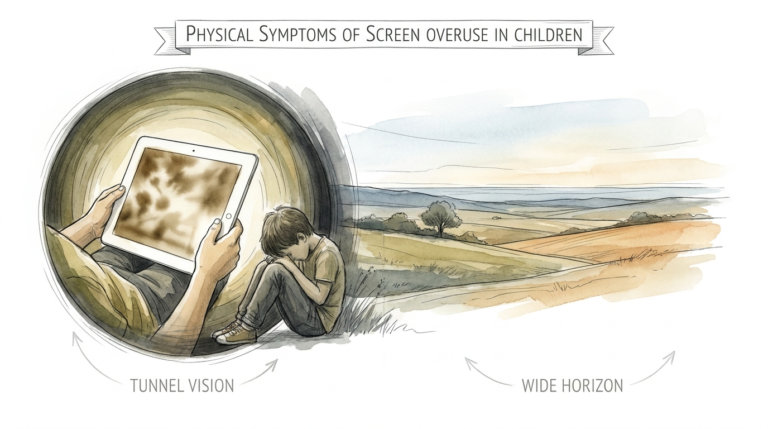
The practical benefits of reducing screen time are measurable across physical, mental, and social domains. Research from the CDC and AAP consistently shows that kids who spend less time on entertainment screens report lower rates of anxiety and depression. By limiting the “digital noise,” children are forced to re-engage with their environment, which has a profound effect on their neurological health.
- Improved Sleep Quality: Screen use within an hour of bedtime suppresses melatonin production by up to 90 minutes. Removing screens ensures deeper, more restorative sleep, which is critical for emotional regulation.
- Boosted Executive Function: Constant, fast-paced digital stimulation can shrink attention spans. Offline activities like building with LEGOs or navigating a trail require sustained focus, “re-wiring” the brain for real-world tasks.
- Social Resilience: Summer is the prime time for developing face-to-face social skills. When kids aren’t “co-playing” through a headset, they learn the nuances of empathy, conflict resolution, and body language.
- Physical Vitality: Replacing sedentary gaming with “free exploration” naturally increases daily step counts and sun exposure, lowering the risk of summer weight gain and vitamin D deficiency.
Ultimately, these boundaries allow for Boredom-Driven Creativity. When a child cannot reach for a phone the moment they feel bored, their brain eventually switches to an “exploratory mode.” This is where original ideas, complex play, and self-discovery happen.
Challenges and Common Mistakes
The most frequent pitfall is the “Punishment Trap.” If screen time is only used as a punishment (taking it away for bad behavior) or a reward (giving it for good behavior), it becomes overly valuable in the child’s mind. This can lead to obsession and more intense power struggles. Instead, treat screen time as a structured part of the daily rhythm, like eating or sleeping.
Another common mistake is Parental Hypocrisy. Children are expert observers of their parents’ habits. If you are enforcing a “no-phone” rule at the park while you are scrolling through social media, the rule will lose all credibility. Modeling the behavior you want to see—such as putting your phone in a “charging basket” during family time—is more effective than any spoken rule.
Parents often fail by being too rigid. Summer is about spontaneity. If a rainy day leads to an impromptu movie marathon, that’s okay. The problem isn’t the occasional long session; it’s the unstructured default of daily excessive use. Avoid “Hard Shutdowns” where you pull the device mid-game; instead, give a 5-minute warning or allow them to reach a “natural stopping point” in their activity to minimize meltdowns.
Limitations and Environmental Constraints
It is important to acknowledge that summer screen time rules are not “one-size-fits-all.” Families living in regions with extreme heat or poor air quality may find it unsafe to be outside for hours at a time. In these scenarios, the focus must shift from “outdoor exploration” to “indoor creative play,” such as board games, cooking, or indoor scavenger hunts.
Working parents also face unique challenges. When both caregivers are working and childcare options are limited, screens often become a necessary tool for safety and quiet. In these cases, focus on Quality over Quantity. Instead of worrying about the total hours, ensure the content is educational, creative, or collaborative rather than just passive scrolling. Utilizing “Digital Sitter” apps that whitelist only specific educational tools can provide a balanced middle ground.
Finally, neurodivergent children may rely on screens for self-regulation or sensory processing. For these children, rigid limits can cause extreme distress. A better approach for this population is “scaffolding”—using screens to transition between activities or as a tool to explore a special interest, rather than a blanket restriction.
Expensive Inactivity vs. Free Exploration
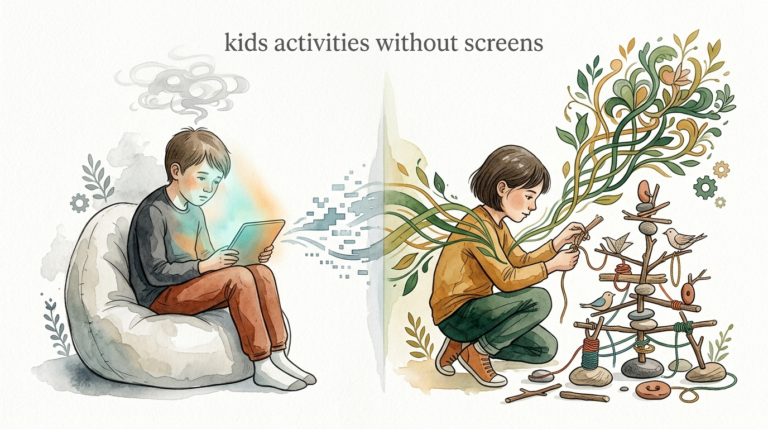
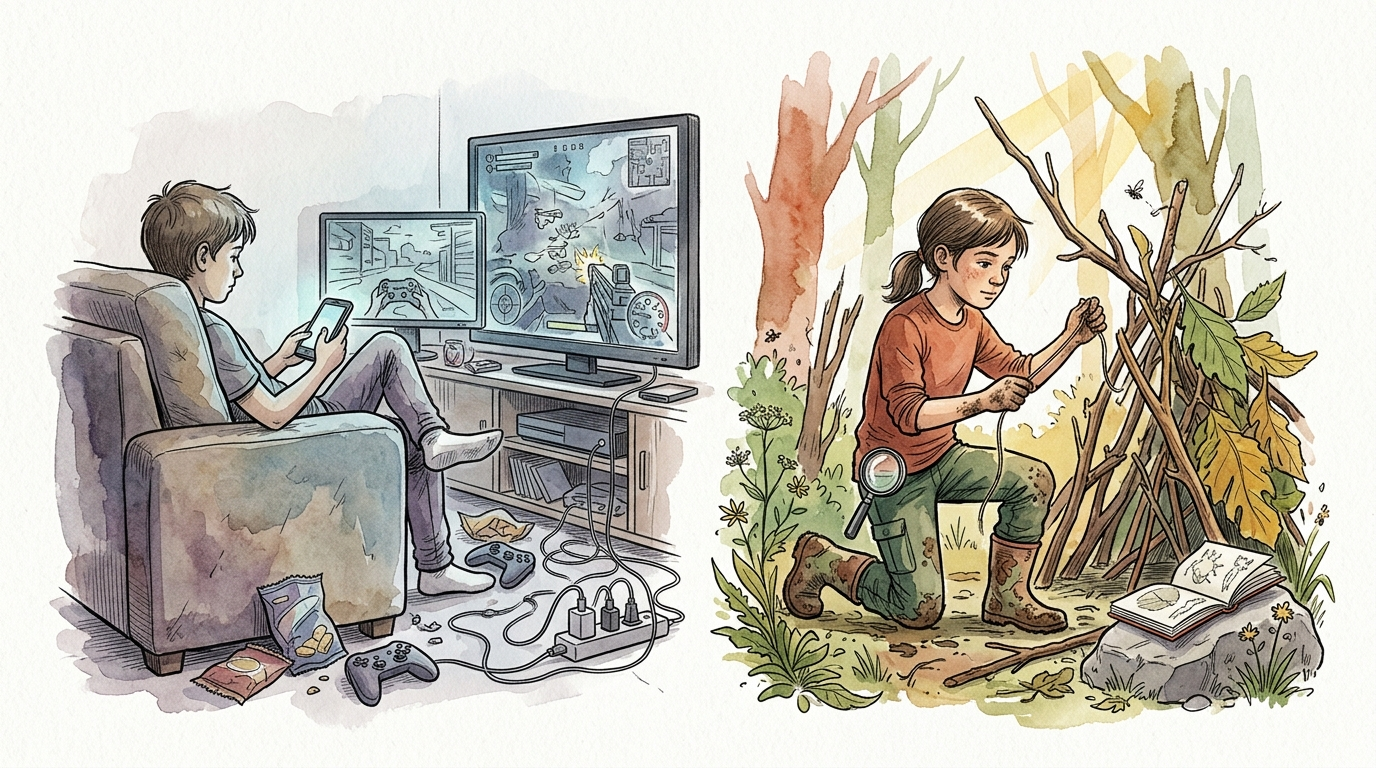
Understanding the trade-off between digital consumption and physical exploration helps frame why these rules matter. Modern gaming and social media are built on “Expensive Inactivity”—even if the app is free, the cost comes in the form of in-app purchases, subscription fees, and the “opportunity cost” of lost development.
| Feature | Expensive Inactivity (Digital) | Free Exploration (Offline) |
|---|---|---|
| Monetary Cost | Subscriptions, Skins, High-Speed Data | Library card, Park passes, Nature trails |
| Physical Impact | Sedentary, Blue-light exposure, Poor posture | Movement, Vitamin D, Sensory variety |
| Skill Acquisition | Digital reflexes, App navigation | Problem-solving, Coordination, Persistence |
| Memory Quality | Short-term, Repetitive, Often forgotten | Long-term, Multisensory, Novel |
Practical Tips for a Screen-Light Summer
To make the transition easier, fill the environment with “cues” for offline play. Place a Boredom Jar on the kitchen counter filled with slips of paper describing 5-minute tasks (e.g., “Do 20 jumping jacks,” “Draw a dragon,” “Find three different leaves”). This provides an immediate answer to the “I’m bored” complaint without needing a screen.
Leverage your local library. Many libraries offer summer reading programs with tangible prizes, creating a built-in “Earn-it” system that you don’t have to manage yourself. Similarly, Geocaching is a free, worldwide treasure hunt that uses GPS on your phone but keeps the activity focused on hiking and outdoor discovery, serving as a perfect bridge for tech-loving kids.
- Create a “Tech Dock”: Designate a central charging station in a common area. Devices live there unless they are actively being used according to the rules.
- The “One-to-One” Rule: For every hour of screen time, require one hour of “High-Energy” activity (playing outside, swimming, or sports).
- Host “Analog Nights”: Dedicate one evening a week to board games, card tricks, or a backyard campfire. No phones allowed for anyone, including parents.
- Utilize Audiobooks: If kids need a “downward” transition, audiobooks or podcasts are excellent screen-free alternatives that still provide a narrative experience.
Advanced Considerations: Teaching Digital Literacy
For parents of teens, the goal of summer rules should be to graduate the child into self-regulation. Instead of just setting a timer, discuss the “Persuasive Design” of their favorite apps. Explain how TikTok’s algorithm uses variable rewards to keep them scrolling and how YouTube’s “Autoplay” is designed to bypass their conscious choice.
Encourage them to track their own “Mood vs. Usage.” Ask them to notice how they feel after an hour of playing a creative game like Minecraft versus an hour of scrolling Instagram. When kids recognize the “hollow” feeling of excessive passive consumption, they are more likely to set their own boundaries. This shifts the dynamic from an external rule to an internal value system.
Consider “Upskilling” as a screen time category. Not all screens are equal. A teenager using a tablet to learn digital illustration, coding, or video editing is engaging in Active Production, which is far more valuable than Passive Consumption. You might choose to have no limits on “Creative Tech” while strictly limiting “Entertainment Tech.”
Example Daily Rhythm: The “High-Energy” Summer
To visualize how these rules work in practice, here is a sample daily rhythm for a 10-year-old child. Note that this is not a rigid schedule, but a flow that prioritizes the “Must-Dos” before the digital rewards.
- 8:00 AM – 10:00 AM: The Morning Anchor. Breakfast, chores, and “Brain Work” (reading or journaling). Devices remain in the Tech Dock.
- 10:00 AM – 12:00 PM: The Outdoor Block. Neighborhood play, swimming, or a trip to the park. High-energy movement to burn off morning restless energy.
- 12:00 PM – 1:00 PM: Lunch and Connection. Phone-free meal with family or friends.
- 1:00 PM – 3:00 PM: Earned Screen Time. The first block of digital use, earned by completing the morning anchor. This is the “hottest part of the day” where indoor time makes sense.
- 3:00 PM – 5:00 PM: Creative/Boredom Zone. LEGOs, art projects, or “The Boredom Jar.” This is when kids often find their “deep play” flow.
- 5:00 PM – 8:00 PM: Family and Outside. Dinner and evening “wild play” (catching lightning bugs, bike rides).
- 8:00 PM: The Digital Sunset. All devices back in the Tech Dock. Audiobooks or quiet reading before bed.
This structure ensures that by the time the child sits down for their first hour of gaming, they have already moved their body, contributed to the household, and engaged their brain in the physical world.
Final Thoughts
The goal of summer screen time rules is not to win a war against technology, but to win back the season for your family. By filling the structural vacuum of summer with intentional rhythms, you protect your child’s development and mental health from the addictive pull of the digital loop. You aren’t just taking away a device; you are clearing a path for creativity, resilience, and genuine connection.
Remember that the most successful systems are flexible and collaborative. Start small, model the behavior yourself, and prioritize Free Exploration over Expensive Inactivity. When you look back at the end of August, the memories won’t be of the levels reached in a game, but of the trails hiked, the books read, and the “real magic” that can only happen offline.
Experiment with these frameworks and adjust them to fit your family’s unique needs. The transition might be met with some resistance at first, but once the “boredom hump” is cleared, you will find that your kids are more curious, more energetic, and more present. That is the true subscription-free gift of a well-balanced summer.
Sources
1 family-checklist.com | 2 timily.app | 3 utah.edu | 4 substack.com | 5 gozen.com | 6 raisingkidswithpurpose.com | 7 thepragmaticparent.com | 8 childmind.org | 9 childmind.org | 10 blog.google | 11 blog.google | 12 illinois.edu | 13 njfamily.com | 14 reddit.com | 15 sparklestories.com | 16 perfectionpending.net | 17 lifebyleanna.com | 18 reconnect-families.com