Physical Benefits Of No Screen Time
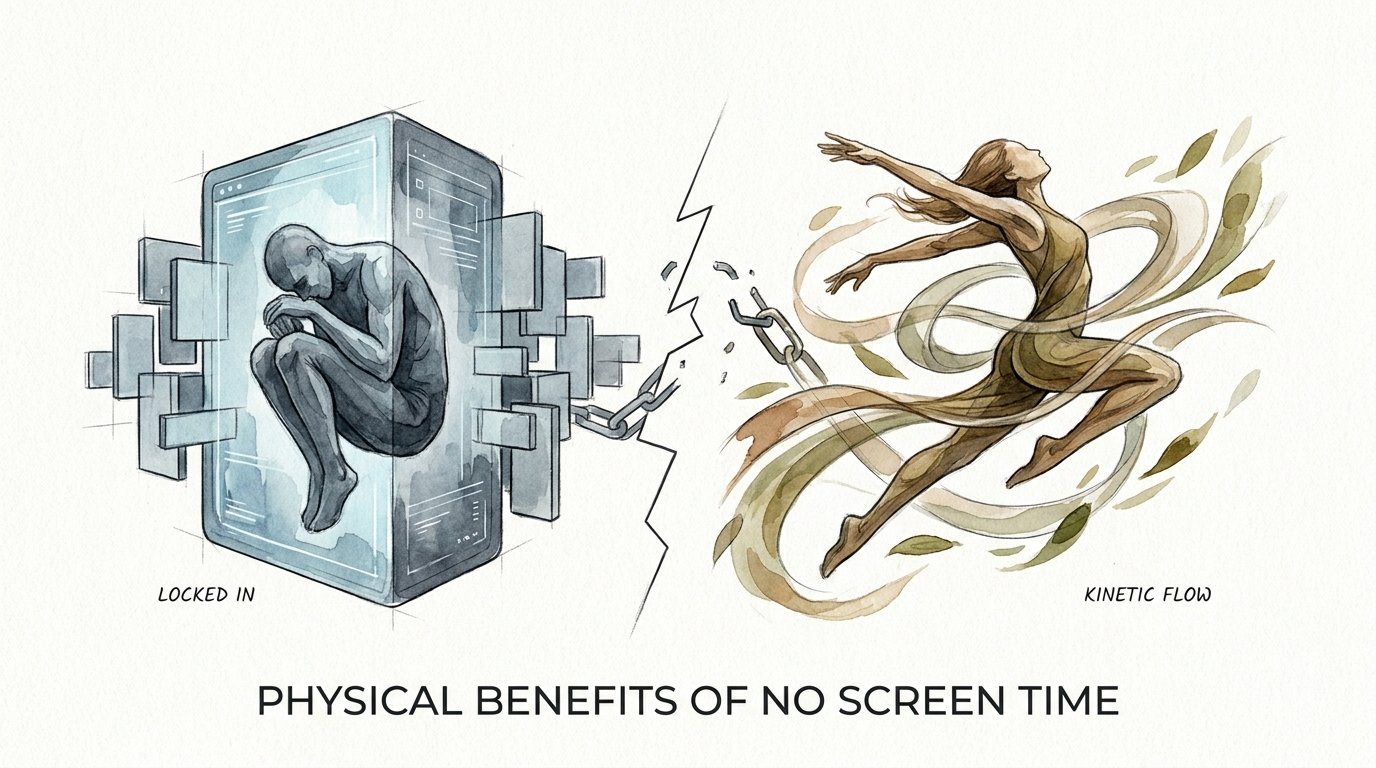
One drains energy while keeping the body still; the other builds the brain by moving the feet. Screen time is high-intensity for the eyes but zero-intensity for the body. This imbalance is exactly why ‘tablet kids’ struggle with emotional regulation. To truly calm the mind, we must engage the body’s dynamic movement systems.

The modern childhood is increasingly defined by a “locked-in” state where the eyes are hyper-stimulated while the muscles remain dormant. This physiological mismatch creates a sensory vacuum. When a child spends hours in front of a screen, they aren’t just “watching a show”; they are opting out of the millions of micro-movements required to build a healthy nervous system. We are seeing a generation where the digital world offers infinite input, but the physical world offers zero output.

Understanding the physical benefits of no screen time isn’t about being “anti-tech.” It is about being “pro-human.” It is about recognizing that a child’s brain is literally built through their feet, hands, and inner ear. When we pull back the curtain on the digital world, we allow the body’s natural development systems to take the lead.
Physical Benefits Of No Screen Time
Physical benefits of no screen time refer to the systemic physiological improvements that occur when sedentary digital consumption is replaced with active, real-world movement. In practical terms, this means the body shifts from a state of passive absorption to a state of active exploration. This transition is vital because children are not designed to be still for long periods; their bodies require constant feedback from the environment to calibrate everything from balance to emotional control.
When we talk about these benefits, we are looking at the reversal of what many experts call the “sedentary screen effect.” This effect describes the postural collapse, reduced metabolic rate, and sensory deprivation that happens when a child is hunched over a tablet. By removing the screen, we naturally trigger the replacement effect. This is the phenomenon where the absence of a digital distraction forces the child to engage with their physical environment, leading to improved gross motor skills and better cardiovascular health.
Think of it like a “system reset” for the body. Instead of blue light suppressing melatonin and shallow breathing accompanying a video game, the child experiences natural sunlight and deep-oxygenating movement. These real-world situations—climbing a tree, running across a lawn, or even just building with blocks—provide the resistance and sensory input that screens cannot replicate.
How Movement Builds the Brain Step-by-Step
The process of “building the brain through the feet” is a biological reality. It starts with the vestibular system and the proprioceptive system. These are the internal GPS systems of the body. The vestibular system, located in the inner ear, handles balance and spatial orientation. The proprioceptive system, fueled by sensors in the muscles and joints, tells the brain where the body is in space.
When a child moves, these systems fire rapidly, sending a flood of data to the brain. This data acts as a structural blueprint for the prefrontal cortex, the area responsible for focus, decision-making, and emotional regulation. Screens, conversely, provide high-velocity visual input but nearly zero vestibular or proprioceptive feedback. This creates a “sensory mismatch” that leaves the child feeling wired but tired.
To optimize this process at home, you can follow these steps:
- Prioritize “Heavy Work”: Activities like pushing a heavy wagon or climbing require significant muscle force. This “heavy work” provides the deep pressure input the brain needs to feel calm and organized.
- Encourage Cross-Lateral Movement: Movements that cross the midline of the body, like skipping or crawling, strengthen the corpus callosum. This is the bridge between the left and right hemispheres of the brain.
- Utilize Nature’s Uneven Terrain: Walking on grass, sand, or rocks forces the body to constantly adjust its balance, which is far more beneficial for motor development than walking on a flat, carpeted floor.
Avoiding the common pitfall of “forced exercise” is important. Children do not need a workout plan; they need unstructured free play. The brain builds itself best when the movement is spontaneous, joyful, and driven by curiosity rather than a timer.
Measurable Advantages of a Screen-Free Body
The practical benefits of reducing screen time are observable almost immediately. One of the most significant advantages is the improvement in sleep architecture. Research shows that for every hour of screen time, the average child loses about 13 minutes of sleep. By removing screens, especially in the evening, you eliminate blue light interference, allowing the body’s natural melatonin production to thrive.
Another major benefit is the development of gross motor coordination. Children who are physically active show significantly higher “Manual Dexterity” and “Ball Skill” scores compared to those with high screen use. This isn’t just about being good at sports; it’s about the neural efficiency required to coordinate complex tasks. A body that can move well is a brain that can think well.
Additionally, movement triggers the release of Brain-Derived Neurotrophic Factor (BDNF). Often called “Miracle-Gro for the brain,” BDNF promotes the growth of new neurons and strengthens existing synapses. Just 20 minutes of moderate physical activity can improve a child’s attention-to-task by up to 20%. This makes movement a more effective “focus tool” than any educational app could ever be.
Challenges and Common Mistakes
The biggest challenge in reducing screen time is digital friction. Modern life is designed around screens, and removing them often leads to immediate boredom or resistance. Parents frequently make the mistake of trying to “entertain” their children the moment the screen goes off. This is a missed opportunity. Boredom is the gateway to physical creativity.
Another common error is treating movement as a punishment. If you say, “You’ve had too much TV, go run laps,” the child associates physical activity with a loss of privilege. Instead, movement should be presented as the “reward” or the default state of the house.
Mistakes often happen because of the dopamine baseline. Screens provide a constant, high-level drip of dopamine. When that is removed, the child’s brain feels a “crash.” Understanding that this irritability is a physiological withdrawal—rather than “bad behavior”—can help you navigate the first few days of a screen reduction.
Limitations and Environmental Constraints
It is essential to acknowledge that “no screen time” is not always a realistic or ideal goal for every family. There are valid environmental limitations to consider. Families living in urban areas with no access to safe parks may find it difficult to provide the same level of outdoor movement as those in rural settings. In these cases, screens might provide a safe, indoor alternative for learning or quiet time.
There is also a trade-off regarding digital literacy. Completely banning screens may leave a child behind in a world that requires technological proficiency. The goal should be intentionality rather than total abstinence. Furthermore, for children with certain physical disabilities, screens can serve as a vital tool for communication and accessibility that “moving the feet” cannot replace.
Recognizing these boundaries strengthens our approach. We aren’t fighting the technology itself; we are fighting the displacement of movement. If the technology is used actively (such as a dance game or a geocaching app), it can actually support the “kinetic flow” we are aiming for.
Locked In vs. Kinetic Flow
To truly understand the difference, we can compare the two primary states a child’s body can inhabit.
| Feature | Locked In (Passive Screen Time) | Kinetic Flow (Active Play) |
|---|---|---|
| Energy State | Stagnant / Drained | Renewed / Building |
| Sensory Input | Visual/Auditory only | Full Multi-Sensory |
| Dopamine Type | High-spike / Quick-crash | Slow-release / Sustained |
| Postural Impact | Forward-slump / Compression | Dynamic / Expansion |
| Brain Impact | Passive Consumption | Active Neurogenesis (BDNF) |
This comparison illustrates that Kinetic Flow is an investment in future capability, while being Locked In is a withdrawal from the body’s physical bank account.
Practical Tips for Immediate Application
Transforming your home into a movement-rich environment doesn’t require a gym membership. Small, tactical shifts can make a massive difference in your child’s physical health.
- Implement the 20-20-20 Rule: If screens must be used, ensure the child looks at something 20 feet away for 20 seconds every 20 minutes to reduce eye strain and reset posture.
- Create “Movement Stations”: Keep a basket of balls, jump ropes, or balance boards in the main living area. If these tools are visible, the child is more likely to use them than to ask for a device.
- Practice “Nature Bathing”: Even 15 minutes of being outside has a regulatory effect on the nervous system. The “green” environment naturally lowers cortisol levels.
- Model the Behavior: Your child will mirror your relationship with your phone. If you are constantly “locked in,” they will see that as the optimal state of being.
Focus on rough-and-tumble play. Wrestling, tickling, and tumbling are not just fun; they are essential for developing social boundaries and physical resilience. This type of play teaches the brain how to “down-regulate” from a high-energy state to a calm state, which is the core of emotional regulation.
Advanced Considerations for Long-Term Development
For those looking to take child development to the next level, we must look at Executive Function (EF). Executive functions are the “CEO of the brain,” handling everything from impulse control to working memory. Research indicates that complex physical activities—like martial arts, dance, or team sports—are significantly more effective at building EF than simple, repetitive exercise.
This is because complex movement requires cognitive engagement. A child playing soccer isn’t just running; they are calculating trajectories, anticipating peer movements, and managing frustration in real-time. This is where the physical and the cognitive merge. The more “brain power” the movement requires, the more robust the neural connections become.
Consider the dopamine baseline reset. If a child has been heavily exposed to screens, their brain’s dopamine receptors may be “down-regulated.” It can take 2 to 4 weeks of significant screen reduction for the brain to recalibrate so that “normal” activities like reading or playing outside feel rewarding again. Understanding this timeline is crucial for long-term success.
Real-World Scenario: The Weekend Reset
Let’s look at a typical example. A family decides to implement a “No-Screen Saturday.” Usually, the children would spend the morning watching cartoons (Locked In), leading to irritability and “meltdowns” by lunchtime.
Instead, the family goes to a local park with a “no-plan” policy. The children spend three hours climbing on rocks, digging in the dirt, and playing a made-up game of tag.
- Observation 1: The children’s breathing is deeper, and their “postural slump” disappears.
- Observation 2: They experience “good” tiredness (physical fatigue) rather than “bad” tiredness (mental overstimulation).
- Observation 3: Sleep comes easily that night, without the usual bedtime battles, because their circadian rhythm was anchored by natural light.
This scenario demonstrates that the physical benefits are not just theoretical; they translate into a more peaceful, functional household.
Final Thoughts
Movement is the primary language of the developing brain. When we prioritize the body’s dynamic systems over static digital consumption, we are giving children the tools they need to regulate their emotions and focus their minds. The physical benefits of no screen time extend far beyond “fitness”; they are the very foundation of a resilient and capable human being.
The goal isn’t to live in the past, but to ensure that the future is built on a solid physical foundation. By encouraging kids to move their feet, we are helping them build their brains in a way that no software ever could. Experiment with a “movement-first” approach this week and observe the change in your child’s energy, mood, and sleep.
Real change happens in the micro-moments—the decision to go for a walk instead of opening an app, or the choice to let a child be “bored” until they find a stick to play with. These are the moments where the brain truly grows. Focus on the flow, resist the lock, and let the body do what it was born to do.
Sources
1 thriveoutside.net | 2 lynnekenney.com | 3 recordablebookbuddy.com | 4 kidsusamontessori.org | 5 skillpointtherapy.com | 6 byu.edu | 7 foundationscognitive.com | 8 bunnyhopkinstoys.com | 9 childrensphysicaltherapyandwellness.com | 10 compasschildcare.com