parenting scripts
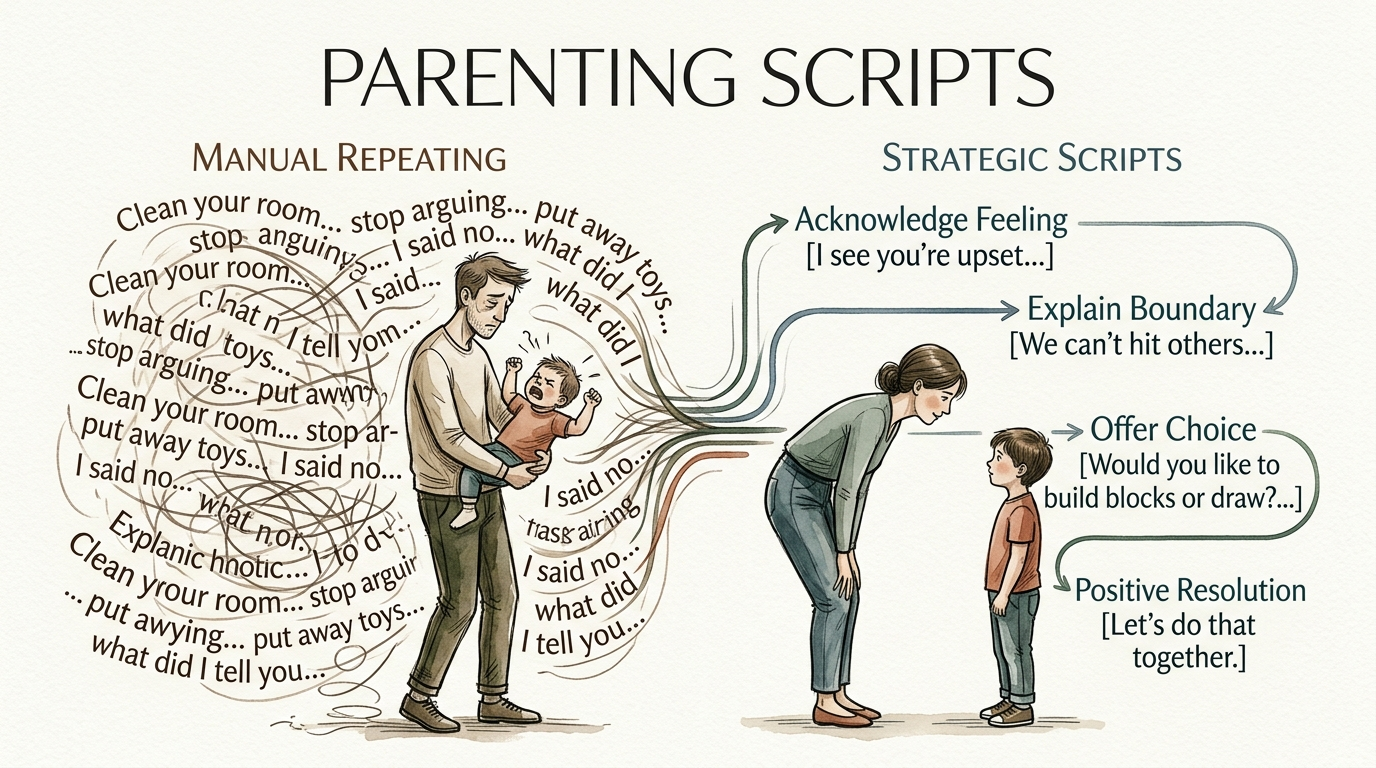
Stop repeating yourself and start being heard with these 5-second shifts. Are you tired of feeling like a broken record? Manual parenting is exhausting. Switch to strategic scripts that leverage child psychology to get cooperation without the power struggle.

Most parents find themselves caught in a cycle of escalation. You ask nicely once, then again with a bit more edge, and finally, you’re shouting just to get them to put on their shoes. This “manual repeating” isn’t just tiring for you; it actually trains your child’s brain to ignore your first few requests. They learn that you don’t really “mean it” until your voice reaches a certain decibel level.
Strategic scripts change this dynamic by shifting the focus from control to connection and clarity. Instead of using words to force compliance, you use them to guide the brain’s executive functions. This transition from being a “nag” to becoming a “guide” transforms the atmosphere of your home from one of constant friction to one of mutual respect and flow.
parenting scripts
Parenting scripts are intentional, pre-planned phrases designed to communicate boundaries, expectations, and empathy in a way that a child’s developing brain can actually process. Think of them as “shortcuts” for high-stress moments. When you are tired or your child is melting down, your own prefrontal cortex—the part of the brain responsible for rational thinking—can go offline. Having a script ready allows you to respond effectively even when you feel reactive.
These scripts aren’t about being robotic or “performance-based.” Instead, they serve as a bridge between a parent’s goal and a child’s current capability. In the real world, scripts are used during transitions (like leaving the park), daily routines (like brushing teeth), and emotional crises (like sibling fights). They provide a predictable structure that makes children feel safe. When a child knows exactly what to expect from your words and actions, their nervous system relaxes, which is the prerequisite for cooperation.
The core philosophy behind these scripts is that “not listening” is rarely a sign of defiance. More often, it is a sign of a brain that is overstimulated, struggling with a transition, or experiencing an auditory processing delay. Strategic scripts account for these neurological realities by using fewer words, offering choices, and focusing on what the child *should* do rather than what they should stop doing.
How Strategic Scripts Work
To understand why these scripts work, you have to look at the “upstairs” and “downstairs” brain. When a child is in a power struggle, their downstairs brain (the amygdala) is in charge. This is the seat of the fight-or-flight response. When you repeat yourself loudly or use “manual parenting” tactics like threats, you accidentally trigger that amygdala, making it physically impossible for the child to listen or cooperate.
Strategic scripts work by bypassing the amygdala and speaking directly to the upstairs brain. Here is the step-by-step process of how to implement them effectively:
- Get Close First: Before you say a single word, move into your child’s physical space. Standing across the room and shouting is “background noise.” Getting down to their eye level is a “connection signal” that tells their brain to pay attention.
- Acknowledge the Current State: Start by narrating what you see. “I see you are having so much fun with those blocks.” This builds a bridge of connection and shows you aren’t just there to interrupt their joy.
- Use the “When/Then” Formula: This is a cornerstone of strategic scripting. Instead of “Clean up or no TV,” try “When the blocks are in the bin, then we can turn on the show.” This frames the requirement as a sequence of events rather than a threat.
- Wait for Processing: Many children have a “processing lag” of 5 to 10 seconds. After you deliver your script, wait in silence. If you repeat yourself too quickly, you reset their “processing clock,” leading to more frustration for both of you.
One of the most common pitfalls is “The Lecture.” When parents are frustrated, they tend to explain *why* something needs to happen in great detail. To a child, this sounds like the “blah blah blah” of the teacher in a Peanuts cartoon. Strategic scripts strip away the filler and provide a clear, actionable directive that the brain can latch onto immediately.
Benefits of Strategic Communication
The primary advantage of using strategic scripts over manual repeating is the preservation of your relationship with your child. When you stop nagging, you stop being the “enemy” in their eyes. This builds a foundation of trust that makes future discipline much easier. Because you aren’t escalating your voice, your child doesn’t learn to fear you; instead, they learn to rely on your consistency.
Practical and measurable benefits include:
- Reduced Parental Burnout: You save an incredible amount of emotional energy when you have a go-to response instead of trying to “think on your feet” while angry.
- Increased Child Autonomy: Scripts that offer choices (e.g., “Do you want to hop to the bathroom like a frog or walk like a dinosaur?”) give children a sense of control, which naturally reduces power struggles.
- Improved Executive Function: By using predictable language, you are essentially “scaffolding” your child’s brain, helping them learn how to sequence tasks and manage their own transitions over time.
- Faster Transitions: Because scripts like the “5-minute warning” or “When/Then” provide a clear roadmap, the time it takes to get out the door or through a meal is significantly reduced.
Choosing this approach over traditional “manual” methods means you are playing the long game. You aren’t just stopping a behavior in the moment; you are teaching your child how to communicate, how to handle disappointment, and how to cooperate with others.
Challenges and Common Mistakes
Even the best scripts can fail if the underlying principles aren’t respected. A frequent error is using a script with a sarcastic or aggressive tone. The words might be “gentle,” but if the energy behind them is “I’m about to lose it,” the child will respond to the energy, not the script. This is why self-regulation for the parent is the first step of any successful communication strategy.
Another common mistake is “Over-Labeling.” Many modern parenting scripts suggest saying, “I see you’re feeling frustrated.” While this works for some children, research shows that for “big reactors,” labeling their emotions in the heat of a meltdown can actually backfire, making them feel more misunderstood or overwhelmed. Sometimes, the best script is no script at all—just a quiet, physical presence until the storm passes.
Mistakes often happen because parents expect scripts to work like a “magic wand.” If you say the script and the child still says “No,” many parents give up and go back to yelling. It is important to remember that a script is a tool for *your* behavior first. It keeps you calm and consistent. The child’s cooperation is a secondary result that develops over time with repetition and trust.
Limitations and Realistic Constraints
There are situations where strategic scripts simply will not work. If a child’s basic physical needs aren’t met—if they are hungry, exhausted, or physically ill—no amount of clever wording will get them to cooperate. In these moments, their brain is in “survival mode,” and the only effective “script” is one that addresses the physical need, such as “It looks like your body is really tired; let’s get you some rest.”
Environmental factors also play a huge role. Trying to use a complex script in a loud, crowded grocery store while you are in a rush is a recipe for failure. In high-stimulation environments, you have to simplify even further. Scripts must be adapted to the developmental stage of the child as well; a script that works for a 3-year-old (focusing on play and simple choices) will feel condescending and “fake” to a 10-year-old.
Finally, scripts cannot replace a lack of boundaries. If you use a gentle script but never follow through with a consequence (like taking the toy away if it’s being used as a weapon), the script becomes empty noise. The script provides the *invitation* to cooperate, but the parent’s consistent action provides the *safety* of the boundary.
The Shift: Manual vs. Strategic
Understanding the difference between these two approaches can be summarized by how they handle common friction points. Manual parenting is often reactive, while strategic scripting is proactive.
| Factor | Manual Parenting (The Broken Record) | Strategic Scripts (The Guide) |
|---|---|---|
| Primary Goal | Immediate Compliance | Long-term Cooperation & Connection |
| Tone | Escalating, Frustrated, Nagging | Calm, Firm, Predictable |
| Focus | What the child is doing wrong | The next step in the process |
| Brain State | Triggers Amygdala (Fight/Flight) | Engages Prefrontal Cortex (Rational) |
| Result | Exhaustion and Resentment | Clarity and Reduced Power Struggles |
Practical Tips for 5-Second Shifts
If you want to start seeing results today, focus on these small but powerful linguistic shifts. These are designed to be used in the heat of the moment to pivot away from a power struggle.
- Shift from “Don’t” to “Do”: Instead of “Don’t run!” try “Walking feet, please.” The brain processes affirmative instructions much faster than negative ones.
- The “I See” Shift: When a child is refusing a task, start with “I see it’s hard to stop playing.” Validating the difficulty of the transition reduces their need to “prove” how hard it is through a tantrum.
- The “Check-In” Shift: If a child isn’t responding, don’t repeat the command. Instead, ask, “What was my instruction?” This forces them to engage their auditory memory and confirms they actually heard you.
Consistency is more important than perfection. You don’t need to get the script right every time. What matters is that you are moving away from the “manual” habit of repeating and toward a more “strategic” way of connecting. If you slip up and yell, simply “repair” the interaction later: “I was frustrated and I yelled. I’m sorry. Let’s try that again with my calm voice.”
Advanced Considerations
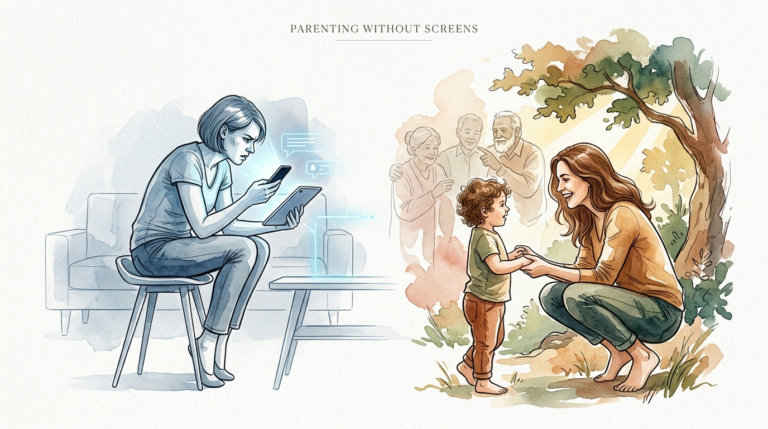
For parents who want to dive deeper, consider the role of non-verbal communication. Research suggests that up to 90% of our communication is non-verbal. This means your body language, your proximity, and your facial expression are doing the heavy lifting before you even open your mouth. A strategic script delivered with a “locked-in” gaze and a relaxed posture is infinitely more effective than one delivered while you are looking at your phone.
Furthermore, consider the “Internal Working Model” of your family. Are you using these scripts to “fix” your child, or are you using them to foster a collaborative culture? Serious practitioners of this approach realize that the goal isn’t a child who obeys without question, but a child who feels understood enough to *want* to cooperate. This involves “improvised scripts” where you eventually move away from the set phrases and start using the underlying principles to have authentic, connected conversations about values and expectations.
Examples and Scenarios
Let’s look at a common real-world scenario: The “Park Transition” struggle. In a manual parenting model, the parent shouts from the bench, “Five more minutes!” Five minutes pass, the parent shouts, “Time to go!” The child ignores them. The parent walks over, angry, and drags the child away while the child screams.
The Strategic Script Version:
Step 1: Walk over to the child at the 5-minute mark. Get on their level.
Step 2: Connect first. “I see you’re making a giant sand castle! That looks so cool.”
Step 3: State the boundary. “In five minutes, it will be time to go. Do you want to do five more slides or five more minutes in the sand?”
Step 4: At the 1-minute mark, give a final “check-in.” “One more minute, then it’s ‘When we get in the car, then you can have your snack.'”
Step 5: When time is up, hold the boundary. “Time is up. Do you want to walk to the car like a giant or a mouse?”
By offering a choice at the end, you give the child a “face-saving” way to comply. They are still leaving the park, but they are doing it on their terms. This small shift prevents the “sucker-punch” feeling children get when they are suddenly forced to stop an activity they love.
Final Thoughts
Transitioning from manual parenting to strategic scripts is a journey, not an overnight switch. It requires you to unlearn decades of “broken record” habits and replace them with a more mindful, psychology-based approach. The effort is worth it, not just for the peace it brings to your daily routine, but for the respect it builds in your relationship with your child.
When you use these scripts, you are essentially providing a “calm exterior” for your child’s “chaotic interior.” You are showing them that you are a sturdy leader who can handle their big emotions without losing your own. This sense of safety is what ultimately leads to the cooperation you’ve been looking for. Start with one “5-second shift” today and watch how the energy in your home begins to change.
Sources
1 psychologistforparenting.com | 2 mother.ly | 3 lernerchilddevelopment.com | 4 lernerchilddevelopment.com | 5 cafo.org | 6 youtube.com | 7 psychologytoday.com | 8 psychologytoday.com | 9 centerforlivingwellwithadhd.org | 10 workingparenting.com | 11 reddit.com | 12 nih.gov | 13 thenation.com | 14 cdc.gov | 15 parent.com | 16 lernerchilddevelopment.com | 17 thenesavu.com | 18 rootspsychology.co.uk