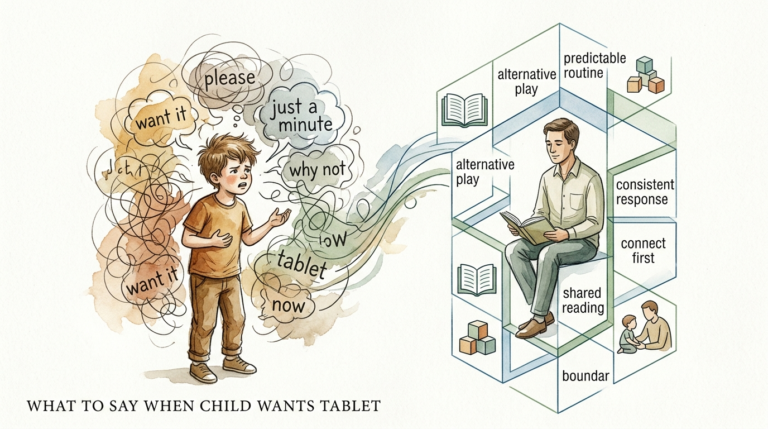
kids screen time infographic
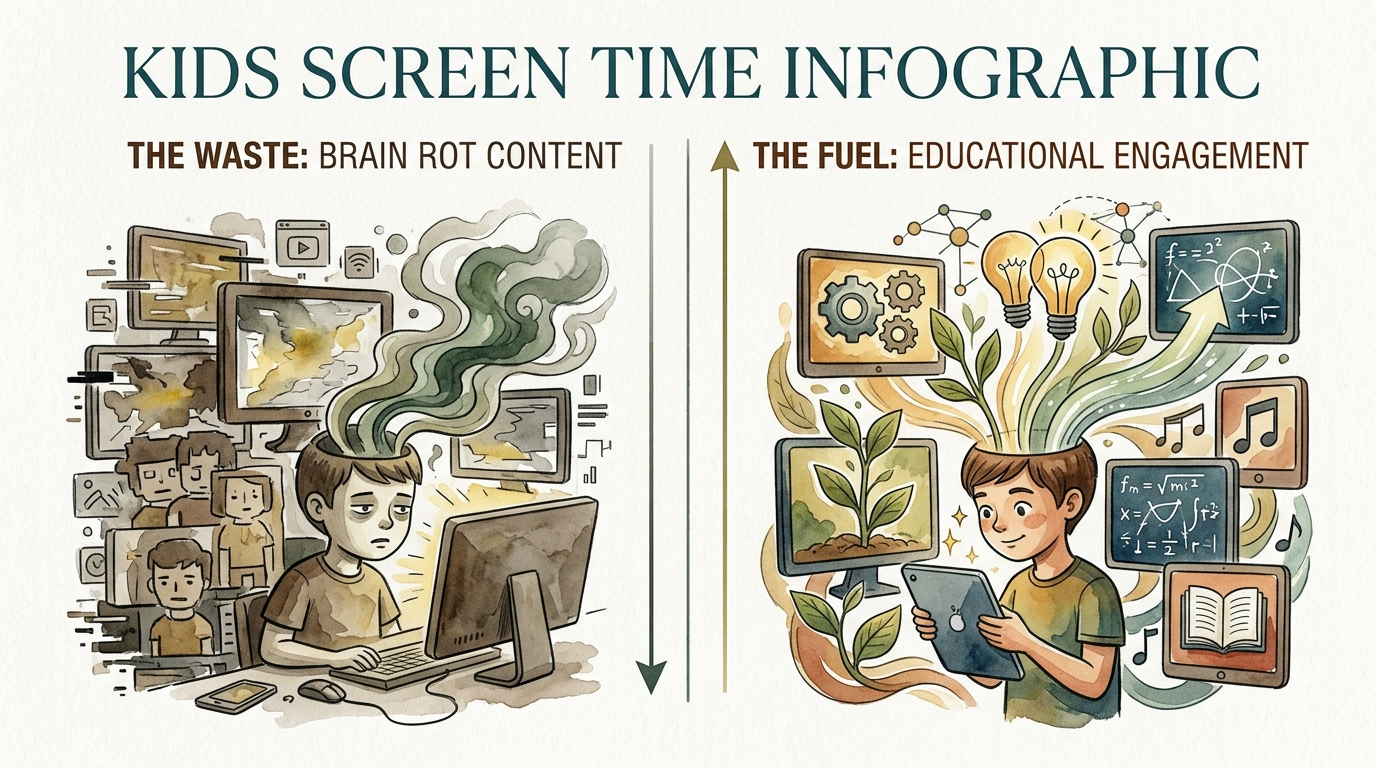
Is their screen time empty calories or a mental feast? Stop worrying about the ‘time’ and start focusing on the ‘content’. This infographic shows how to turn wasted scrolling into mental fuel. Every parent has felt the pang of guilt seeing their child lost in a digital trance. Digital devices are everywhere, and they can either interfere with creativity or enhance learning depending on how we use them. Most conversations revolve around the clock, but the real needle-mover is the quality of the “digital calories” being consumed. High-quality or educational content supports child development, whereas repetitive, low-effort loops can lead to “brain rot”.

Modern parenting requires a shift from being a “timekeeper” to being a “content curator”. This guide explores the spectrum of digital consumption and provides a roadmap to transform passive scrolling into active engagement. Understanding this distinction is the first step toward building a healthy digital diet that fuels your child’s brain instead of draining it.

kids screen time infographic
The concept of a kids screen time infographic serves as a visual framework to categorize digital content into different “nutritional” levels. It helps parents quickly distinguish between high-value engagement and mindless consumption. In a world where 81% of children under 13 have their own devices, this visual tool is essential for managing daily habits.
The infographic usually places content on a spectrum. On one end, you have “The Waste,” often referred to in modern slang as “Brain Rot”. This includes low-quality, AI-generated memes, hyper-fast YouTube Shorts, and nonsensical repetitive videos that provide high dopamine hits but zero cognitive value. On the opposite end is “The Fuel,” which consists of interactive coding apps, long-form storytelling, and problem-solving games like Minecraft.
Parents use these frameworks in real-world situations to set better boundaries. For example, a child might be allowed more “Fuel” time because it builds neural connections, while “Waste” time is strictly limited or eliminated entirely. It functions much like a food pyramid, helping families visualize that not all minutes on a tablet are created equal.
How It Works: The Science of Digital Consumption
Digital content affects the brain through two primary mechanisms: dopamine-driven reward loops and neuroplasticity. When a child watches short-form, high-intensity videos, the brain receives rapid-fire dopamine hits. This “impoverished stimulation” compared to reality can make focusing in less stimulating environments, like school, much more difficult. The constant novelty of “Brain Rot” content trains the brain to expect an exaggerated world of visual information, which can impair long-term attention spans.
Active screen time works differently by engaging the child mentally or physically with the content. When a child codes a game or follows a complex narrative, they are building neural pathways. The growing human brain is constantly building connections while pruning away less-used ones. If a child spends hours in “Brain Rot” loops, the brain tailors itself to those unique demands, potentially leading to reduced activity in reward-processing regions like the caudate nucleus.
To implement a healthier system, parents must focus on the “3 C’s”: Content, Context, and the Child.
- Content: Does the media encourage creativity, problem-solving, or social connection?
- Context: Is the child watching alone, or are you co-viewing and discussing the material together?
- Child: How does this specific content affect your child’s mood and behavior afterward?
Benefits of High-Quality Educational Engagement
Choosing “The Fuel” over “The Waste” leads to measurable cognitive and emotional gains. Educational media can support language, reading, and social development when used thoughtfully. Unlike passive watching, active engagement encourages “bottom-up” attention, helping kids learn to navigate complex digital environments.
Practical benefits include:
- Skill Acquisition: Apps like Scratch or Khan Academy teach hard skills like coding and mathematics.
- Language Development: High-quality programs designed for literacy can serve as a means for early language development in toddlers.
- Executive Function: Strategic games require planning, memory, and cognitive flexibility.
- Safe Risk-Taking: Digital play provides a safe environment for children to fail and try again, building resilience.
Challenges and Common Mistakes
The biggest challenge is the design of the platforms themselves. You are one person fighting against platforms designed by hundreds of engineers to capture and hold your child’s attention. This often leads to a “Dopamine Loop” where the child becomes irritable and incapable of focusing on slower-moving books or 22-minute episodes of real TV shows.
Common mistakes parents make include:
- Using Screens as a “Calming Tool”: Using devices to avoid meltdowns or tantrums can prevent children from learning how to self-regulate their emotions.
- Ignoring the Algorithm: Autoplay features often lead a child from a harmless video to “Brain Rot” content within minutes.
- Setting Strict Time Limits Without Content Limits: One hour of a coding tutorial is vastly different from one hour of mindless scrolling, yet many parents treat them as identical.
- Neglecting Sleep Hygiene: Using blue-light-emitting devices before bed suppresses melatonin and disrupts the deep REM sleep essential for memory processing.
Limitations: When Even Good Screen Time Isn’t Ideal
Despite the benefits of “Fuel” content, screens have realistic constraints. They cannot replace the “diverse menu” of offline experiences every child needs. Boredom is often the space where creativity and imagination happen, and screens frequently eliminate that space by providing instant entertainment.
Environmental limitations also play a role. Physical activity is often displaced by screen use, which is strongly associated with obesity in children aged 5 to 17. Furthermore, research shows that learning from screens is generally less effective than real-world experiences. Children often struggle to transfer knowledge acquired on a screen into real-life situations unless an adult helps them make the connection.
The Waste vs. The Fuel: A Comparison
Understanding the difference between low-value and high-value content is easier when you see them side-by-side.
| Feature | The Waste (Brain Rot) | The Fuel (Educational Engagement) |
|---|---|---|
| Pace | Hyper-fast, jump cuts every 2 seconds. | Intentional, follows a logical narrative. |
| Interaction | Passive scrolling or tapping. | Active problem-solving or creating. |
| Goal | Retention through dopamine hits. | Education or skill mastery. |
| Post-Use Mood | Often irritable or “zombie-like”. | Inspired, talkative, or energized. |
| Examples | TikTok loops, Skibidi Toilet, YouTube Shorts. | Minecraft, Duolingo, Hilda, Curiosity Stream. |
Practical Tips and Best Practices
You can apply these strategies immediately to clean up your child’s digital diet. Start by auditing the apps your child uses most. If an app relies on “mystery box” mechanics or infinite scrolls, it likely belongs in “The Waste” category.
- Curation over Restriction: Instead of just saying “no” to the tablet, provide a folder of pre-approved “Fuel” apps.
- Co-Viewing: Spend 15 minutes watching with them. Ask questions like, “What do you think happens next?” to turn a passive experience into an active conversation.
- Device-Free Zones: Establish screen-free mealtimes and bedrooms to promote uninterrupted human connection and better sleep.
- Use “The Clean Stop”: Transition out of screen time using music or physical activity. For example, have a specific “dance song” that signals the end of tablet time.
- Check for Quality: Look for “Child-Centered Design” that prioritizes the child’s well-being over engagement metrics.
Advanced Considerations for Serious Practitioners
For those who want to go deeper, consider the role of AI and gamification in education. Modern tools can now provide personalized “media meal plans” based on a child’s age and interests. Advanced practitioners look for “high-protein” media—content that tells a real story or builds deep curiosity.
Scaling these habits requires a shift in household culture. It is not just about the child; it is about the “Socio-ecological system” of the home. If parents are constantly scrolling through “Brain Rot” content themselves, children will naturally follow suit. Digital wellness is a family-wide endeavor that involves modeling healthy boundaries and demonstrating how to use technology as a tool for creation rather than just consumption.
Examples of Screen Time Scenarios
Consider two different Saturday mornings. In Scenario A, a child spends two hours on a smartphone scrolling through “Italian Brain Rot” memes and AI-generated short-form videos. By lunchtime, they are irritable, have a short fuse, and struggle to focus on a family board game. Their brain has been overstimulated by “impoverished” content that offers high reward with zero effort.
In Scenario B, the same child spends two hours on a laptop using Scratch to code a simple animation. They have to troubleshoot why a character isn’t moving, search for a tutorial on “loops,” and record their own voice for sound effects. While the “time” is the same, this child is energized. They want to show their parents what they built, demonstrating that screen time has served as a bridge to real-world social interaction and skill-building.
Final Thoughts
Turning wasted scrolling into mental fuel is one of the most important challenges of modern parenting. The 2026 AAP guidelines emphasize that quality, context, and conversation matter more than a ticking clock. By focusing on “The Fuel” and minimizing “The Waste,” you can protect your child’s developing brain from digital overload while harnessing the incredible educational power of technology.
Practical value comes from consistent, small changes. Start today by replacing one “empty calorie” app with a creative tool or a long-form story. Encourage your child to move from being a consumer to a creator. As you apply these principles, you will likely see a shift in their mood, focus, and curiosity. Technology is a powerful tool—make sure it is working for your child, not against them.
Sources
1 harvard.edu | 2 harvard.edu | 3 shichida.com.au | 4 shichida.com.au | 5 screenwiseapp.com | 6 childrenandscreens.org | 7 childrenandscreens.org | 8 psychologytoday.com | 9 wonjo.kids | 10 cpa.ca | 11 edoovo.com | 12 explodingtopics.com | 13 thevoiceofearlychildhood.com | 14 youtube.com | 15 nih.gov | 16 choc.org | 17 rocketshipschools.org