kids screen time video
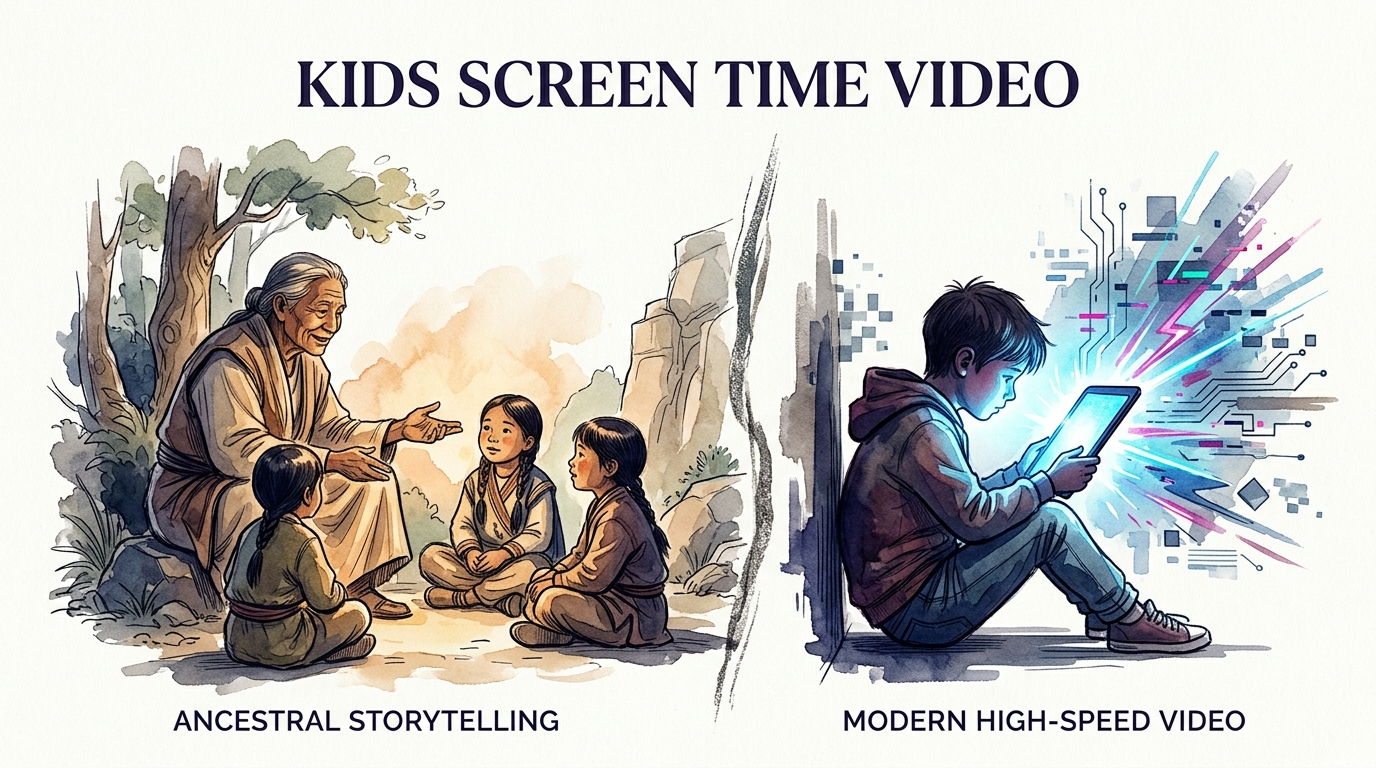
Human brains were built for stories, not 15-second dopamine hits. Modern videos are designed to hijack a child’s attention. Ancestral storytelling was designed to build their imagination. It’s time to bridge the gap.
We are living through a massive neurological experiment. Every time a toddler swipes a screen, their developing brain encounters a firehose of stimuli that our ancestors never could have imagined. This shift from slow, oral traditions to rapid-fire pixels is changing how children think, feel, and focus.
Understanding the mechanics of modern media is the first step toward regaining control. Parents often feel like they are losing a battle against an invisible force. That force is a combination of persuasive design and evolutionary biology.
It is not just about the content; it is about the pace. When we trade the campfire for the smartphone, we trade deep cognitive processing for shallow, automatic reactions. This article explores why this matters and how you can navigate the digital landscape with purpose.
kids screen time video
The term kids screen time video refers to the digital content specifically designed to engage young audiences through mobile devices, tablets, and televisions. While television has existed for decades, modern screen time is fundamentally different due to its accessibility and intensity. In the past, “Saturday morning cartoons” were a scheduled event; today, the stream is infinite and portable.

This modern phenomenon exists because of the “attention economy.” Developers and creators use high-saturation colors, rapid frame changes, and loud, repetitive sounds to ensure a child remains glued to the screen. In real-world terms, this is often used as a “digital pacifier” or an “algorithm babysitter” to keep children quiet during high-stress moments like long car rides or grocery store trips.
The typical kids screen time video today is often short-form, lasting anywhere from 15 seconds to 3 minutes. Platforms like YouTube Kids and TikTok have popularized “random reinforcement” schedules, where the next video is always a surprise. This unpredictability is what makes the content so difficult for a child to turn away from.
Children are not just watching these videos; they are being conditioned by them. Because their prefrontal cortex—the part of the brain responsible for impulse control—is not fully developed, they lack the “brakes” to stop watching. This creates a cycle where the screen becomes the primary source of regulation and entertainment.
How High-Speed Video Hijacks the Developing Brain
Modern videos work by overwhelming the sensory system. A standard “high-speed” cartoon might have a scene change every 11 seconds, compared to older, “slow-paced” shows that may keep a single shot for 30 seconds or more. These rapid cuts force the brain to constantly re-orient itself to new information.
This process triggers the release of dopamine, the neurotransmitter associated with reward and motivation. Every new scene, bright color, or funny sound effect provides a small “hit.” Over time, the brain begins to crave this high-frequency stimulation. This is often referred to as the “dopamine loop.”
When a child is in this loop, their “executive function” begins to drain. Executive function includes skills like working memory, self-regulation, and the ability to delay gratification. Research has shown that just nine minutes of high-speed, fantastical content can cause an immediate drop in a four-year-old’s ability to solve problems and follow directions.
To implement a healthier approach, parents must learn to identify “high-arousal” content. Look for shows with rapid transitions, frequent loud noises, and characters that move at unnatural speeds. These are the primary triggers for overstimulation and the dreaded “screen time meltdown” that occurs when the device is finally removed.
Benefits of Slowing Down and Ancestral Storytelling
Ancestral storytelling involves oral narratives, picture books, or slow-paced media where the child must use their own mind to fill in the gaps. When a child listens to a story, their brain has to “render” the images internally. This is an active cognitive process that strengthens the imagination.
The primary advantage of this approach is the development of sustained attention. Unlike high-speed videos that do the work for the child, slow media requires the child to pay attention to a single narrative thread over a longer period. This builds the mental “muscle” needed for reading and classroom learning later in life.
Language development is another measurable benefit. Slow-paced stories allow children to hear the pauses between words and the nuances of tone. High-speed content often uses “squeaky” or distorted voices that can actually hinder a child’s ability to map out sentence structures and phonemes.
Empathy is also fostered through slower narratives. When a story takes the time to explore a character’s feelings and the consequences of their actions, children have the “cognitive space” to reflect on those emotions. Rapid-fire videos often jump from one slapstick moment to another, leaving no room for emotional processing.
Challenges and Common Mistakes
One of the biggest challenges is the “Cocomelon Effect,” where parents find that only the most stimulating content will keep their child occupied. Once a child is used to high-octane videos, slower educational content feels “boring.” This makes the transition to better media feel like an uphill battle.
A frequent error is using screens as the primary tool for emotional regulation. If a child is given a tablet every time they have a tantrum, they never learn how to self-soothe. The screen becomes a “crutch” that prevents the development of natural resilience and coping mechanisms.
Another pitfall is the “educational trap.” Many parents believe that because a video teaches numbers or letters, it is automatically good. However, if that educational content is delivered via rapid-fire cuts and overstimulating music, the “how” of the delivery may outweigh the “what” of the lesson. The brain remains in a state of high arousal regardless of the subject matter.
Parents also often fail to provide an “off-ramp.” Abruptly stopping a high-dopamine activity causes a sudden “crash” in the brain’s reward system. This is why children often scream or become aggressive when the screen is turned off; they are experiencing a literal withdrawal from the stimulation.
Limitations and Realistic Constraints
We cannot ignore that we live in a digital world. Completely banning screens is often impractical and can lead to social isolation for older children. The goal is not total elimination, but rather “digital hygiene” and intentional consumption.
Environmental factors play a massive role. In a single-parent household or a home where both parents work, the screen often provides a necessary window of time for essential tasks. Recognizing these trade-offs is important for maintaining parental mental health and avoiding “parental guilt.”
Not all children react to screen time in the same way. Children with ADHD or sensory processing disorders may be significantly more vulnerable to the negative effects of high-speed video. For these children, the “limitations” of screen time must be even more strictly defined to prevent chronic dysregulation.
Comparison: Fast-Paced vs. Slow-Paced Media
The following table illustrates the measurable differences between the two primary types of kids screen time video. Understanding these factors can help you make better decisions about what your child consumes.
| Feature | Fast-Paced (High-Arousal) | Slow-Paced (Ancestral-Style) |
|---|---|---|
| Scene Changes | Every 2–11 seconds | Every 30+ seconds |
| Brain Activity | Passive / Reactive | Active / Imaginative |
| Dopamine Level | Frequent “Hits” (High) | Steady / Sustained (Low) |
| Post-Watch Behavior | Irritability / Meltdowns | Calm / Transition-ready |
| Primary Goal | Maximum Engagement | Comprehension & Story |
Practical Tips for Healthier Screen Habits
Start by implementing the “Slow-Start Method.” If you are going to use screen time, begin with the slowest, most “boring” content first. This prevents the brain from being “red-lined” early in the day, making it easier for the child to transition to other activities like playing with blocks or drawing.
Curate your own playlists instead of letting the algorithm decide. Disable “Autoplay” on all platforms immediately. When the algorithm picks the next video, it chooses based on engagement, not quality. By manually selecting the content, you regain the role of the “gatekeeper.”
Use “Off-Ramps” to prevent meltdowns. Give your child a five-minute and a two-minute warning. Better yet, use a physical visual timer. When the time is up, transition them into a “high-sensory” physical activity, like jumping on a trampoline or playing with playdough, to help their nervous system recalibrate.
Incorporate “Co-Viewing” whenever possible. Talk to your child about what they are seeing. Ask questions like “Why did that character do that?” or “What do you think happens next?” This turns a passive activity into a social, language-rich experience that mimics ancestral storytelling.
Advanced Considerations for Serious Practitioners
Serious practitioners of digital wellness should look into the concept of “neuroplasticity.” The child’s brain is physically wiring itself based on its environment. If the environment is a constant stream of 15-second bursts, the brain’s “wiring” will prioritize short-term novelty over long-term focus. This is a structural change that can take months of “boredom” to reverse.
Consider the impact of blue light on circadian rhythms. High-intensity screens within two hours of bedtime suppress melatonin production. This leads to poor sleep quality, which further impairs executive function the following day, creating a vicious cycle of irritability and screen dependence.
Look for “stopping cues.” Modern apps are designed to be “bottomless,” with no natural end point. Ancestral stories have a beginning, middle, and end. Prioritize media that has a clear conclusion, as this helps the child’s brain recognize that the activity is over, making it easier for them to move on.
Examples and Scenarios
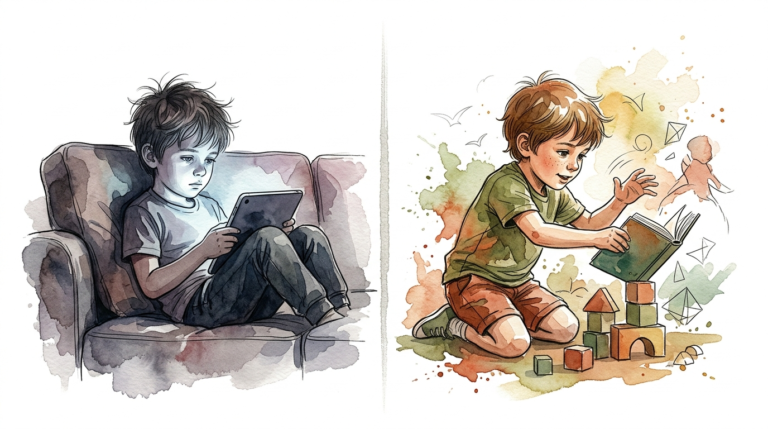
Imagine two four-year-olds, Liam and Maya. Liam watches nine minutes of a popular, high-speed cartoon featuring talking sponges and rapid scene cuts. Maya spends nine minutes drawing or watching a slow-paced show about a boy and his dog where the camera stays still for long periods.
After the nine minutes are up, both children are asked to play a game where they have to wait for a signal before touching a toy. Research suggests that Liam will struggle significantly more with this task. His brain has been “primed” for instant feedback and rapid changes, making the act of “waiting” feel physically painful.
Maya, on the other hand, is much more likely to follow the instructions. Her executive function has not been depleted. She is still in a “calm-alert” state rather than a “high-arousal” state. This small difference, multiplied over years of daily screen use, creates a massive gap in their ability to function in a classroom setting.
Final Thoughts
The goal of managing kids screen time video is not to live in the past, but to protect the future. We can use modern technology without letting it rewire our children’s brains for impulsivity. By choosing quality over quantity and pace over pixels, we can provide the “cognitive nutrition” they need to thrive.
Remember that you are the architect of your child’s environment. While the algorithms are powerful, they are not your child’s parent. Reclaiming the narrative through ancestral storytelling—whether through books, oral history, or slow-paced media—is one of the greatest gifts you can give to their developing mind.
Take the first step today by auditing one show your child watches. If it’s too fast, swap it for something slower. Watch the difference in their behavior after the screen goes dark. The results will speak for themselves, and you will find that a calmer, more focused child is worth every minute of the effort.
Sources
1 sciencealert.com | 2 sciencealert.com | 3 sciencealert.com | 4 phillyintegrative.com | 5 forbes.com | 6 grandpakenreadingtime.com | 7 instituteofchildpsychology.com | 8 instituteofchildpsychology.com | 9 katychildpsychology.com | 10 sedentarybehaviour.org | 11 reverehealth.com | 12 oneeducation.co.uk | 13 nih.gov | 14 youtube.com | 15 thelegendaryconnection.com | 16 impact-psych.com | 17 thejacobsladdergroup.org | 18 ucdbabylab.com | 19 mayoclinic.org | 20 connectedfamilies.org