screen free evening routine
Are you dependent on a battery to relax? Build a resilient routine that works anywhere, anytime. Most of us have fallen into the trap of using a smartphone as a digital pacifier after a long day. True relaxation shouldn’t require a Wi-Fi signal. Here is how to build a routine that relies only on you.
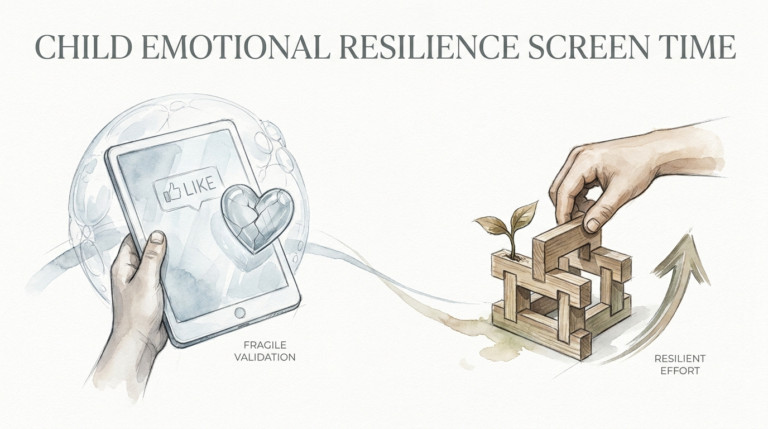
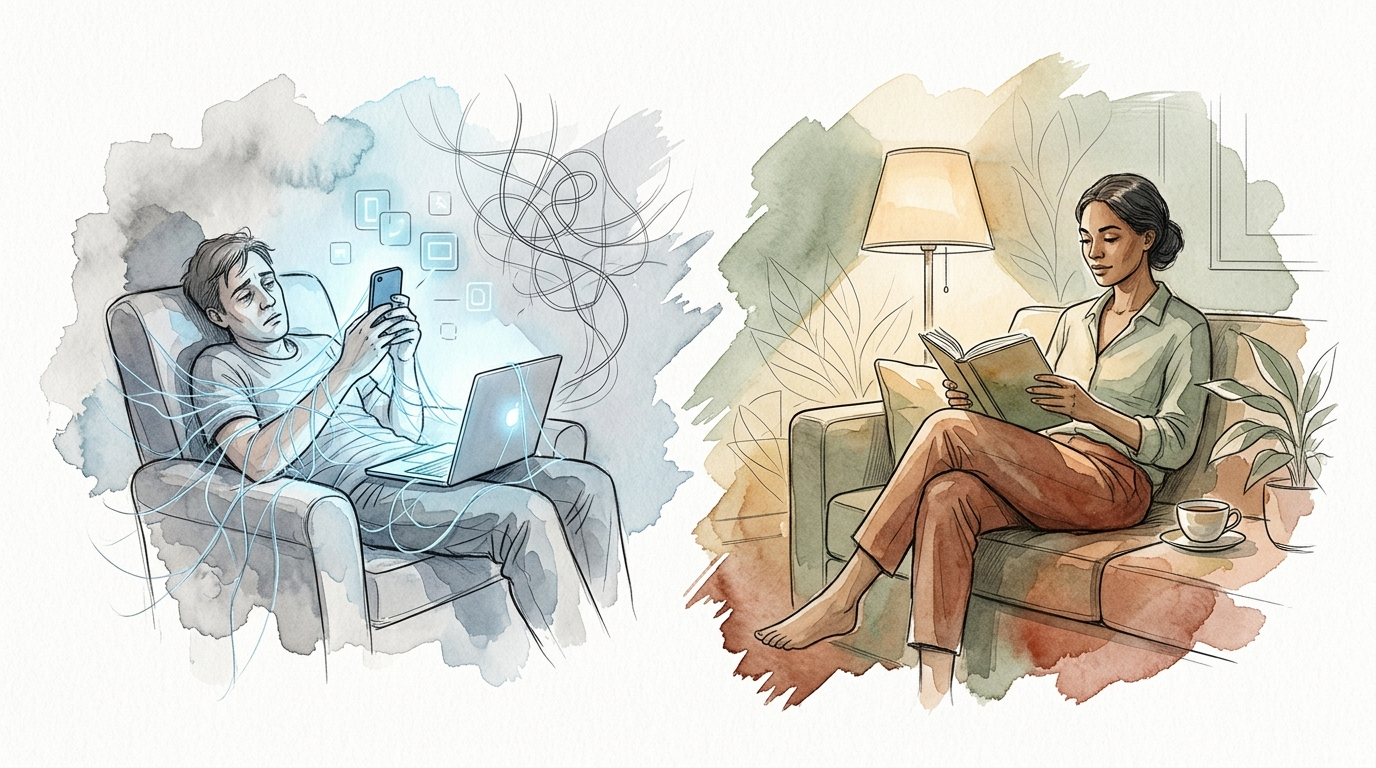
Digital devices are often a fragile crutch for our tired minds. We scroll through feeds hoping to unwind, but we usually end up “wired and tired.” This habit is a form of fragile self-regulation that disappears the moment the battery dies. Resilient self-regulation is different because it belongs to you and works regardless of your tech.
Building a routine that doesn’t need a screen is about reclaiming your biology. It allows your brain to transition from a state of high-alert processing to deep, restorative rest. You are not just turning off a phone; you are turning on your body’s natural recovery systems.
screen free evening routine
A screen free evening routine is a deliberate period before sleep where you eliminate all light-emitting electronic devices. This includes smartphones, tablets, computers, and televisions. This practice is designed to protect your circadian rhythm from the disruptive effects of artificial blue light.
Blue light in the 450–480 nm range is particularly problematic at night. Research shows that even one hour of screen use before bed can reduce total sleep time by an average of 24 minutes. For university students, this same habit is linked to a 59% higher chance of experiencing insomnia symptoms.
This routine exists to bridge the gap between a high-stimulation workday and a low-stimulation sleep state. In the real world, it looks like a “Digital Sunset.” You set a specific time to power down your devices and switch to analog activities. This shift signals to your brain that the environment is safe and the day is over.
Think of your mind like a massive cargo ship. It cannot stop on a dime or turn instantly. A screen free evening routine acts like the tugboats that slowly guide that ship into the harbor. Without this transition, your brain stays in the “open ocean” of high-energy processing, making deep sleep almost impossible.
How to Build Your Resilient Evening System
Transitioning to an analog evening requires a phased approach. You cannot simply flip a switch and expect your brain to be happy. Start by setting a “hard stop” time for all work-related digital communication. This is your first line of defense against cognitive overload.
The next step is the physical removal of devices from your immediate environment. Place your phone in a dedicated charging station in a different room. If you use your phone as an alarm, consider replacing it with a simple analog clock. This prevents the “just one more scroll” temptation when you are already in bed.
Engage in tactile activities that ground you in the physical world. This could include preparing a cup of herbal tea, organizing your space for the next morning, or light stretching. These actions move your focus from the abstract digital space to your physical body.
Implement a “Low-Light Layering” strategy in your home. Swap bright overhead LED lights for warm-toned floor lamps or candles. Lower light levels encourage the pineal gland to begin secreting melatonin, the hormone responsible for sleep onset. Red light is particularly effective because it does not suppress melatonin like blue light does.
Establish a “Termination Ritual” to close out the day mentally. Writing a “brain dump” list of tomorrow’s tasks can prevent your mind from racing once the lights go out. This ritual tells your subconscious that you have a plan, which lowers cortisol levels.
Benefits of an Analog Wind-Down
The most immediate benefit is a significant increase in sleep quality. Adults who avoid screens before bed report 33% higher rates of good sleep quality compared to those who use devices. Deep sleep (REM and NREM) is where your brain processes emotions and clears out metabolic waste.
Your mental health receives a massive boost when you break the dopamine loop of social media. “Doomscrolling” creates a variable ratio reinforcement cycle that keeps you hooked but leaves you feeling depleted. Replacing this with a physical hobby or reading increases life satisfaction and emotional resilience.
Focus and cognitive capacity improve over time. Constant digital switching fractures our attention spans and leads to “attention residue.” An evening spent away from screens allows your brain to enter a state of “soft fascination.” This state is restorative and helps rebuild your ability to concentrate during the day.
Long-term health outcomes are also measurable. Engaging in analog hobbies is associated with a lower risk of functional decline and even a 29% lower risk of mortality in older adults. These activities foster a sense of purpose and calm that digital consumption cannot replicate.
Physical tension decreases as you step away from the “tech neck” posture. Most screen use involves hunching over or looking down, which strains the cervical spine and shoulders. An analog routine encourages natural movement and better posture, leading to fewer tension headaches and less muscle pain.
Challenges and Common Mistakes
The “Digital Hook” is the biggest hurdle to overcome. Apps are designed using behavioral psychology to be as addictive as slot machines. You might feel a sense of boredom or anxiety when you first put the phone away. This is a normal withdrawal response, not a sign that the routine isn’t working.
Relying on willpower alone is a frequent mistake. Willpower is a finite resource that is often exhausted by the end of a workday. If your phone is sitting on your nightstand, you will eventually reach for it. Successful routines rely on environmental design, not just grit.
Another pitfall is “Sneaky Screens.” You might think using a Kindle with a backlight or checking a “quick” notification is harmless. However, even brief exposure to blue light can stall melatonin production for up to 90 minutes. Consistency is the key to training your internal clock.
Many people fail because they don’t have a plan for what to do instead. If you sit on the couch in the dark without a book or a hobby, you will naturally gravitate back to your phone. You need an “Analog Toolkit” ready to go before you turn off the electronics.
Ignoring the “Social Jetlag” factor can also derail your efforts. This happens when your weekend routine differs wildly from your weekday routine. If you stay up until 2 AM on Saturday scrolling, your body will struggle to adjust on Monday. Aim for a consistent power-down time seven days a week.
Limitations and Environmental Constraints
A screen free evening routine is highly effective, but it does have practical boundaries. Those working in emergency services or on-call roles may not be able to fully disconnect. In these cases, using blue-light-blocking glasses or “night mode” filters is a necessary compromise, though less effective than a total blackout.
Travel and unfamiliar environments can also make the routine difficult to maintain. Hotel rooms often have bright, non-adjustable lighting or lack comfortable spaces for analog hobbies. In these situations, bringing a portable analog kit—like a physical book and a small red-light clip—is essential.
Caregivers of young children or elderly parents may face frequent interruptions. A rigid one-hour window might be impossible during a crisis. The goal is “resilient” regulation, which means being flexible. If your routine is interrupted, simply return to the analog state as soon as the situation is resolved.
Living with others who are not committed to the routine can create social friction. If your partner is watching a bright TV in the same room, your melatonin production will still be affected. Communication and shared “screen-free zones” in the house are vital for collective success.
Seasonal changes also play a role. During winter months in high latitudes, the lack of natural light can make you feel sleepy much earlier. You may need to adjust the timing of your routine to match the seasonal shift in your own energy levels.
Comparison: Fragile Crutch vs. Resilient Regulation
| Feature | Fragile Digital Crutch | Resilient Self-Regulation |
|---|---|---|
| Energy Source | Requires electricity and Wi-Fi. | Internalized skills and analog tools. |
| Hormonal Impact | Suppresses melatonin, raises cortisol. | Promotes melatonin, lowers cortisol. |
| Attention Span | Fragmented and reactive. | Focused and intentional. |
| Sleep Quality | Often “wired but tired” state. | Faster onset, deeper cycles. |
| Portability | Limited by charging/connectivity. | Works anywhere with minimal prep. |
Practical Tips for Immediate Application
Invest in a dedicated analog alarm clock. This single change is the most effective way to keep your phone out of the bedroom. It removes the primary excuse for having a screen within arm’s reach while you sleep.
Create an “Analog Toolkit” box. Fill it with things you enjoy that don’t have a screen. Good options include a current physical book, a sketchbook, a deck of cards, or a puzzle. Having these items organized and visible makes the transition much easier.
Try the “3-2-1 Rule” for a balanced evening. Stop eating three hours before bed, stop working two hours before bed, and stop screens one hour before bed. This tiered approach handles your metabolic, mental, and biological needs in order.
Practice Progressive Muscle Relaxation (PMR) to physically release stress. Lie down and tense each muscle group—starting from your toes and moving up to your face—for five seconds, then release for twenty. This technique has been shown to significantly decrease cortisol and systemic worry.
Use “Box Breathing” if your mind is racing. Inhale for four counts, hold for four, exhale for four, and hold for four. This rhythmic pattern activates the parasympathetic nervous system, which is the “rest and digest” mode of your body.
Advanced Considerations for Serious Practitioners
Optimize your environment for the “Drop-Off.” The Suprachiasmatic Nucleus (SCN) in your brain is highly sensitive to light and temperature. Keep your bedroom between 60–67 degrees Fahrenheit (15–19 degrees Celsius) to facilitate the core body temperature drop needed for sleep.
Consider the role of “Evening Chronotypes.” If you are naturally a “night owl,” you might feel more creative or alert in the late hours. For these individuals, a screen free evening routine is even more critical to prevent “social jetlag” and ensure they get enough total rest.
Integrating red-light therapy can enhance the routine. Specific red LEDs (660nm–850nm) can help reduce inflammation and do not disrupt the circadian rhythm. Using a red-light lamp during your analog hour can deepen the relaxation response.
Evaluate your “Cognitive Load” during the day. If you spend eight hours in front of a computer, your brain is starved for tactile and spatial stimulation. Engaging in a hobby like gardening or woodworking in the evening provides the sensory variety your brain craves for health.
Monitor your “Attention Residue.” If you must check a screen, do it quickly and for a single purpose. The goal is to avoid the “switching cost” that occurs when your brain has to reorient from one task or app to another. The more you “switch,” the more exhausted your prefrontal cortex becomes.
Example Scenarios: Crutch vs. Resilience
Scenario A: The Digital Crutch. Alex finishes a stressful day at 7:00 PM. He eats dinner while watching a streaming show. At 9:30 PM, he lies in bed and scrolls through news and social media for “ten minutes,” which turns into an hour. His brain is flooded with blue light and stressful information. He finally puts the phone down at 11:00 PM but tosses and turns until 1:00 AM. He wakes up groggy and reaches for his phone immediately.
Scenario B: Resilient Regulation. Sarah finishes work at 7:00 PM. She eats dinner and has a light conversation with her family. At 8:30 PM, she enters her “Digital Sunset” and places her phone in the kitchen charger. She spends thirty minutes reading a physical novel and fifteen minutes doing light stretching in a room lit by a warm lamp. At 9:30 PM, she does five minutes of Box Breathing and falls asleep by 10:00 PM. She wakes up naturally at 6:00 AM feeling restored.
In Scenario B, Sarah has built a routine that works even if the power goes out. She has trained her body to recognize specific environmental cues for rest. Alex, however, is at the mercy of his algorithm and his battery life. Sarah’s routine is resilient because it is based on her biology, not her hardware.
Final Thoughts
Reclaiming your evenings from the digital world is one of the most powerful moves you can make for your health. A screen free evening routine isn’t about being productive or “perfect”; it’s about giving your nervous system the space it needs to repair itself. When you rely on internal tools rather than external gadgets, you build a life that is truly resilient.
Start small by choosing just one analog activity to replace your final thirty minutes of screen time. Notice how your focus improves and how your morning “brain fog” begins to lift. You will likely find that the world doesn’t end when you are offline, but your personal world becomes much clearer.
Experiment with different activities until you find what feels like true rest to you. Whether it is journaling, stretching, or just sitting in silence, the key is to make it yours. You have the biological equipment for deep relaxation already built into your body—you just need to give it the right environment to function.
Sources
1 trinityhealth.com | 2 theteaspot.com | 3 berkeley.edu | 4 drkristinedwards.com | 5 trinityhealth.com | 6 thensf.org | 7 sleepeducation.org | 8 sleepeducation.org | 9 thensf.org | 10 montville-cabins.com.au | 11 rowancenterla.com | 12 jaimedicalsystems.com | 13 medium.com | 14 reddit.com | 15 sbm.org | 16 neurodivergentinsights.com | 17 optum.com | 18 southeastbehavioral.com