family tech rules printable template
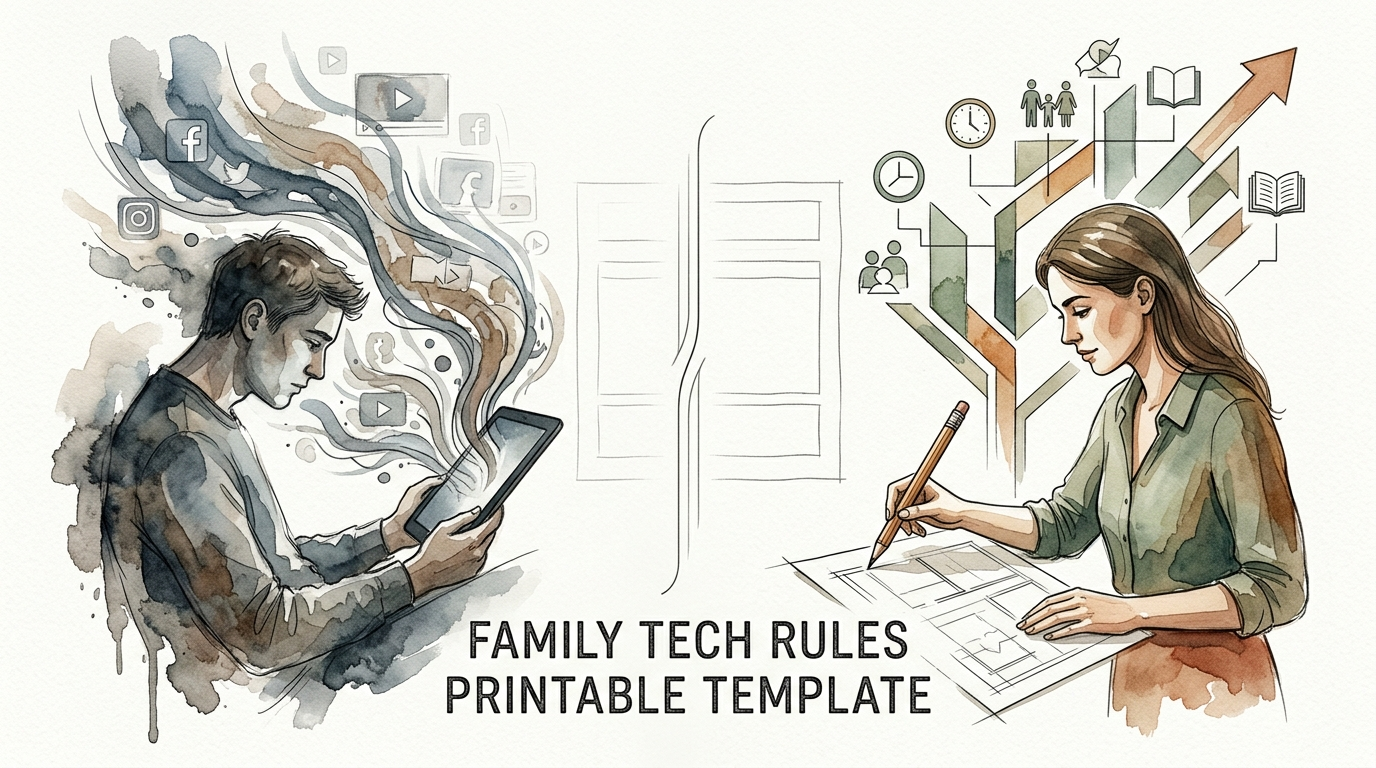
Don’t let the algorithm design your day. Become the architect of your family’s time. If you don’t have rules, the tech companies will make them for you. Use our printable template to shift from passive consumers to active architects of your own life.
Every swipe, scroll, and notification is a bid for your attention. These platforms use psychological triggers to keep you glued to the screen. Without a plan, your family’s time evaporates into a digital void. You deserve more than a life lived through a blue-light filter.
The goal is not to banish technology. We want to master it. By creating a structured environment, you move from being a Passive Content Consumer to an Active Life Architect. You start choosing your experiences instead of letting a line of code choose them for you.
This guide provides everything you need to build a digital fortress. We will walk you through the psychology of screen time and the practical steps to reclaim your living room. Let’s build a life that is lived out loud, not just liked online.
family tech rules printable template
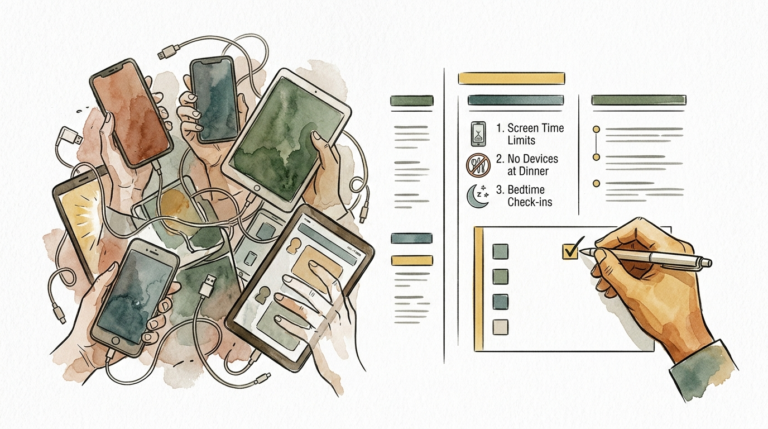
A family tech rules printable template is a physical document that outlines how your household interacts with the digital world. It serves as a visual contract and a constant reminder of your shared values. This isn’t a list of punishments; it is a roadmap for freedom.
Think of it as a constitution for your home. It defines the “when,” “where,” and “how” of device usage. In the real world, we use traffic lights to prevent crashes. In the digital world, we use tech rules to prevent burnout and disconnection.
Most families fall into the trap of reactive parenting. You see a kid on a phone for too long and you yell. The child gets defensive, and the cycle continues. A printable template shifts the focus from conflict to consistency. Everyone knows the expectations before the device even turns on.
Your template should include specific sections for different age groups. A toddler’s needs are vastly different from a teenager’s digital life. Our template allows for these nuances while maintaining a unified family vision.
How to Design Your Family Media Plan
Creating your rules requires a collaborative approach. If you hand down a list of “thou shalt nots,” you will meet resistance. Sit down together. Bring snacks. Make it a positive event where every voice matters.
Start by identifying your family’s “non-negotiables.” These are the sacred times and places where tech has no home. For most families, the dinner table and bedrooms are the first zones to be declared tech-free. Removing screens from these areas encourages face-to-face eye contact and improves sleep quality.
Next, define the “Four S’s” of digital safety: Sleep, Social Isolation, Salacious Content, and Sexual Predators. Discuss how specific rules protect against these dangers. For example, charging all phones in a central “parking lot” at 8:00 PM directly protects sleep and limits late-night social isolation.
Use the “Earned Screen Time” model. Instead of tech being the default state, make it a reward for completing physical or creative tasks. Children should finish their homework, chores, and at least 30 minutes of outdoor play before the digital world opens up.
Implement a “one screen at a time” rule. This reduces the cognitive load of multitasking. If the TV is on, the phones are away. This helps train the brain to focus on one stream of information at a time, combating the fractured attention span typical of heavy tech users.
Benefits of a Structured Tech Agreement
The primary benefit is mental clarity. Constant digital stimulation keeps the brain in a state of “high alert.” When you establish clear boundaries, you give your nervous system permission to rest. You will notice lower anxiety levels across the board.
Improved relationships are a natural byproduct. When phones are “parked,” conversations become deeper. You stop competing with an algorithm for your child’s attention. You start noticing the small details of their day that were previously obscured by a screen.
Academic performance often sees a boost. Without the distraction of group chats and notifications, students can enter a “flow state” more easily. Deep work becomes possible when the digital noise is silenced by a pre-arranged schedule.
Digital literacy is the long-term win. By involving children in the rule-making process, you teach them to think critically about their habits. They learn that technology is a tool to be used with intention, not a master to be obeyed without question.
Challenges and Common Mistakes
The biggest pitfall is parental hypocrisy. If you tell your kids to stay off their phones while you are scrolling through work emails at the dinner table, the rules will fail. You must model the behavior you want to see. Your kids are watching your habits more than they are listening to your rules.
Inconsistency is another major hurdle. If you enforce the rules on Monday but let things slide on Friday because you are tired, the boundary loses its power. Children need predictable environments to feel safe and to develop self-discipline.
Rules that are too restrictive can backfire. If you ban all technology, you may drive your children to use it in secret. Secret usage is dangerous because you cannot guide them through the risks. Aim for intentional use rather than total abstinence.
Failing to update the rules is a common error. A plan made for a ten-year-old will not work for a fourteen-year-old. Set a recurring date—perhaps every six months—to review the template and make adjustments as your children mature.
Limitations and Realistic Constraints
Technology is now integrated into the education system. You cannot simply turn off the internet when your child has three hours of research to do for a school project. Your rules must distinguish between Productive Use and Passive Consumption.
Environmental factors often interfere. If you live in a small apartment, “tech-free zones” are harder to maintain than in a large house. You may need to use “tech-free times” instead of physical spaces to create boundaries.
Social pressure is real. For teenagers, being offline can feel like social suicide. You must find a balance that protects their mental health without completely isolating them from their peer group. This requires ongoing conversation and trust.
Rules won’t fix underlying emotional issues. Sometimes, excessive screen time is a symptom of anxiety, depression, or boredom. If you find your child is obsessively seeking screens despite clear rules, it may be time to look deeper into their emotional well-being.
Passive Consumer vs. Active Architect
| Feature | Passive Content Consumer | Active Life Architect |
|---|---|---|
| Decision Making | Follows the “Up Next” autoplay | Decides what to watch before turning on the device |
| Focus | Easily distracted by notifications | Uses “Do Not Disturb” and focus modes |
| Environment | Phone is always within reach | Designated “Parking Lots” for devices |
| Output | Mostly scrolling and watching | Uses tech for creation and learning |
| Sleep | Screens in bed until eyes close | Digital sunset 60 minutes before bed |
Practical Tips and Best Practices
Create a “Digital Sunset.” One hour before bed, all screens go off. This allows the brain’s natural melatonin production to begin without interference from blue light. Replace the screen with a physical book, a board game, or a family conversation.
Use hardware solutions to support your software rules. High-quality parental control routers can schedule “internet blackouts” automatically. This takes the “bad guy” role away from the parent and gives it to the system.
Establish “Tech-Free Transitions.” When someone walks through the front door after work or school, keep the phones away for the first twenty minutes. This allows for a meaningful reconnection after being apart, setting a positive tone for the rest of the evening.
Leverage the “Creation Over Consumption” ratio. For every hour of watching YouTube, encourage thirty minutes of creating something—whether it’s digital art, coding, or building something in the real world. This shifts the mindset from taking to making.
Keep the printable template in a high-traffic area. The refrigerator or the command center in the kitchen are perfect spots. Visibility is key to accountability. When the rules are hidden in a drawer, they are forgotten.
Advanced Considerations for Digital Wellness
Understand the Dopamine Loop. Apps are designed to trigger small hits of dopamine through likes and comments. Teach your children how these loops work. When they understand the “why” behind their urges, they are more empowered to resist them.
Privacy is the new currency. Go beyond time limits and discuss data footprints. Teach your teens that every post and search contributes to a permanent digital profile. Review privacy settings together regularly to ensure they are not oversharing with the world.
Discuss the “Hidden Costs” of free apps. If you aren’t paying for the product, you are the product. Explain how advertising algorithms use their data to influence their purchasing habits and opinions. This develops a healthy skepticism toward digital content.
Consider the impact of Artificial Intelligence. As AI becomes more prevalent in social media, distinguishing between real and synthetic content is vital. Talk about deepfakes and AI-generated influencers to keep your family grounded in reality.
Example Scenarios
Scenario A: The Saturday Morning. Without a plan, the kids wake up and immediately reach for iPads. They stay in pajamas until noon, ignored and ignoring. With a tech plan, the rule is “No Screens Before Noon on Weekends.” The morning is filled with a family breakfast, chores, and an hour at the park. At 1:00 PM, they sit down for a pre-selected movie, enjoying it as a planned treat rather than a mindless habit.
Scenario B: The Weekday Homework. A teenager is struggling to finish an essay because their phone is buzzing with group chat notifications. Every buzz breaks their concentration. With the tech rules in place, the phone is in the “Parking Lot” in the kitchen during study hours. The essay gets done in half the time, leaving more time for actual social interaction later in the evening.
Scenario C: The Family Dinner. A parent receives a work notification during dinner. In a reactive home, they check it and spend ten minutes typing a reply while the kids wait to tell a story. In an “Architected” home, the phone is in another room. The parent hears the notification but stays present with their family. The work email can wait; the childhood stories cannot.
Final Thoughts
Building a family tech culture is not a one-time event. It is a continuous practice of awareness and intentionality. The printable template is your anchor, but your daily commitment is the wind that moves the ship. You are not just managing screen time; you are protecting your family’s soul.
Start small if you need to. Choose one tech-free zone and one tech-free time. Once those habits are locked in, expand your architecture. You will be amazed at how much “found time” appears when you stop letting the algorithm dictate your schedule.
Remember, you are the architect. You have the power to design a life that is rich in connection, creativity, and presence. Download the template, gather your family, and start building your legacy today. The digital world can wait; your real life is happening right now.
Sources
1 aap.org | 2 keltymentalhealth.ca | 3 esafekids.com.au | 4 multiscreensite.com | 5 substack.com | 6 childmind.org | 7 wi.gov | 8 healthychildren.org | 9 finalsite.net | 10 securedevices.net | 11 kidshubms.com | 12 centerforonlinesafety.com | 13 aacap.org | 14 hmd.com | 15 psychologytoday.com | 16 houstoncreativemedia.com