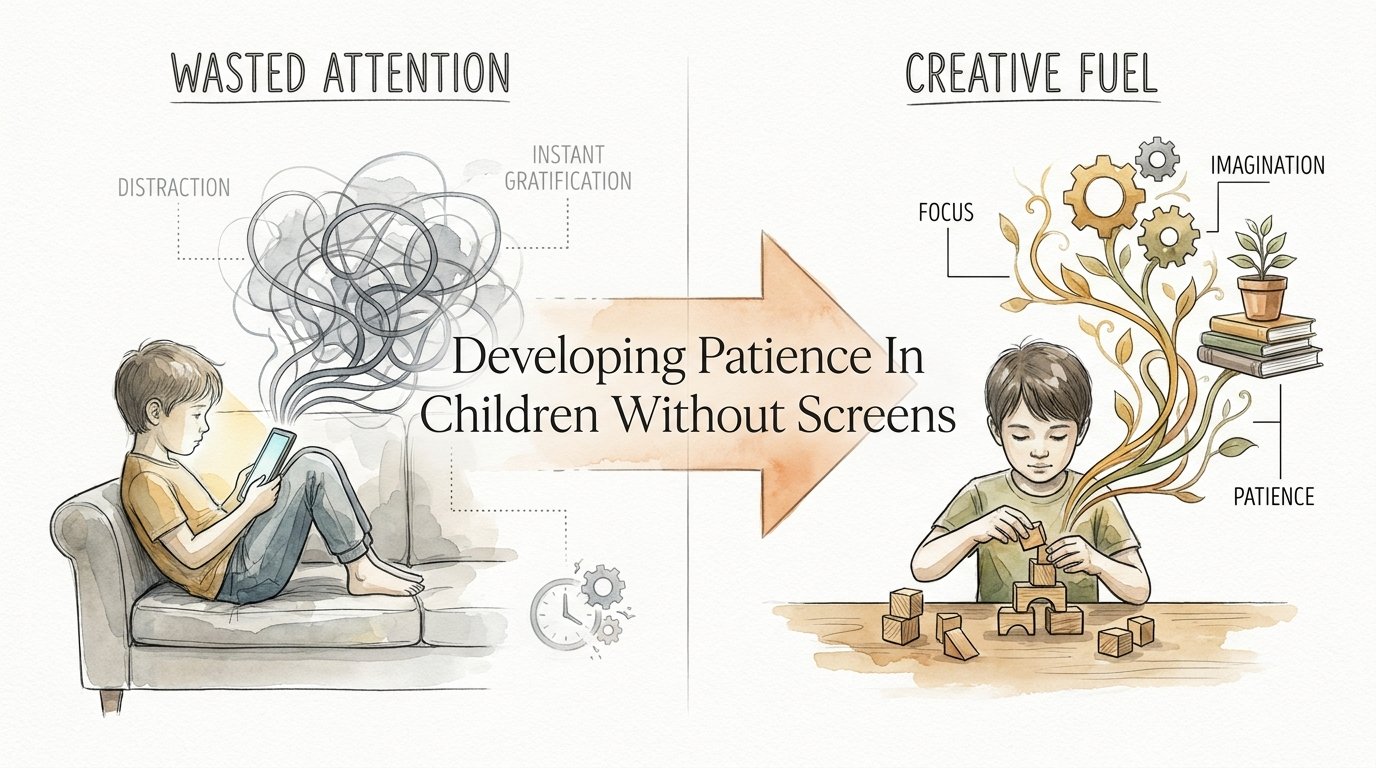
Developing Patience In Children Without Screens
If they can’t handle five minutes of silence, the habit has become a hunger. We use screens to ‘kill time,’ but we are actually killing the development of patience and observation. A sign of overuse is when ‘waiting’ becomes an emergency. We can treat boredom as waste, or we can use it as the fuel for a child’s inner engine of thought.
Waiting used to be a natural part of life. We waited for the mail, for the bus, or for our favorite show to air at 4:00 PM. Today, the world is on-demand, and our children are growing up in a high-speed digital loop. This “instant-fix” culture isn’t just about convenience; it is actively reshaping how young brains handle frustration.
When we hand over a smartphone to quiet a restless child, we are solving a short-term problem but creating a long-term deficit. Developing patience is a muscle. If that muscle is never flexed, it remains weak. This guide will show you how to trade digital distraction for real-world resilience.
Developing Patience In Children Without Screens
Developing patience is the ability to manage the gap between a desire and its fulfillment. It is more than just “sitting still.” It is a complex act of emotional regulation and executive function. In a screen-free context, patience is about building the internal toolkit a child needs to navigate “the slow parts” of life.
Real-world patience is different from “digital waiting.” On a screen, waiting is usually passive—a loading bar or a transition screen. In real life, patience is active. It requires a child to observe their surroundings, engage their imagination, and manage their own internal restlessness.
Think of it as the difference between being fed a meal and learning to cook. Screens feed the brain constant stimulation. Screen-free patience teaches the brain to cook up its own entertainment. This skill is foundational for academic success, healthy relationships, and long-term mental health.
How It Works: The Mechanics of Waiting
Patience is governed by the prefrontal cortex, the part of the brain responsible for decision-making and impulse control. When a child waits without a screen, they are performing a “dopamine workout.” They are training their brain to stay regulated even when the “reward” is delayed.
1. Scaffolding the Wait
You cannot expect a toddler to wait thirty minutes for a meal immediately. Start with “micro-waits.” When they ask for a snack, say, “I will get that as soon as I finish wiping this counter.” This creates a 30-second gap of intentional waiting.
2. Modeling Out Loud
Children mirror our emotional states. If you are huffing and puffing in a grocery line, they learn that waiting is a crisis. Instead, narrate your own patience. Say, “The line is long today. I’m going to use this time to look at all the different types of fruit while we wait.”
3. Using Visual Tools
Young children have a poor concept of time. Terms like “five minutes” are abstract and scary. Use a visual timer where the red disappear as time passes. This turns an invisible enemy into a visible, manageable process.
4. The Power of Boredom
Boredom is the precursor to creativity. When a child is bored, their brain enters the “default mode network.” This is where they start to daydream, plan, and invent. If we never let them be bored, we are effectively starving their imagination.
Benefits of Screen-Free Patience
Choosing the “slow road” yields measurable advantages that extend far beyond a quiet dinner at a restaurant.
- Increased Attention Span: Children who practice waiting in the real world develop a higher tolerance for tasks that don’t provide instant feedback, such as reading or math.
- Emotional Resilience: When “waiting” is no longer an emergency, children become less prone to meltdowns. They learn that discomfort is temporary.
- Enhanced Creativity: Without a screen to fill the void, children are forced to invent. A salt shaker becomes a rocket ship; a shadow becomes a monster.
- Better Social Skills: Patience is required for turn-taking, listening, and empathy. Screen-free environments encourage children to look up and interact with people.
Challenges and Common Mistakes
The biggest obstacle to developing patience isn’t the child; it is the environment. We live in a world designed to eliminate friction, which makes intentional waiting feel counter-intuitive.
The “Digital Pacifier” Trap
The most common mistake is using a screen as a preventative measure. We hand over the phone *before* the child gets restless. This prevents the child from ever reaching the “boredom threshold” where growth happens.
Empty Praise
Telling a child “Good job” after they wait is too vague. Instead, use specific praise: “I saw how you waited patiently while I talked to the doctor. I noticed you were looking at the pictures on the wall to stay busy. That was great.”
Parental Guilt
Many parents feel they are being “mean” by making a child wait. This is a misunderstanding of development. You aren’t being mean; you are being a coach. You are preparing them for a world that will not always cater to their immediate whims.
Limitations: When Patience Isn’t the Priority
While building patience is vital, there are times when it shouldn’t be the primary focus. Understanding these boundaries prevents unnecessary frustration for both parent and child.
Physical Needs First
A child who is “hangry,” exhausted, or ill cannot be expected to practice high-level emotional regulation. In these moments, their “engine” is out of fuel. Address the physical need before demanding a character virtue.
Neurodivergent Considerations
Children with ADHD or Autism may process waiting differently. Their nervous systems might experience a “wait” as physical discomfort or high anxiety. For these children, waiting strategies must include sensory support, clear transitions, and sometimes, the use of a regulated digital tool as a legitimate accommodation.
Developmental Realities
An eighteen-month-old is biologically incapable of long-term delayed gratification. Expecting a toddler to wait like a ten-year-old is a recipe for failure. Always align your expectations with the child’s developmental stage.
Digital Distraction vs. Active Waiting
Understanding the difference between these two approaches helps in choosing the right strategy for the right moment.
| Feature | Digital Distraction | Active Waiting |
|---|---|---|
| Brain State | Passive / High Dopamine | Active / Regulation-Focused |
| Long-Term Skill | Escapism / Avoidance | Focus / Resilience |
| Creativity | Suppressed | Stimulated |
| Social Interaction | Disconnected | Connected to Environment |
Practical Tips for Screen-Free Waiting
You need a “waiting toolkit” that doesn’t involve a charger. These are actionable strategies to keep in your back pocket for those high-stress public moments.
- The “Waiting Bag”: Keep a small bag in your car filled with items that *only* come out when you are waiting. Think of Wikki Stix, a deck of cards, or a magnifying glass. Novelty sustains interest.
- I Spy / 20 Questions: These classic games are classics for a reason. They force the child to observe their environment and think logically.
- The “Thinking Cap”: Tell your child, “We have to wait for ten minutes. Let’s put on our thinking caps. I want you to look around and find five things that are green, or three people wearing hats.”
- Storytelling Chains: Start a story with one sentence: “Once there was a blue squirrel…” and let the child add the next sentence. This builds narrative skills and passes time quickly.
- Finger Games: Teach them thumb wrestling, rock-paper-scissors, or simple clapping patterns. These require zero equipment and build hand-eye coordination.
Advanced Considerations: The Dopamine Detox
If your child is already heavily reliant on screens, they may be in a state of “dopamine debt.” This means their baseline for stimulation is so high that real-world waiting feels physically painful.
To fix this, you may need a “digital reset.” This involves a period of 24–72 hours without any high-speed digital input. It allows the brain’s reward receptors to “down-regulate.” During this time, expect irritability. It is a sign that the brain is recalibrating.
Once the baseline is lower, the strategies for building patience will be significantly more effective. A child who isn’t constantly chasing a digital high is much more likely to find a cloud shaped like a dog interesting enough to wait for.
Scenario: The Restaurant Wait
Imagine you are at a restaurant. The server says the food will be 20 minutes. Usually, the phone comes out. Here is the screen-free alternative.
First, acknowledge the wait. “The food is going to take a little while. Let’s explore our table.” Give them a sugar packet and see if they can balance it on its end. Ask them to guess how many tiles are on the floor in your section.
Next, engage their senses. “Close your eyes. What do you smell? What is the loudest sound you can hear right now?” This is a form of mindfulness that grounds the child in the present moment.
Finally, bridge the gap. If they get restless, use a “transition object” like a napkin. “Can you fold this napkin into a triangle? What about a boat?” By the time they finish their “mission,” the food arrives. They have successfully navigated a 20-minute gap using only their own brain and the environment.
Final Thoughts
Patience is not the absence of desire; it is the mastery of it. When we remove screens from the “waiting” equation, we give our children back their own minds. We allow them to move from being passive consumers to active observers of the world around them.
This process takes time and consistency. There will be loud moments. There will be failed attempts. But every time your child sits in the silence or finds a way to entertain themselves with a stray button, they are growing. They are building the “inner engine” that will power their focus and creativity for the rest of their lives.
Start small. Be patient with their lack of patience. The goal isn’t a child who never complains; it is a child who knows that they are capable of handling the slow parts of life without a digital escape hatch. Experiment with these tools today, and watch as “waiting” transforms from an emergency into an opportunity.
Sources
1 brighthorizons.co.uk | 2 youtube.com | 3 childandfamilysolutionscenter.com | 4 berkeley.edu | 5 brighthorizons.com | 6 youthconnectionscoalition.org | 7 connectedfamilies.org | 8 safariltd.com | 9 learningrx.com | 10 vivvi.com | 11 bekindcoaching.com | 12 medium.com | 13 ourtinythinks.com | 14 parent.com | 15 veryspecialtales.com