chore chart for screen time
One chart to rule the day. Why stop at just chores? A chore chart shouldn’t just be a list of tasks—it should be a roadmap for the day. See how we integrated screen time rewards into a multi-use dashboard that keeps the whole family on track.
Every parent knows the struggle. You want the dishes done. They want another level of Minecraft. It feels like a constant negotiation at a high-stakes peace summit. But what if you could turn that friction into fuel for growth?
Transforming a simple list of “to-dos” into a comprehensive life dashboard changes the game entirely. It moves the conversation from “Go clean your room” to “Check your dashboard.” This shifts the responsibility from your voice to a system they can own and master.
Modern families are ditching the dusty fridge list for integrated systems. These dashboards handle schedules, habits, and rewards in one central hub. It is about creating a visual economy where effort equals access, teaching children the value of work and the importance of boundaries in a digital world.
chore chart for screen time
A chore chart for screen time is essentially a currency exchange for the modern household. It functions as a visual contract where children complete specific responsibilities to “earn” digital minutes. This system acknowledges that screens are a high-value privilege rather than an infinite right.
Think of it as an introductory course in economics. Kids learn that time is a finite resource. When they see a direct link between vacuuming the rug and twenty minutes of gaming, the “work” becomes a goal-oriented activity rather than a burden. This clarity reduces power struggles because the rules are visible and static.
In the real world, adults work for wages to pay for leisure. This system mirrors that reality. It uses “operant conditioning,” a psychological principle where behavior is shaped by its consequences. By rewarding positive actions with something the child values, you reinforce those habits until they become second nature.
Recent data shows that children aged 8 to 12 spend an average of 4 to 6 hours on screens daily. Without a system in place, this time often expands to fill every available gap. A chore-based reward system provides the necessary friction to ensure chores, homework, and physical play happen first.
How It Works: Building Your Command Center
Setting up a multi-use dashboard starts with choosing your medium. You can go old-school with a magnetic whiteboard or high-tech with a dedicated family tablet. The key is visibility. If it isn’t in a high-traffic area like the kitchen or entryway, it will be forgotten within a week.
Assign a specific “point” or “minute” value to every task. Simple jobs like making the bed might earn 5 minutes. Higher-effort tasks like weeding the garden could be worth 30 minutes. Be transparent about these values from the start to prevent mid-day bargaining sessions.
Use the “Show, Do Together, Step Aside” method for new responsibilities. First, you demonstrate the chore while they watch. Then, you complete it together. Finally, they do it solo while you supervise. This ensures they actually know how to “clean the bathroom” before you hold them accountable to that standard.
Integrate non-chore items into the dashboard to make it a true life roadmap. Include a section for “Habits” like teeth brushing or reading, and “Schedules” for sports practices. When a child sees their whole day at a glance, they develop better time management and executive function skills.
Physical vs. Digital Dashboards
Physical boards provide tactile satisfaction. Moving a magnet from “To-Do” to “Done” gives a small dopamine hit that digital buttons often lack. This is especially effective for younger children who need a concrete representation of their progress.
Digital dashboards offer automation and remote access. Apps like PointWiseSystem or Choreio allow parents to approve tasks from work. Some systems even include “Kiosk Mode” for wall-mounted tablets, keeping the focus on family management rather than web browsing.
Benefits: Why This Approach Wins
Research indicates that engagement in household chores significantly predicts better working memory and inhibitory control. These are core components of “executive function,” the brain’s management system. By requiring kids to plan their chores to earn screen time, you are literally building their brain’s capacity to handle complex tasks.
One major advantage is the reduction in parental nagging. When the dashboard is the authority, you stop being the “bad guy.” You aren’t taking away their tablet; the system is simply reporting that the requirements for the tablet haven’t been met yet.
This approach fosters a sense of belonging. Children who contribute to the household feel like “helpers” rather than just subjects of their parents’ rules. Studies show that kids who perform routine chores have higher self-esteem and better overall life satisfaction because they see themselves as capable, contributing members of a group.
It also teaches delayed gratification. In a world of instant streaming and one-click purchases, the ability to work now for a reward later is a superpower. Earning screen time prevents the “passive consumption” trap, where kids aimlessly scroll because they have nothing else to do.
Challenges and Common Mistakes
Inconsistency is the number one killer of any chore system. If you let them have the iPad on Tuesday without checking the list, the system loses its authority by Wednesday. You must be as disciplined in checking the dashboard as they are in completing the tasks.
Over-complicating the point system is another frequent error. If a child needs a calculator to figure out how much time they’ve earned, they will lose interest. Keep the math simple. Round numbers are your friend. A 1:1 ratio—one minute of work for one minute of screen—is easy for everyone to track.
Inflation can also ruin your family economy. If you offer too many points for easy tasks, your kids will end up with “bank accounts” so large they never have to do chores again. Periodically review and “tune” the rewards to keep the motivation high and the work meaningful.
Relying solely on screens as the reward can be a trap. This can accidentally teach children that screen time is the *only* thing worth working for. Balance the dashboard by offering “offline” rewards like picking the Friday movie, a trip to the ice cream shop, or staying up 30 minutes late.
Limitations: When This May Not Be Ideal
Very young children under the age of 18 months should generally avoid screens entirely, according to official pediatric guidelines. For toddlers aged 2 to 5, the limit should stay at roughly one hour of high-quality content. A chore system shouldn’t be used to bypass these health-based limits.
Neurodivergent children may struggle with traditional checklists. For kids with ADHD, the reward might feel too far away to be motivating. In these cases, you might need to provide “micro-rewards” or more frequent check-ins to keep them engaged with the dashboard.
If a child has a genuine screen addiction, a reward-based system might actually exacerbate the obsession. In those rare cases, a “digital detox” or a more restrictive, schedule-based approach may be necessary before a reward system can be safely introduced.
Space and environmental constraints matter too. A complex digital dashboard requires a reliable device and internet connection. If your home life is currently in a state of high transition or instability, a simple paper list might be more reliable than a high-tech solution.
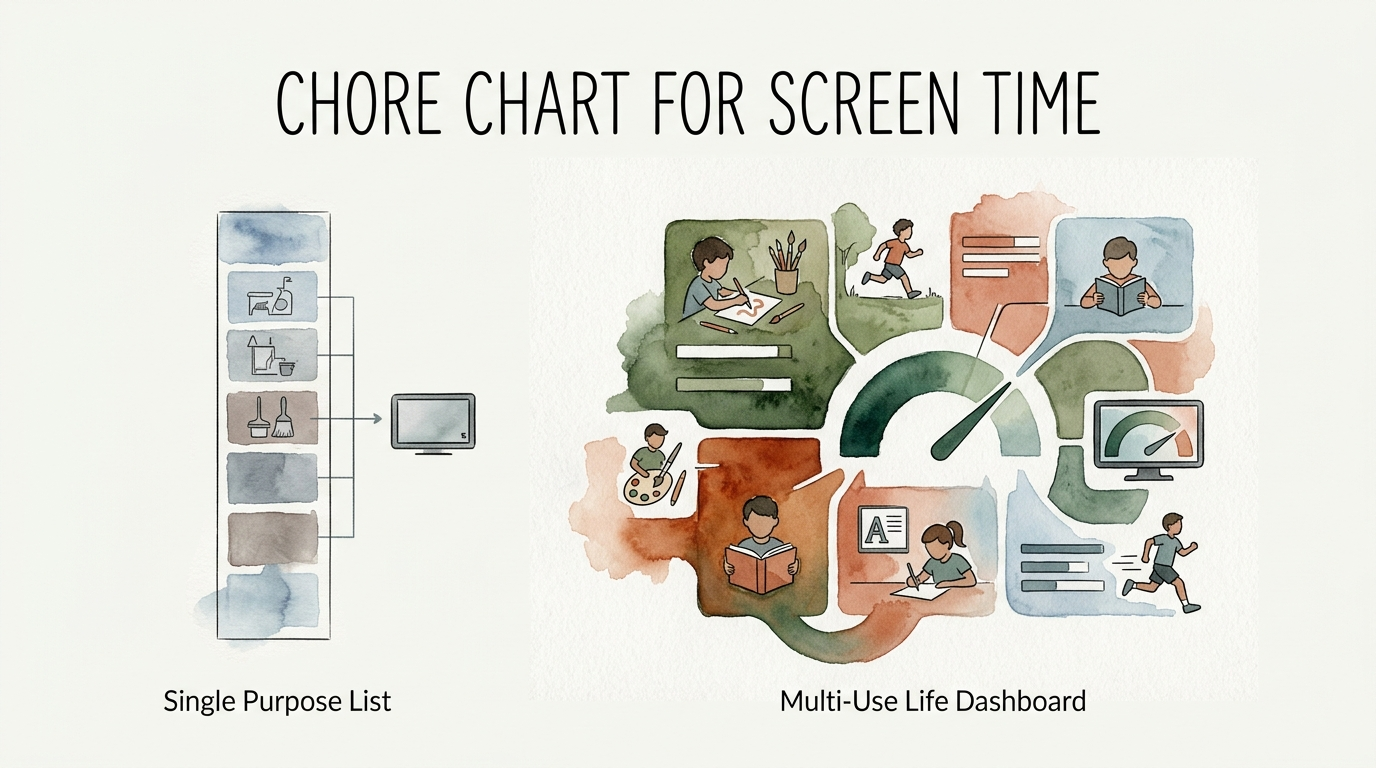
Single Purpose List vs. Multi-Use Life Dashboard
A single-purpose list is a reactive tool. It tells a child what they did wrong or what they still need to do. It often feels like a “honey-do” list that only grows longer. This creates a psychological weight that can lead to avoidance and resistance.
The Multi-Use Life Dashboard is a proactive roadmap. It integrates chores with the things they *want* to do, like screen time or outings. It provides context for their day, showing how their responsibilities fit between soccer practice and their favorite YouTube show.
| Feature | Single Purpose List | Multi-Use Dashboard |
|---|---|---|
| Primary Focus | Task completion only | Total daily management |
| Motivation | Avoiding punishment | Earning privileges |
| Visibility | Often hidden or ignored | Central, high-traffic hub |
| Long-Term Skill | Obedience | Executive function & Agency |
| Flexibility | Static and rigid | Dynamic & adaptable |
Practical Tips and Best Practices
Rotate chores weekly to prevent boredom. If one child is always responsible for the trash, they will eventually resent the task. Using a “chore wheel” or a randomized assignment on your dashboard keeps things fresh and ensures everyone learns every life skill.
Incorporate “Bonus Quests” for extra screen time. These are deep-cleaning tasks that aren’t part of the daily routine, like cleaning out the car or organizing the pantry. It gives kids an opportunity to “grind” for extra rewards when they have a big gaming session planned.
Establish “Screen-Free Zones and Times.” No matter how many points they have earned, screens shouldn’t be allowed at the dinner table or in bedrooms after 8 PM. These boundaries protect sleep and family connection, regardless of the chore economy.
Use “Photo Proof” for digital systems. Many apps allow kids to snap a picture of the finished chore. This adds a layer of accountability and lets you “approve” the work from anywhere, preventing the “I’ll do it later” excuse.
Implement a “Grace Period” for transition. When the timer for screen time goes off, give them a two-minute warning. Abruptly shutting off a game can trigger a “fight or flight” response. A predictable exit strategy makes the system feel fair rather than punitive.
Advanced Considerations for Serious Practitioners
Consider “Dynamic Pricing” for chores based on difficulty or urgency. If the house is a mess because guests are coming over, you can offer double points for a “speed clean.” This teaches children about supply, demand, and prioritizing high-value opportunities.
Integrate habit-tracking for long-term goals. While chores are “one-and-done” tasks, habits like “practicing piano for 20 minutes” are ongoing. A advanced dashboard can track “streaks,” where completing a task five days in a row earns a significant bonus reward.
Scale the system for teenagers by tying the dashboard to their allowance or gas money. For older kids, screen time is often less of a motivator than cold hard cash or social freedom. The transition from “earning minutes” to “earning responsibility levels” mirrors their growing independence.
Explore AI-powered management tools. Some modern platforms can suggest age-appropriate chores based on your family’s routine or even track “kindness points” when kids help each other without being asked. This moves the dashboard from a task-manager to a character-builder.
Examples and Scenarios
The “Token Jar” is a classic physical example. Each completed chore earns a physical token (like a marble or a poker chip). Each token is worth 10 minutes of screen time. The child physically “pays” the jar when they start their device. This makes the exchange of value incredibly concrete.
The “Bingo Challenge” is perfect for weekends or summer breaks. Create a 5×5 grid of chores, reading goals, and outdoor activities. Completing a line earns a small reward, while “blacking out” the whole card earns an afternoon of unlimited gaming or a special trip. This turns a boring Saturday into a quest.
The “Digital Command Center” setup often involves a wall-mounted tablet running a shared calendar like Cozyla or a Notion template. In this scenario, the dashboard syncs with the parents’ phones. When a child completes their homework and checks it off on the wall, the parent receives a notification to unlock the gaming console remotely.
The “Menu System” offers variety. Instead of a fixed price, create a “menu” of rewards. 50 points could buy 30 minutes of iPad, a $5 Robux card, or a “Get Out of Chores Free” card for one day. Giving kids the power to choose how they spend their earnings increases their buy-in and financial literacy.
Final Thoughts
Integrating a chore chart for screen time into a broader family dashboard is more than a way to get a clean house. It is a comprehensive strategy for raising responsible, tech-literate humans. By shifting from a culture of nagging to a system of agency, you empower your children to manage their own time and energy.
Success doesn’t require a perfect, high-tech setup on day one. Start simple. Find a central spot in your home, define your currency, and be consistent. As your family grows comfortable with the system, you can add layers of complexity, from habit tracking to AI integrations.
The goal is a harmonious home where screens are a joyful reward rather than a source of conflict. When children understand that work leads to play, they carry that lesson far beyond the living room. Start your dashboard today and watch how one chart can truly rule the day.
Sources
1 mommyonpurpose.com | 2 choreio.app | 3 pointwisesystem.com | 4 mobicip.com | 5 apolosign.com | 6 cornell.edu | 7 nih.gov | 8 additudemag.com | 9 embolden.world | 10 msu.edu | 11 gamifychores.com | 12 ccrcca.org | 13 mayoclinic.org | 14 everblog.com | 15 medium.com | 16 reddit.com | 17 mychoreboard.com | 18 365daysofnoscreens.com | 19 aacap.org | 20 harvard.edu | 21 moneyprodigy.com