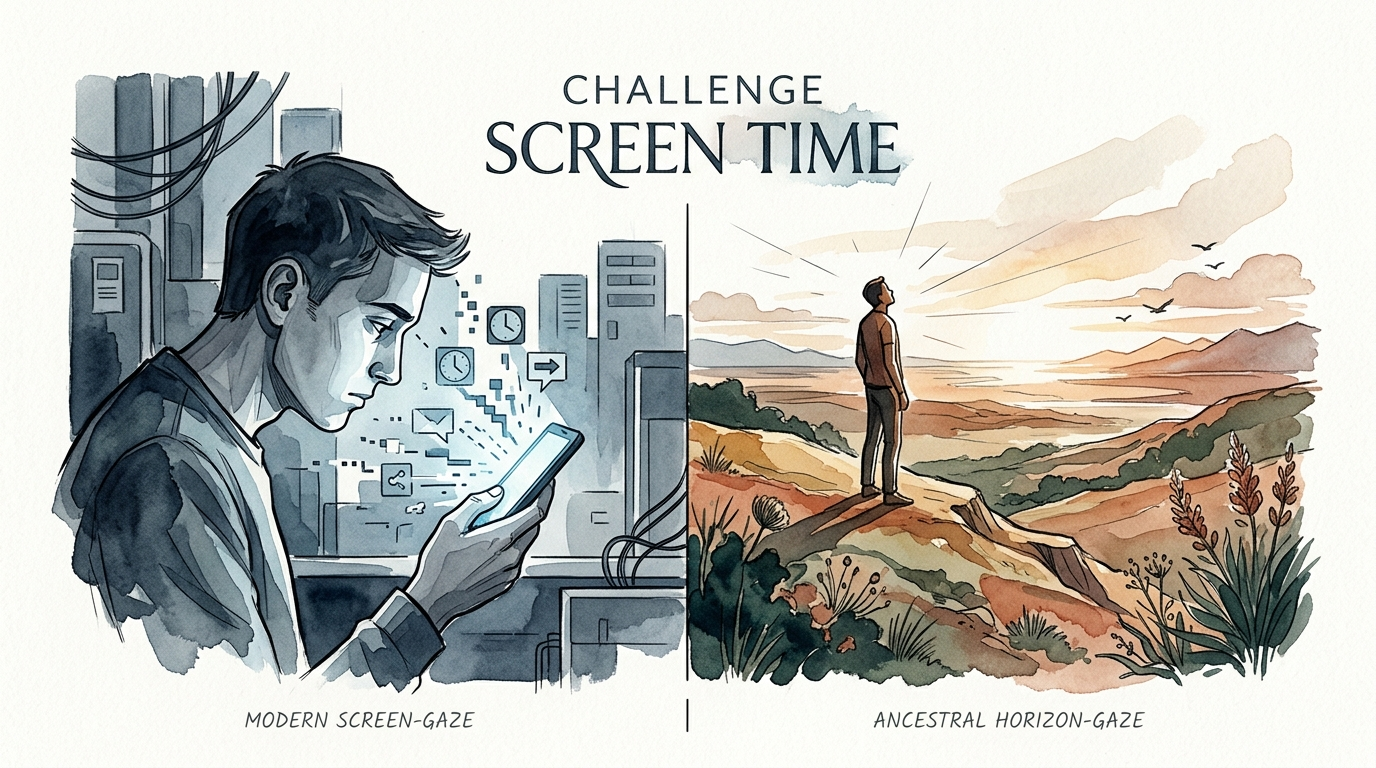
challenge screen time
Your eyes were designed for horizons, not 6-inch displays. For thousands of years, humans looked at the stars and the horizon. Now we look at pixels. Challenge your screen time and remember what it’s like to be human.
challenge screen time
Challenge screen time is a call to action against the digital gravity that pulls our focus toward glowing rectangles. It is an intentional effort to reclaim the biological heritage of our vision and mental focus. In the modern world, the average person spends roughly 6 hours and 40 minutes per day staring at a screen. This equates to nearly 40% of our waking lives. For many, this number climbs even higher, especially for those in remote work environments or digital-first industries.
Screens exist everywhere. They are in our pockets, on our desks, and mounted on our walls. While these devices provide incredible utility, they also impose a physical and psychological tax. Evolution did not prepare us for the “Modern Screen-Gaze.” Our ancestors spent their days scanning wide vistas for food, predators, and safe passage. This behavior developed our peripheral vision and linked it directly to our internal state of calm.
Today, we live in a state of “focal vision.” This is a narrow, tunnel-like focus required to read text or watch videos on a small display. Constant focal vision triggers the sympathetic nervous system. It sends subtle signals to the brain that we are in a high-alert or “hunting” mode. When this state persists for 8 to 12 hours a day, it results in chronic stress, eye fatigue, and a sense of being “wired but tired.”
The concept of challenging screen time is not about becoming a Luddite. It is about balance. It is about understanding that your eyes are part of your brain. How you use your eyes determines how your brain feels. Moving from the “Modern Screen-Gaze” back toward the “Ancestral Horizon-Gaze” is one of the fastest ways to reset your nervous system. It is a biological hack for the digital age.
How the “Dopamine Slot Machine” Works
Digital platforms are engineered to hold your attention using principles of behavioral psychology. Designers use “variable reward schedules” to keep you scrolling. This is the same mechanism used in slot machines. You swipe down to refresh a feed because you do not know what is coming next. The anticipation of a reward—a like, a funny video, or a breaking news story—triggers a release of dopamine in the brain.
Dopamine is the neurotransmitter of “more.” It is not about pleasure; it is about seeking. This “Dopamine Loop” is why you find yourself scrolling for an hour when you only meant to check a single notification. The “infinite scroll” design choice removes any natural stopping points. In physical life, a book has a page turn, and a magazine has a back cover. Digital feeds have no end, which prevents the brain from receiving a “completion cue.”
The visual system plays a crucial role in this addiction. Because screens are close and bright, they command our “focal vision.” This intense focus makes it harder for the brain to disengage. Your eyes lock onto the high-contrast light, and your internal clock begins to drift. This is especially true at night when the blue light from screens suppresses melatonin production, convincing your brain that the sun is still up.
The Physiology of Near-Work
Focusing on a screen just 12 inches from your face requires the ciliary muscles in your eyes to contract. These muscles stay contracted as long as you are looking at the screen. Think of it like holding a bicep curl for eight hours straight. Eventually, the muscle fatigues. This fatigue manifests as “Digital Eye Strain” or Computer Vision Syndrome (CVS). Symptoms include blurred vision, dry eyes, and headaches.
Blink rates also plummet during screen use. Normally, humans blink about 15 to 20 times per minute. When staring at a screen, this rate drops by up to 50% or 60%. Blinking is what lubricates the eye. Without it, the surface of the eye dries out, leading to irritation and redness. This physical discomfort feeds back into your mental state, making you feel irritable and exhausted by the end of the workday.
Benefits of Reducing Your Digital Footprint
Reducing screen time offers immediate improvements to your physical health. When you stop staring at near objects, the ciliary muscles in your eyes finally relax. This can reduce the frequency of “tension headaches” that many office workers accept as normal. Giving your eyes frequent breaks also allows your blink rate to return to a natural rhythm, which restores the protective moisture layer on your eyeballs.
Mental clarity is the most significant psychological benefit. When you step away from the “Dopamine Loop,” your brain has the chance to enter “Default Mode.” This is a state of mind where creativity and problem-solving happen. Constant digital stimulation prevents this mode from activating. By challenging your screen time, you create space for original thoughts and deeper insights that cannot occur during a mindless scroll.
Sleep quality improves dramatically when you limit screen use before bed. Removing the source of artificial blue light allows your pineal gland to release melatonin naturally. This makes it easier to fall asleep and helps you reach the deeper, more restorative stages of REM sleep. Better sleep translates to better emotional regulation, higher energy levels, and improved cognitive function the following day.
Social connections also become more meaningful. “Phubbing”—the act of snubbing someone in favor of your phone—is a major driver of relationship dissatisfaction. Putting the phone away signals to others that they are your priority. This builds trust and fosters deeper empathy. You begin to notice the subtle non-verbal cues that are invisible when you are looking at a display.
Challenges and Common Mistakes
The biggest challenge in reducing screen time is the “Withdrawal Effect.” Because digital devices hijack the dopamine system, you may feel bored, anxious, or irritable when you first try to cut back. This is your brain recalibrating to lower levels of stimulation. Many people make the mistake of trying to quit “cold turkey.” This often leads to a quick relapse followed by even more intensive usage.
Another common pitfall is the “Replacement Trap.” You might decide to spend less time on social media, but you end up spending that extra time on a different digital distraction, like mobile gaming or streaming videos. To be successful, you must replace digital habits with physical ones. If you do not have an analog alternative ready, your hand will naturally reach for the phone out of muscle memory.
Setting unrealistic goals is a frequent error. If your job requires eight hours of computer work, you cannot simply stop using screens. The goal should be to manage “discretionary” screen time—the hours spent scrolling on the couch or in bed. Mistaking “work screen time” for “leisure screen time” can lead to frustration and a sense of failure.
Failure to change your environment is a massive hurdle. Humans are highly sensitive to “cues.” If your phone is always sitting on your desk or next to your bed, you will use it. Willpower is a finite resource. It is much more effective to remove the temptation by placing the phone in a different room or using a “phone locker” to create physical barriers between you and the screen.
Limitations: When High Screen Time is Unavoidable
Total avoidance of screens is impossible for most people in the 21st century. Remote workers, software developers, and researchers must interact with displays to perform their duties. In these cases, the focus should shift from “reduction” to “mitigation.” You cannot always control how much you use a screen, but you can control how you use it and what you do during your breaks.
Environmental factors also play a role. Those living in urban environments with little access to natural light or green spaces may find it harder to practice “Horizon-Gaze.” If you are surrounded by concrete walls, your eyes are perpetually trapped in a near-work environment even when you are outdoors. In these situations, looking up at the sky or using high-quality artificial lighting that mimics the sun can help.
Physical disabilities or chronic pain may also make digital devices a primary source of connection and entertainment. For individuals with limited mobility, screens are a bridge to the outside world. In these contexts, the “Challenge Screen Time” movement should be adapted to focus on ergonomics and eye health rather than strict time limits. The priority is to maintain a high quality of life while minimizing the physiological strain.
Ancestral Horizon-Gaze vs. Modern Screen-Gaze
Understanding the difference between these two states of vision is essential for reclaiming your focus. One state is programmed for survival and calm, while the other is programmed for task-completion and stress. The following table highlights the key differences between our biological design and our modern reality.
| Factor | Ancestral Horizon-Gaze | Modern Screen-Gaze |
|---|---|---|
| Focal Distance | Infinite / Long Distance | Near (12-24 inches) |
| Visual Field | Panoramic / Peripheral | Tunnel / Focal |
| Eye Muscle State | Relaxed Ciliary Muscles | Contracted Ciliary Muscles |
| Blink Rate | High (15-20 per min) | Low (5-10 per min) |
| Nervous System | Parasympathetic (Calm) | Sympathetic (Alert) |
| Neural Reward | Sustained Engagement | Dopamine Spikes (Variable) |
Practical Tips for Digital Wellness
Implementing a “Digital Wellness” strategy starts with small, repeatable actions. The 20-20-20 rule is the industry standard for reducing eye strain. Every 20 minutes, look at something at least 20 feet away for at least 20 seconds. This simple act forces your ciliary muscles to relax and encourages you to blink. It is a biological reset button for your vision.
Grayscale mode is a powerful psychological tool. Most app icons and notification bubbles are designed in bright reds and oranges to catch your eye. Turning your phone to grayscale removes the visual “sugar” that makes the device so addictive. You will find that social media is much less interesting when it looks like a 1950s newspaper. This reduces the urge to mindlessly scroll.
Establish “No-Phone Zones” in your home. The bedroom should be the first priority. Using a physical alarm clock instead of your phone prevents the “first thing in the morning” scroll. When you wake up and immediately check your email or news, you are allowing the world to dictate your mental state. Starting your day with 30 minutes of screen-free time gives you the chance to set your own intentions.
- Use “App Timers” to set hard limits on social media and news apps.
- Keep your screen at eye level to prevent “Tech Neck” and cervical spine strain.
- Walk without headphones to engage your auditory and visual peripheral senses.
- Optimize your lighting by using warm-toned lamps in the evening and bright natural light in the morning.
Advanced Considerations for Practitioners
Serious practitioners of digital wellness look beyond simple time limits. They optimize the “quality” of the light they consume. High-flicker screens and low-quality LED bulbs can cause “sub-perceptual” stress. This means your brain is processing the rapid flickering of the light even if you cannot see it. Investing in flicker-free monitors and high-CRI (Color Rendering Index) lighting can significantly reduce fatigue.
Dopamine Fasting is another advanced technique. This involves dedicated periods—ranging from a few hours to a full weekend—where you avoid all highly stimulating digital activities. The goal is to “upregulate” your dopamine receptors. When you stop the constant influx of high-intensity digital rewards, your brain becomes more sensitive to simple, natural pleasures like reading a book, going for a walk, or having a conversation.
Consider the impact of “Cognitive Switching Penality.” Every time you check a notification while working, it takes your brain an average of 23 minutes to return to deep focus. Advanced practitioners use “Batching” to manage their digital lives. They check emails and messages only at specific times of the day. This protects their “Deep Work” hours and prevents the mental fragmentation that comes from constant task-switching.
Example Scenario: The Remote Worker’s Reset
Imagine a software developer named Sarah. Sarah spends 10 hours a day in front of three high-resolution monitors. By 3 PM, she often has a “brain fog” that makes it hard to write complex code. She experiences dry eyes and frequently rubs her temples to ease a recurring headache. This is a classic case of Modern Screen-Gaze exhaustion.
Sarah decides to challenge her screen time with a “Horizon Protocol.” Every hour, she sets a timer to stand up and look out her window at a distant tree line for two minutes. She also changes her phone settings to grayscale and leaves it in a drawer during work hours. During her lunch break, she goes for a walk without her phone, purposefully scanning the sky and the street rather than looking at her feet.
Within one week, Sarah noticed a significant change. Her headaches vanished. Her “brain fog” lifted because she was no longer constantly interrupted by notifications. Most importantly, she found that her “Deep Work” sessions lasted longer and were more productive. By reclaiming her “Ancestral Horizon-Gaze” during her breaks, she improved her performance during her “Modern Screen-Gaze” tasks. She worked less but achieved more.
Final Thoughts
The transition from horizons to pixels is one of the most radical changes in human history. We are the first generation to live with our eyes locked onto glowing boxes for the majority of our lives. While technology offers us the world, it often costs us our presence. Challenging your screen time is not about rejecting progress; it is about protecting your biological integrity.
Your nervous system thrives on the wide and the far. When you look at the horizon, you are telling your brain that you are safe. When you look at a screen, you are telling your brain that you are working. Balancing these two states is the key to longevity, focus, and mental health in a digital world. Start by looking up. The stars and the horizon are still there, waiting for you to remember them.
Experiment with these strategies today. Turn off a notification. Look out a window. Leave your phone behind for a ten-minute walk. You might be surprised at how much of your humanity you find in the spaces between the pixels. Deepening your understanding of these systems will give you the ultimate competitive advantage: a focused mind in a distracted world.
Sources
1 blankspaces.app | 2 upandupaba.com | 3 glosso.fr | 4 awisee.com | 5 doralhw.org | 6 medium.com | 7 rowancenterla.com | 8 northfultoneyecenter.com | 9 amazonaws.com | 10 proeye.com | 11 carmelmountainvisioncare.com | 12 berkeley.edu | 13 psychologytoday.com | 14 workingoncalm.com | 15 unimelb.edu.au | 16 allaboutvision.com