How To Bond With Kids Without Screens
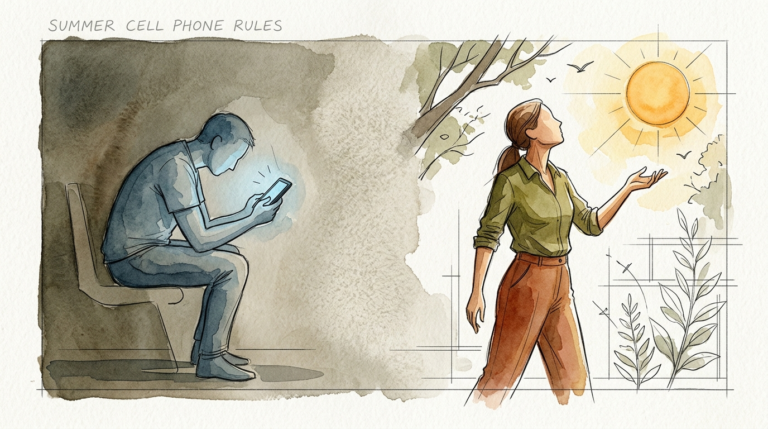
We are often more connected to the Wi-Fi than we are to the people sitting right next to us. The tablet doesn’t just isolate the child; it creates invisible walls throughout the entire home. The 7-day reset is the hammer that breaks those walls down.

If you have ever looked across the dinner table and seen three different screens instead of three different faces, you know the feeling. It is a quiet kind of distance. It is the sound of notifications replacing the sound of laughter.

This guide is for the parent who is tired of competing with an algorithm for their child’s attention. We are going to walk through exactly how to reclaim your home. This isn’t about being “anti-tech.” It is about being “pro-connection.”
How To Bond With Kids Without Screens
Bonding without screens is the intentional act of engaging in shared, face-to-face activities that require mutual attention and emotional presence. In the modern world, we have outsourced “entertainment” to devices, but we have accidentally outsourced “connection” along with it.
Real bonding happens in the gaps. It happens when there is no “next video” to auto-play. It exists in the messy, loud, and sometimes boring moments of real life. This is where children learn empathy, social cues, and emotional regulation.
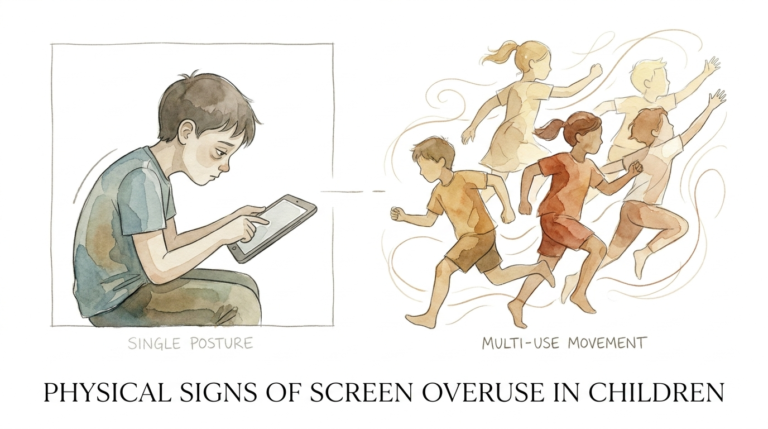
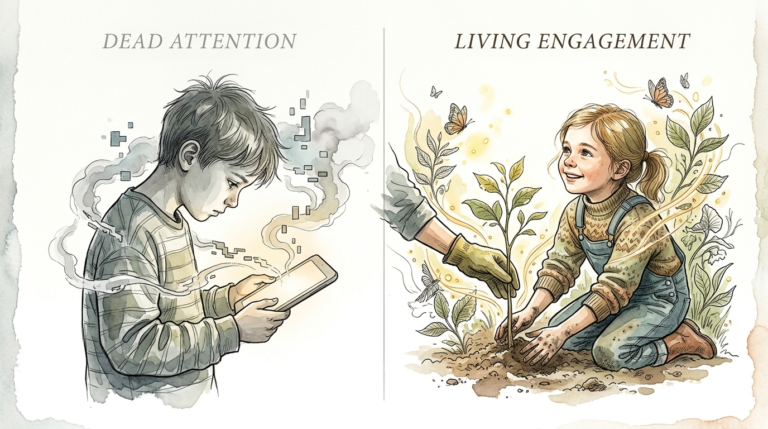
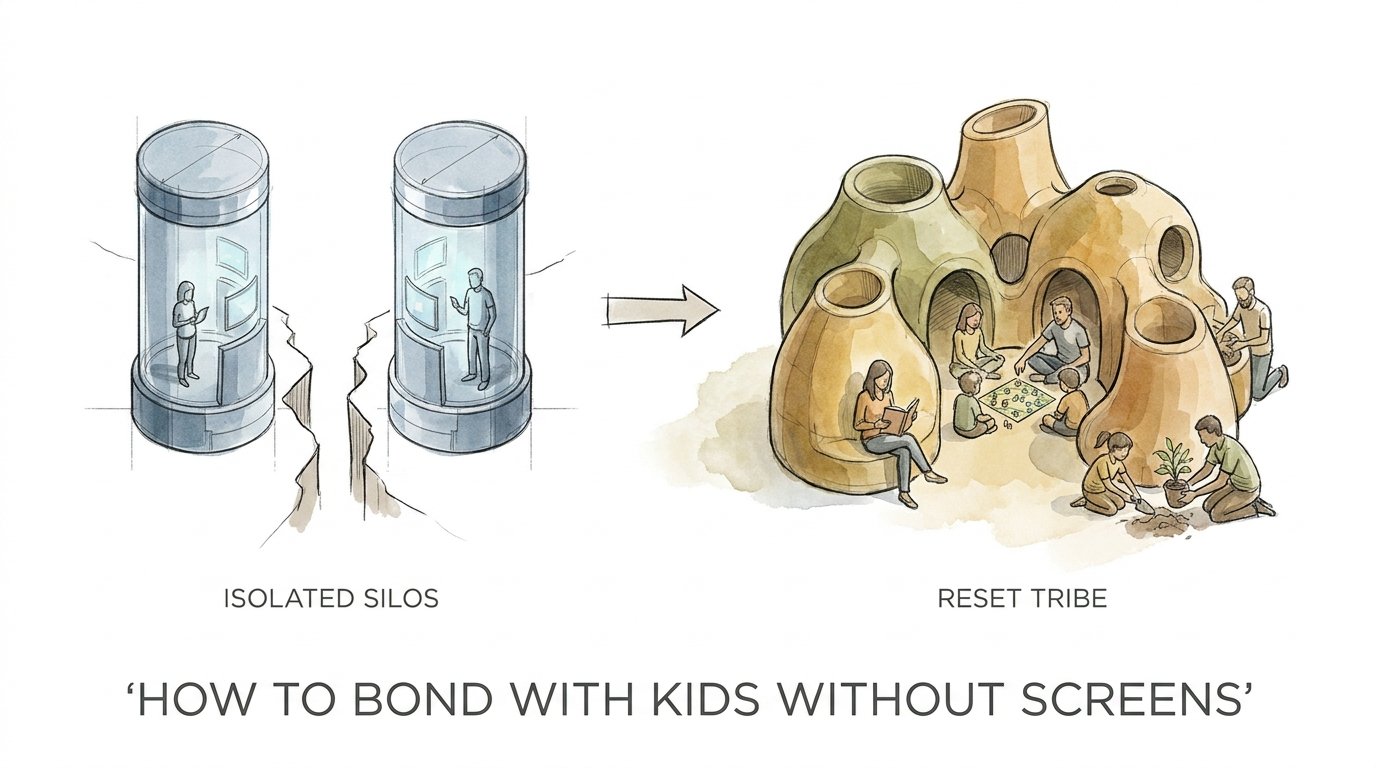
When a child is on a screen, they are in a state of consumption. When they are bonding with you, they are in a state of contribution. They are contributing to a conversation, a game, or a shared memory. This shift is what turns a house full of ISOLATED SILOS into a RESET TRIBE.
Think of it like a muscle. If your family hasn’t exercised the “boredom muscle” or the “conversation muscle” in a while, it might feel weak. That is okay. The reset is the training program that gets everyone back in shape.
How the 7-Day Reset Works
The 7-Day Reset is a structured process designed to break the dopamine loops created by digital devices. It isn’t just a “break” from tech; it is a full recalibration of your family’s nervous system.
Day 1: The Awareness Audit
The first step is seeing the invisible walls. Spend Day 1 simply observing. How many times does someone reach for a phone during a meal? How often do kids ask for the iPad when they feel 30 seconds of boredom?
Talk to your kids. Explain that the family is going on an adventure for a week. Frame it as a “brain holiday” rather than a punishment. If they feel involved in the “why,” they are less likely to fight the “how.”
Day 2: Clearing the Gateway Drugs
Identify the “gateway” devices. These are the screens that people reach for out of pure habit. The phone in the pocket, the tablet on the coffee table, the TV that stays on as background noise.
Collect these items. Place them in a central “parking station” or a designated basket. For the next six days, these stay parked. Use physical alarm clocks instead of phones to prevent the “first-thing-in-the-morning” scroll.
Day 3: Embracing the Boredom
This is usually the hardest day. When the dopamine from the screens stops, irritability often kicks in. This is a sign that the brain is resetting. Do not cave.
Boredom is the gateway to creativity. When a child has nothing to do, they are forced to look inward. They will eventually find a toy they haven’t touched in months or start a project you didn’t see coming.
Day 4: Designating Tech-Free Zones
Establish permanent borders. The kitchen table, the car, and the bedrooms should be “No-Fly Zones” for screens. This creates physical spaces where connection is the only option.
Use this day to introduce a “Kitchen Table Project.” This could be a 1,000-piece puzzle or a massive Lego build that stays out all week. It gives everyone a reason to gather in a tech-free zone without feeling forced.
Day 5: The Skill-Share Shift
Instead of watching someone else do something on YouTube, do it yourselves. Ask each family member to teach the others one thing.
Maybe your son knows how to make a paper airplane that actually flies. Maybe your daughter can teach everyone a dance routine. This flips the script from “consuming content” to “creating value.”
Day 6: Community and Service
Take the connection outside the home. Go for a long nature walk, visit a local park, or volunteer for an afternoon. Connecting with the wider world reminds kids that life is bigger than the digital bubble.
Focus on “shared attention” activities. Birdwatching, geocaching, or picking up litter at a local trail requires everyone to look at the same thing at the same time. This builds a sense of “we” instead of “me.”
Day 7: The Full Fast and Future Planning
The final day is a 24-hour total fast. No exceptions. No “quick checks.” Spend the evening talking about what felt good during the week.
Ask the kids: “What did you do this week that you actually enjoyed?” You might be surprised to hear that they liked the board game marathon more than the Minecraft marathon. Use this feedback to build your “Family Media Plan” for the future.
Benefits of the Reset Tribe Approach
The rewards of breaking down those invisible walls are immediate and measurable. You aren’t just saving time; you are saving relationships.
- Restored Circadian Rhythms: Blue light from screens inhibits melatonin production. Without screens an hour before bed, children (and parents) fall asleep faster and reach deeper sleep cycles.
- Improved Emotional Regulation: Continuous digital stimulation keeps the brain in a high-arousal state. Removing the “constant hit” of dopamine helps kids learn to manage their emotions without a digital pacifier.
- Enhanced Social Intelligence: Eye contact is the foundation of empathy. Without screens in the way, children learn to read facial expressions and vocal tones, which are essential for long-term social success.
- Increased Creativity: When screens are the primary source of play, the “imagination muscle” atrophies. A reset forces the brain to invent its own fun, leading to more original thinking.
Choosing this approach over “passive parenting” (using screens as a babysitter) builds a culture of trust. Your children begin to see you as the primary source of engagement and wisdom, rather than an obstacle to their device.
Challenges and Common Mistakes
The path to a screen-free bond is rarely smooth. You will face resistance, but knowing why it happens makes it easier to handle.
The “Digital Withdrawal” Tantrum: Understand that for many kids, the loss of screen time feels like a physical loss. Their brains are used to high levels of stimulation. When that is gone, they may become irritable, anxious, or even aggressive. Do not take this personally. It is a biological reaction, not a character flaw.
Parental Hypocrisy: This is the most common pitfall. You cannot tell your child to put down the tablet while you are scrolling through your emails. You must be the leader of the tribe. If you aren’t willing to do the reset, they won’t be either.
The “Entertainment” Trap: Many parents feel they have to become a 24/7 cruise ship director during the reset. This is a mistake. Your job isn’t to entertain them; it is to be present with them. If they are bored, let them be bored. That is where the magic happens.
Limitations and Practical Boundaries
While a 7-day reset is powerful, we live in a digital world. There are realistic constraints that you must manage to ensure the reset doesn’t fall apart.
First, consider educational requirements. Many schools require digital logins for homework. During the reset, treat schoolwork like “utility” tech—do what is necessary and then park the device immediately. Avoid “recreational” tech during this time.
Second, think about work-life integration. If you are a parent who must be “on-call,” explain this to the family. Set a specific “Work Zone” and “Work Time.” When you are out of that zone, the phone goes away. Total transparency prevents kids from feeling like there is a double standard.
Finally, realize that one size does not fit all. For neurodivergent children (such as those with ADHD or Autism), screens can sometimes serve as a vital tool for self-regulation or sensory management. In these cases, a “reset” might look more like a “curation”—removing high-dopamine apps while keeping calming or educational tools.
ISOLATED SILOS vs. RESET TRIBE
How do you know which state your family is currently in? Use the table below to evaluate the current “temperature” of your home connection.
| Feature | ISOLATED SILOS | RESET TRIBE |
|---|---|---|
| Communication | Transactional (What’s for dinner? Where is my charger?) | Relational (How did you feel about today? Tell me a story.) |
| Physical Space | Everyone in separate rooms with separate devices. | Gathered in shared spaces with shared activities. |
| Mealtime | Silent scrolling or background TV. | Active conversation and eye contact. |
| Conflict | Avoided by retreating into a screen. | Addressed through face-to-face interaction. |
| Energy Levels | High-stimulation/Low-engagement (The “Zombified” look). | Natural stimulation/High-engagement. |
Practical Tips for Immediate Application
You don’t have to wait for a Monday to start making changes. Here are actionable steps you can take today to improve bonding.
- The “Boredom Box”: Fill a box with open-ended items—magnifying glasses, old magazines for collages, decks of cards, and clay. When a child says “I’m bored,” point to the box. Do not offer suggestions; let them explore.
- The “Car Rule”: Make all car rides under 30 minutes screen-free. Use this time for “High-Low-Buffalo”—everyone shares their high point of the day, their low point, and something “buffalo” (something weird or unexpected).
- The “Go-Bag”: Keep a bag by the door with a frisbee, a ball, and a picnic blanket. When the energy in the house gets tense, grab the bag and head to the nearest patch of grass.
- Analog Hobbies: Reintroduce physical books, board games, and puzzles. There is something tactile and grounding about physical objects that screens cannot replicate.
Advanced Considerations for the Long Term
Once the 7-day reset is over, the goal isn’t to live in the 1800s. It is to build a sustainable Digital Citizenship.
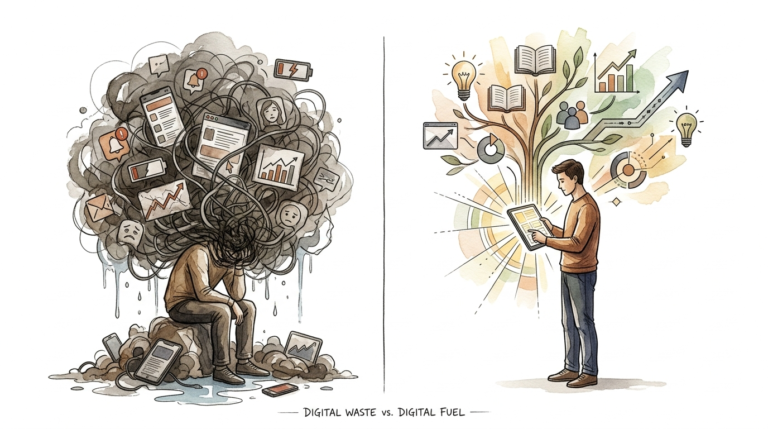
Consider a “tiered” access system. Instead of “Screen Time,” think in terms of “Digital Nutrition.” Just as we have “junk food” (social media scrolling) and “protein” (learning a new language or coding), we should categorize tech use.
Establish a Family Media Agreement. This is a written document that everyone signs. It defines when screens are okay and when they are not. Having a pre-set rule prevents the daily “Can I have my iPad?” power struggle.
Scaling this means looking at your own social circles. Encourage your friends and your children’s friends’ parents to adopt similar rules. It is much easier for a teenager to stay off Instagram if their three best friends are also on a “social media Sunday” break.
Example Scenario: The Sunday Night Shift
Imagine a typical Sunday night. Usually, Dad is watching the game, Mom is on Pinterest, and the kids are in their rooms on YouTube or gaming. This is the ISOLATED SILO.
Now, apply the RESET TRIBE model. The TV stays off. Dad pulls out an old deck of cards. He starts a game of “Spit” or “Rummy.” At first, the kids groan. They say it’s boring.
Dad stays consistent. He doesn’t lecture; he just plays. Within 15 minutes, the curiosity takes over. One child sits down. Then the other. Suddenly, there is laughter. There is a “rematch.” There is a shared story about how Grandpa used to cheat at this exact game.
The “invisible walls” have been hammered down. No one is looking at a clock. They are looking at each other. This is the power of the reset in action.
Final Thoughts
The 7-day reset is not a one-time event; it is a lifestyle adjustment. It is about realizing that your child’s childhood is happening right now, in the physical world, not behind a piece of glass.
By choosing to be present, you are giving your children the greatest gift they will ever receive: your undivided attention. You are teaching them that they are more interesting than an app and more valuable than a “like.”
Experiment with these steps. Be patient with the tantrums and the boredom. The silence that follows the screen-shutting is not a void; it is the space where your family’s new story begins to be written. Break the walls down and build your tribe.
Sources
1 familyitguy.com | 2 evolvewellness.love | 3 thechildunplugged.com | 4 screenfree.org | 5 childrenandscreens.org | 6 lawfirm.com | 7 haven-psychology.com | 8 bestchoicecounselling.com | 9 sodexo.com | 10 workspaceforchildren.com | 11 nih.gov | 12 springfreetrampoline.com | 13 betterscreentime.com | 14 substack.com | 15 replit.app | 16 psychologytoday.com | 17 smhvenice.com | 18 well-concepts.com | 19 childrenshospital.org | 20 exonpublications.com | 21 gamequitters.com