Signs Of Screen Addiction In Kids
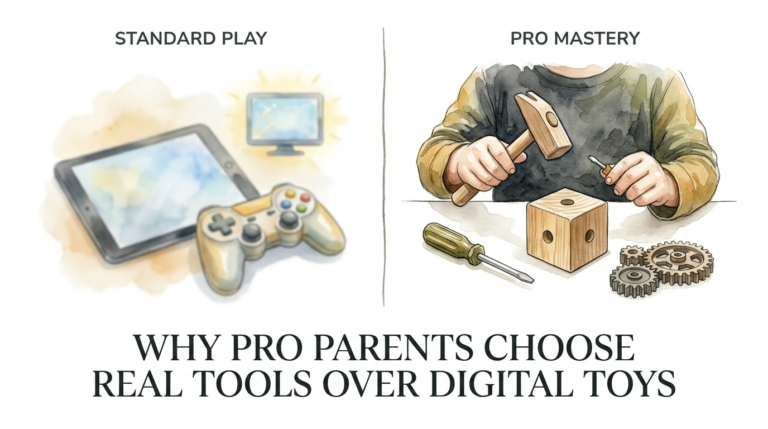
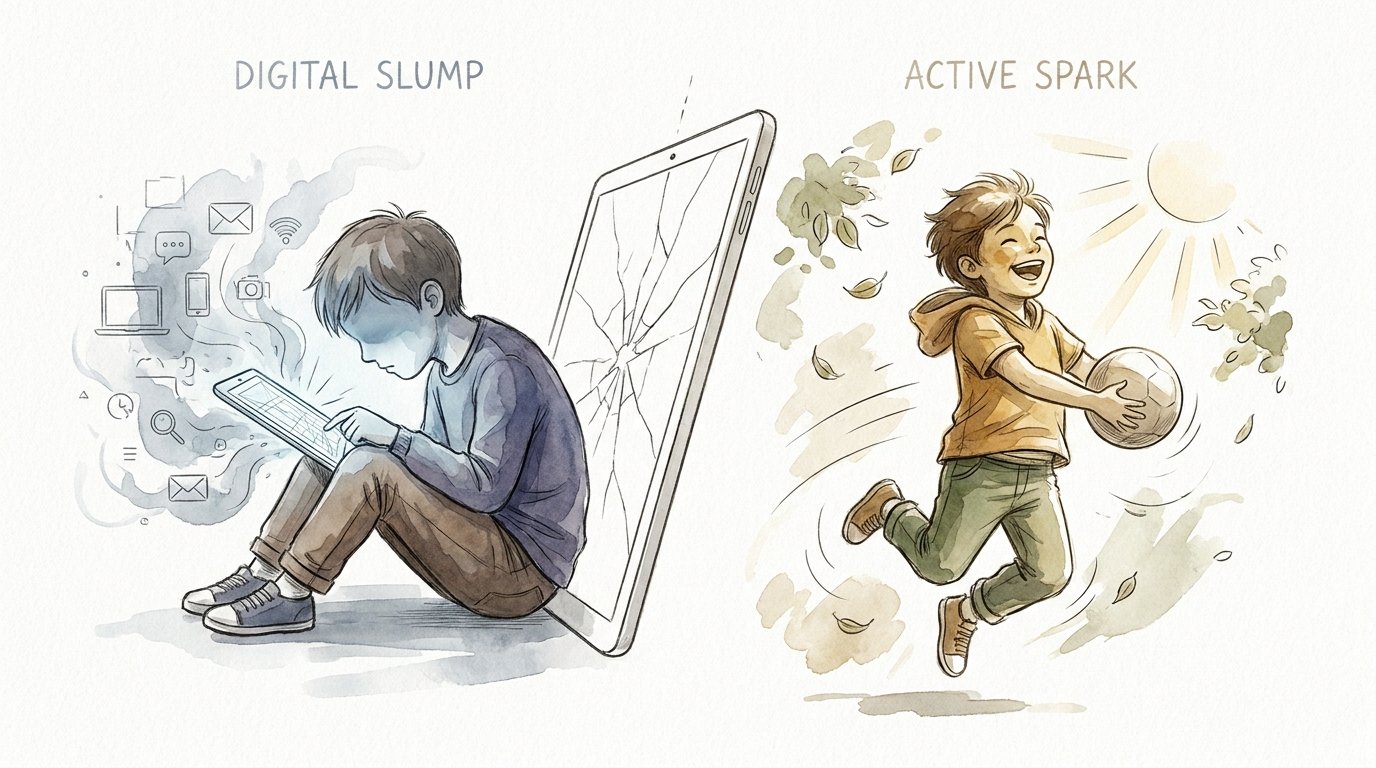
One is a passive consumer of light; the other is an active creator of meaning. After 7 days without the screen, the ‘iPad glaze’ disappears. You aren’t just removing a device; you are witnessing the literal rebirth of your child’s curiosity.

Screens have become the modern-day pacifier. They are in our pockets, on our walls, and increasingly, in the hands of toddlers before they can even speak full sentences. This isn’t just about a “distraction” anymore. It is about how a child’s brain develops its core sense of engagement with the world.

We are currently navigating a massive, uncontrolled experiment. The results are showing up in our living rooms every single day. If you have ever noticed your child looking “hollow” after an hour of YouTube, or if they explode in a rage the moment the Wi-Fi drops, you have seen the early indicators. This guide is built to help you navigate the journey from the **DIGITAL SLUMP** back to the **ACTIVE SPARK**.
Signs Of Screen Addiction In Kids
Screen addiction isn’t just “watching too much TV.” It is a neurobiological dependency on high-frequency, low-effort stimulation. In clinical terms, we often look for behaviors that mirror substance abuse. When a child is addicted to a screen, their world begins to shrink until the only thing that provides “color” is the glowing rectangle.
The most visible sign is the ‘iPad glaze.’ This is the dazed, foggy look children get after prolonged scrolling. Their eyes become fixed. Their posture slumps. They become unresponsive to their name being called. This happens because the brain is being flooded with more information than it can effectively process, leading to a state of cognitive “overload” and emotional “numbing.”
Look for these specific behavioral markers in your household:
- Irritability upon removal: A normal child might be annoyed when playtime ends. An addicted child will experience a 30-minute “meltdown” or show genuine aggression when the device is taken away.
- Loss of interest in real-world hobbies: Toys that used to fascinate them—Legos, bikes, dolls—now sit gathering dust. They complain of being “bored” within seconds of being offline.
- Preoccupation: They talk about the game or the video even when they aren’t playing it. Their first question upon waking up or coming home is about the tablet.
- Sneaking and Deception: You find them under the covers with a phone at 2:00 AM, or they lie about how long they have been playing.
- Physical Withdrawal: Some children exhibit restlessness, headaches, or even “itching” sensations when deprived of their digital “hit.”
This exists because modern apps are designed by attention engineers. They use variable reward schedules—the same mechanism used in slot machines—to keep the brain’s dopamine levels spiked. In the real world, rewards take effort. On a screen, a reward is just one swipe away.
The Dopamine Loop: How It Works
To understand why your child is struggling, you have to understand the Dopamine Loop. Dopamine is the “motivation molecule.” It is designed to make us pursue things that help us survive—like food, social connection, and learning. Under normal conditions, a child gets a small dopamine hit for finishing a puzzle or climbing a tree.
Digital media hacks this system. Instead of one small hit for twenty minutes of effort, a tablet provides a massive surge of dopamine every few seconds. Every “like,” every new level, and every auto-playing video sends a fresh bolt of pleasure to the nucleus accumbens, the brain’s reward center.
Over time, the brain adapts. To protect itself from overstimulation, it reduces the number of dopamine receptors. This is called desensitization. Now, the child needs the screen just to feel “normal.” Without it, the world feels gray, boring, and frustrating. The prefrontal cortex—the part of the brain responsible for impulse control and “saying no” to cravings—is still developing in children, making them essentially defenseless against these engineered loops.
The 7-Day Protocol: How to Do a Screen Detox
If you want to see the “rebirth of curiosity,” you cannot just “limit” time. You need a full system reset. A 7-day detox allows the brain’s dopamine receptors to begin the process of up-regulation. It gives the child’s nervous system a chance to downshift from “high-alert” digital mode to “steady” real-world mode.
Step 1: The Pre-Detox Preparation
Don’t just snatch the tablet away on a Monday morning. That invites war. Hold a family meeting. Explain that the “screens are taking a nap” so that the family can “recharge our brains.” Frame it as a challenge rather than a punishment. Stock up on high-engagement alternatives: art supplies, new books, or outdoor gear.
Step 2: Days 1 to 3 (The Withdrawal Phase)
Expect resistance. This is when the irritability is highest. Your child is physically “coming down” from the digital stimulation. Your job is to be the anchor. Do not negotiate. Provide “heavy work” activities—physical tasks like gardening, building with wood, or long walks—to help regulate their nervous system.
Step 3: Days 4 to 5 (The Boredom Threshold)
This is the most critical stage. The initial anger has faded, but the “I’m bored” complaints will peak. **Do not solve their boredom.** Boredom is the precursor to creativity. When a child is bored and realizes a screen isn’t coming to save them, their brain is forced to look inward. This is when they pick up the old drawing pad or start a game of make-believe.
Step 4: Days 6 to 7 (The Rebirth)
By now, the “iPad glaze” has usually lifted. You will notice better eye contact, longer attention spans, and improved sleep quality. They are starting to find “meaning” in the physical world again. This is where the ACTIVE SPARK becomes visible.
Benefits of Unplugging
The results of a screen detox are often immediate and measurable. When you remove the constant noise of digital media, you create a vacuum that the child’s natural development rushes to fill.
One of the most profound benefits is improved sleep hygiene. The blue light from screens suppresses melatonin, the hormone that tells the body it’s time to sleep. Without screens in the hour before bed, children fall asleep faster and reach deeper stages of REM sleep. This directly translates to better mood regulation the following day.
Beyond biology, the social benefits are immense. Children who spend less time on screens are forced to practice social cognition. They learn to read non-verbal cues, navigate conflict without a “reset” button, and develop empathy through face-to-face interaction. Academically, the ability to focus on a “slow” task—like reading a book or solving a math problem—increases as the brain becomes re-sensitized to lower-frequency stimulation.
Challenges and Common Mistakes
The biggest pitfall is “The Vacuum Trap.” Parents often remove the screen but don’t fill the time with anything else. A bored child without a screen and without a parent’s engagement is a recipe for a relapse. You don’t have to be their entertainer 24/7, but you must provide the environment where they can entertain themselves.
Another mistake is Hypocrisy. If you tell your child to get off the iPad while you are scrolling through Instagram, the message is lost. Children model behavior far more than they follow verbal instructions. If you want a screen-free child, you must be a screen-conscious parent.
Finally, avoid the “Gradual Reduction” trap during a crisis. If a child is showing signs of genuine addiction, “cutting back by 15 minutes” is like trying to quit smoking by having one less cigarette a day. It keeps the craving alive. A clean break—even for just a week—is often the only way to break the cycle of dependency.
Limitations: When Screens are Not the Enemy
It is important to maintain a balanced perspective. Screens are tools. Technology is not inherently “evil”; it is the passive, high-frequency consumption that causes the damage. There are situations where digital use is not only acceptable but beneficial.
Educational platforms that require active participation—like coding, digital art, or supervised research—do not trigger the same “glaze” as passive scrolling. Similarly, video chatting with a distant grandparent provides social connection that a physical book cannot. The limitation here is context and content. High-quality, age-appropriate content, viewed alongside a caregiver (co-viewing), can actually mitigate many of the negative effects of screen time.
We must also recognize environmental constraints. A parent working two jobs or living in an area without safe outdoor spaces may rely on screens more than a stay-at-home parent with a backyard. In these cases, the goal isn’t “zero screens,” but rather “higher-quality screens” and “intentional breaks.”
DIGITAL SLUMP vs ACTIVE SPARK
To help visualize the difference between healthy and unhealthy engagement, consider the following comparison:
| Feature | DIGITAL SLUMP | ACTIVE SPARK |
|---|---|---|
| Mental State | Passive, “Zoned out,” Reactive | Creative, Engaged, Proactive |
| Dopamine Type | High-Frequency, Instant | Low-Frequency, Delayed |
| Social Impact | Isolation, “Solo” play | Connection, Eye Contact, Empathy |
| Physical Effect | Sedentary, Poor Posture | Movement, Fine Motor Skills |
| End Result | Irritability and Fatigue | Satisfaction and Growth |
Practical Tips for Long-Term Balance
Once you have completed a detox, the goal is not to live in 1950 forever. The goal is Sustainable Balance. You want your child to be “digitally literate” without being “digitally dependent.”
- Establish Tech-Free Zones: The dining table and the bedroom should be sacred ground. No devices, no exceptions. This ensures that meals remain social and sleep remains restorative.
- The 1-for-1 Rule: For every hour spent on a screen, the child must spend an hour in active play or reading. This teaches them that digital time is a “withdrawal” from their energy bank that must be “deposited” back with real-world activity.
- Curate, Don’t Just Limit: Move away from “infinite scroll” apps like TikTok or YouTube Kids. Switch to “closed-ended” content like movies or specific games that have a clear beginning and end.
- Use the 20-20-20 Rule: To prevent physical strain, teach your child that every 20 minutes, they must look at something 20 feet away for at least 20 seconds.
Advanced Considerations: Neuroplasticity
Serious practitioners of digital wellness understand that we are dealing with neuroplasticity. The child’s brain is literally “wiring” itself based on its environment. If a brain is wired for constant 3-second bursts of stimulation, it will physically struggle to engage with a 40-minute classroom lesson later in life.
This is why “executive function” is so heavily impacted by screen time. Executive function is the brain’s “CEO”—it handles planning, focus, and emotional control. Excessive screen time “outsources” this job to the device. The app tells the child what to look at and when to feel excited. By reclaiming screen-free time, you are forcing the child’s own prefrontal cortex to take back the reins. You are building their “attention muscle” through the practice of sustained, real-world focus.
Scenario: The Saturday Morning Shift
Imagine a typical Saturday. In the DIGITAL SLUMP scenario, the child wakes up, grabs the tablet, and spends three hours in a dark room. By 11:00 AM, they are irritable, they haven’t eaten breakfast, and they refuse to go outside because the sun “hurts their eyes.” The day is already a loss.
Now, imagine the ACTIVE SPARK scenario. The tablets are locked away. The child wakes up and, after a few minutes of complaining, finds a box of old buttons and some glue. They spend two hours building a “robot city” on the kitchen floor. They are talking to themselves, narrating a story, and using fine motor skills. When you suggest a trip to the park, they are ready to go because their brain isn’t already “fried” by dopamine exhaustion.
The difference isn’t just about what they are *doing*; it’s about who they are *becoming*. One child is waiting to be entertained; the other is entertaining themselves.
Final Thoughts
The “iPad glaze” is not a permanent condition, but it is a wake-up call. It is the sign of a brain that has been over-saturated and under-challenged. By implementing a structured 7-day detox and moving toward an ACTIVE SPARK lifestyle, you are giving your child the greatest gift possible: the ability to be present in their own life.
Transitioning away from heavy screen use is difficult, but the rewards are measurable in every smile, every creative drawing, and every peaceful bedtime. You aren’t just taking away a toy; you are restoring a childhood. Start small, stay consistent, and watch as your child’s natural curiosity returns to the surface.
Experiment with these protocols. Observe the changes in your home. You might find that as your child unplugs, you find yourself reconnecting with the things that truly matter as well. The digital world will always be there; your child’s formative years will not. Choose the spark.
Sources
1 fairplayforkids.org | 2 mayoclinichealthsystem.org | 3 crosswindscounseling.org | 4 mmguardian.com | 5 healthywithin.com | 6 livescience.com | 7 thejacobsladdergroup.org | 8 1stepfamilywellness.com | 9 childrenshospital.org | 10 strong4life.com | 11 aacap.org | 12 staywellsolutionsonline.com | 13 gabb.com | 14 nih.gov