Preschool Logic Skills Training
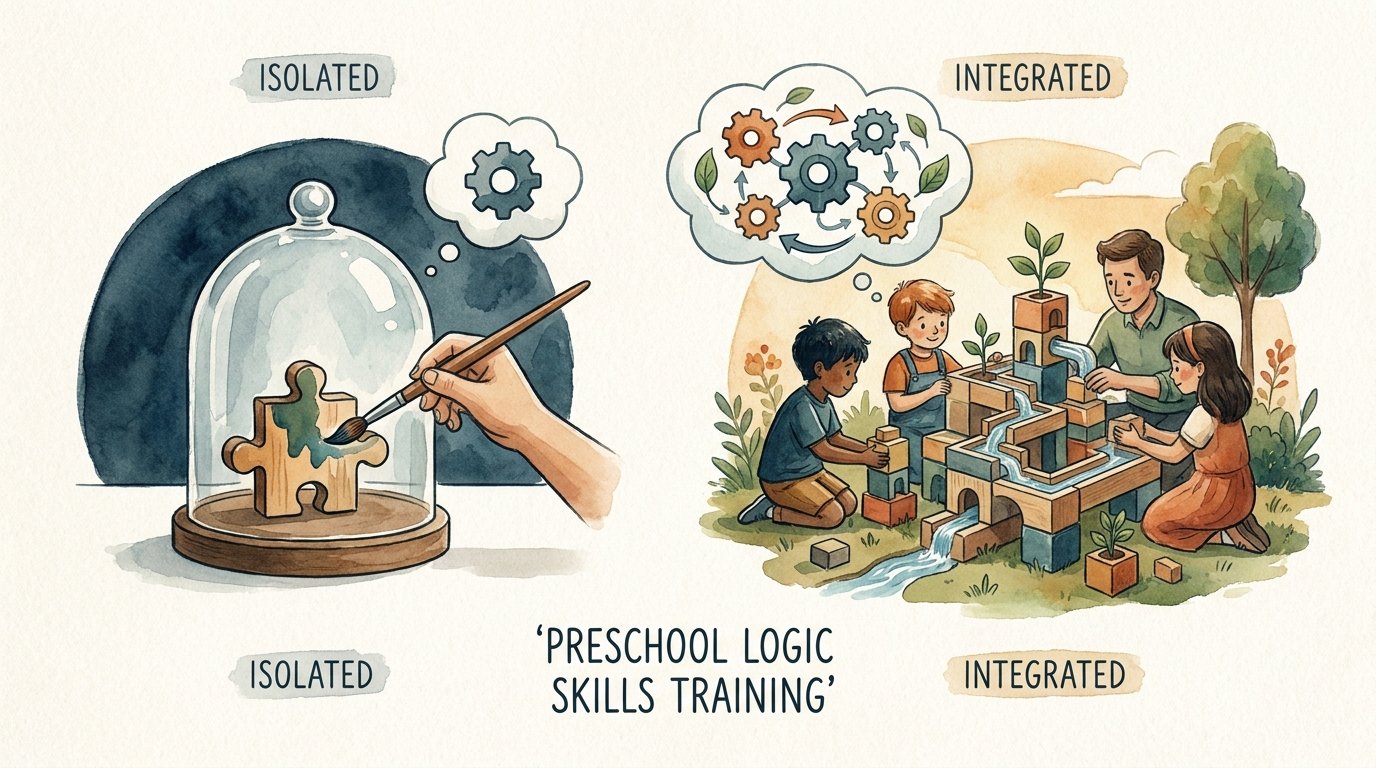
Why solve a puzzle when you could solve a problem? Isolated puzzles teach mindless repetition; integrated stories teach ‘systems thinking.’ When the worksheet has a ‘why’—like helping a bird find materials for a nest—the brain works 10x harder to find the ‘how.’ Stop teaching puzzles, start teaching solutions.
You might remember sitting at a tiny desk, matching a plastic triangle to a triangular hole. It felt like a win when the piece clicked into place. But what did that actually teach you about the world? It taught you that things fit when they look the same. That is a fine start, but the modern world demands more. It demands kids who can see the forest and the trees at the same time.
Logic is the invisible engine of the human mind. It is how we decide which shoe goes on which foot and how we realize that if the dog is barking at the door, someone might be outside. For a preschooler, these realizations are massive cognitive leaps. This guide will show you how to turn those leaps into a steady, powerful stride.
Preschool Logic Skills Training
Preschool logic skills training is the process of teaching children aged three to six how to reason, identify patterns, and understand cause-and-effect. It is not about doing math on a chalkboard. It is about helping a child build a mental toolkit to navigate their environment. When a child learns logic, they are learning how to process information effectively rather than just memorizing facts.
Think of it as the “operating system” for the brain. Before you can install “apps” like reading, writing, or long division, you need a solid OS. Logic provides that structure. It exists in every corner of a child’s life. When they sort their laundry by color, they are practicing classification. When they realize that pushing a button makes a toy pop up, they are mastering cause-and-effect.
In the real world, logic is the difference between a child who gets frustrated when a tower falls and a child who looks at the base to see why it was unstable. We use these skills in engineering, medicine, law, and even social interactions. A child who understands logic can eventually understand why a friend might be upset or how to plan a multi-step project. This training starts with simple, tactile experiences and moves toward abstract thinking.
How Logical Thinking Works in the Growing Brain
The preschool brain is a whirlwind of “magical thinking.” Between the ages of two and seven, children are in what psychologists call the preoperational stage. This means they often believe their thoughts can influence the physical world. If they wish for rain, and it rains, they think they caused it. Logic training helps them bridge the gap between this magic and reality.
To make logic work, we use four main pillars often found in computational thinking. These pillars provide a framework for any problem a child encounters:
1. Decomposition
Decomposition is the art of breaking a big job into tiny pieces. A preschooler might see “cleaning the playroom” as an impossible mountain. Logic training teaches them to see it as “pick up the blocks,” then “put the books on the shelf,” then “find the toy cars.” Breaking down the task makes the “impossible” manageable.
2. Pattern Recognition
Patterns are everywhere. They are in the rhythm of a song, the stripes on a shirt, and the daily routine of “breakfast, then play, then nap.” When children recognize patterns, they begin to predict what comes next. Prediction is a massive component of safety and social success. It allows a child to think, “Every time I leave my milk on the edge of the table, it spills. I should move it.”
3. Abstraction
Abstraction is about focusing on what matters and ignoring the rest. If a child is sorting buttons, they might decide to sort them by “number of holes.” In that moment, the color and size of the button do not matter. Training a child to filter out “noise” helps them focus on the core goal of any task.
4. Algorithmic Thinking
This sounds fancy, but it is just a “recipe” for doing things. It is a step-by-step process. Brushing teeth is an algorithm: put paste on brush, scrub top, scrub bottom, rinse. When children learn to follow and create these sequences, they are building the foundation for everything from coding to baking a cake.
Benefits of Integrated Logic Training
Choosing an integrated approach—where logic is part of a story or a real-world task—offers measurable advantages over simple, isolated drills. You are not just teaching a skill; you are building a mindset.
Cognitive Flexibility: Children learn that there is often more than one way to solve a problem. If the red block is missing, they might find two smaller blue blocks that equal its size. This flexibility is the hallmark of a “systems thinker.”
Emotional Regulation: Logic is a great antidote to frustration. When a child has the tools to analyze why something went wrong, they are less likely to have a meltdown. They move from “It’s broken!” to “Let me see if I can fix it.”
Academic Readiness: Logic is the “pre-math” and “pre-reading” phase. Reading requires recognizing patterns in letters. Math requires understanding relationships between numbers. A child with strong logic skills often finds these subjects much easier to grasp later on.
Enhanced Communication: To solve a problem with someone else, you have to explain your reasoning. Logic training encourages kids to use words like “because,” “if,” and “then.” This clarifies their thoughts and helps them interact better with peers.
Challenges and Common Mistakes
Teaching logic to a four-year-old is not always a smooth ride. Many parents and educators fall into traps that can actually stall progress.
Rushing to the Answer: It is tempting to tell a child, “The square goes in the square hole.” Resist this urge. When you give the answer, the learning stops. The “work” happens in the struggle. Let them try the triangle, the circle, and the star first. The click of the square should be their victory, not yours.
Over-reliance on Digital Tools: Apps can be great, but they often lack the “tactile feedback” the preschool brain craves. A screen can show a pattern, but a child cannot feel the weight of the blocks or the friction of the pieces. Real-world logic happens in 3D.
Using Timers or Pressure: Logic requires “meandering thought.” If you put a child on a clock, their brain shifts into “stress mode.” Stress shuts down the prefrontal cortex, which is exactly where logic happens. Keep activities low-stakes and unhurried.
Ignoring the “Why”: Many worksheets focus on the “what.” “What comes next in the pattern?” is a common question. Instead, ask “Why do you think that comes next?” This forces the child to verbalize their internal logic, which solidifies the concept.
Limitations of Preschool Logic Training
While logic training is powerful, it has its boundaries. You cannot force a child to be a “mini-computer.” Their biology sets the pace.
Biological Constraints: A three-year-old’s brain is still developing the physical connections needed for complex reasoning. You cannot expect a toddler to understand long-range consequences or complex abstract metaphors. Logic should always be anchored in something they can see, touch, or hear.
Attention Spans: The average preschooler has an attention span of about 5 to 10 minutes for structured tasks. If a logic “mission” takes longer than that, you will likely lose them. Short, punchy sessions are far more effective than long, drawn-out lessons.
Environmental Factors: A child who is hungry, tired, or overstimulated cannot think logically. Logic is a high-energy cognitive task. If the environment is too loud or the child is stressed, their brain will prioritize emotional survival over logical reasoning.
Isolated vs. Integrated Learning
It is helpful to understand the difference between the old way of teaching (Isolated) and the new, more effective way (Integrated).
| Feature | Isolated Puzzles | Integrated Missions |
|---|---|---|
| Core Motivation | Finish the task to get a “done” sticker. | Solve the problem to help a character or achieve a goal. |
| Context | Abstract shapes on a flat surface. | Real-world scenarios (e.g., building a bridge for a toy car). |
| Brain Engagement | Low (repetition-based). | High (systems-based thinking). |
| Skill Retention | Short-term (task-specific). | Long-term (transferable reasoning). |
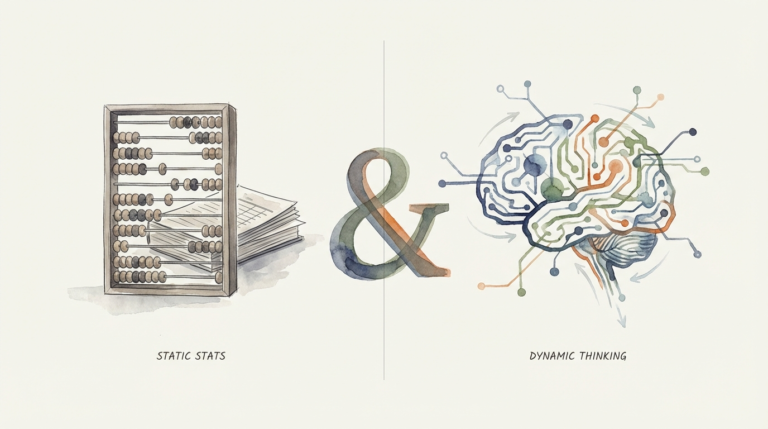
Integrated missions win because they mimic how we actually use logic. We don’t solve logic puzzles in a vacuum; we solve them to fix a broken faucet, plan a trip, or navigate a conversation.
Practical Tips for Daily Training
You do not need an expensive curriculum to teach logic. You just need to change how you talk and play with your child.
- The “What If” Game: While driving or walking, ask hypothetical questions. “What if the sun never went down tonight? What would we do about bedtime?” This encourages predictive reasoning.
- Narrate Your Logic: Let your child hear you think. “I am putting the heavy groceries at the bottom of the bag because if I put them on top, they will squish the bread.” You are modeling the “why” behind your actions.
- Sorting Missions: Turn cleaning up into a logic game. “Can you find all the things that are made of wood and put them in this basket?” This builds classification skills.
- Open-Ended Materials: Provide blocks, sticks, fabric, and “loose parts.” Unlike a puzzle with one right answer, these materials have infinite solutions. They force the child to invent their own logic.
- Natural Consequences: When it is safe, let logic play out. If a child builds a tower that is too skinny, let it fall. Then, ask them to investigate. “Which part moved first?” This makes the lesson tangible.
Advanced Considerations for Practitioners
For those looking to go deeper, logic training can eventually transition into “computational thinking” without a computer. This involves more complex scaling and algorithmic design.
Algorithmic Play: You can create “human coding” games. One person is the “robot” and the other is the “programmer.” The programmer must give specific, step-by-step instructions to get the robot across the room without hitting an “obstacle” (like a pillow). This teaches the necessity of precision in logic.
Executive Function Scaling: Logic is closely tied to executive function—the brain’s ability to manage itself. As a child masters simple logic, you can introduce “conditional logic” (If/Then/Else). “If it is raining, we wear boots. Else, we wear sneakers.” This prepares the brain for higher-level math and programming.
Systems Mapping: Older preschoolers can start to see how different systems interact. You can talk about how the rain helps the grass grow, which feeds the bunnies, which are part of the park. Drawing these “webs” of connection helps them move from linear logic to systems thinking.
Example: The “Bird’s Nest” Scenario
Let’s look at how an “integrated story” works in practice compared to a standard worksheet.
The Isolated Way: You give the child a worksheet with a picture of a bird and a picture of a nest. There is a maze between them. The child draws a line through the maze. They have finished the task, but they have only practiced fine motor skills and simple pathfinding.
The Integrated Way: You tell the child, “A bird is trying to build a nest for her eggs, but she needs three different types of materials: something soft, something strong, and something sticky. Can you look around the yard and find one of each?”
Now, the child’s brain is on fire. They have to:
1. **Analyze** the bird’s problem (need a nest).
2. **Categorize** materials (what is “soft” vs. “strong”?).
3. **Search and Filter** (abstraction—ignoring rocks if they aren’t sticky).
4. **Execute** a multi-step plan (decomposition).
The child isn’t just drawing a line; they are acting as an engineer, a biologist, and a problem-solver. They are learning that their logic has a real-world impact.
Final Thoughts
Logic is not a subject to be taught; it is a lens through which to see the world. By shifting from isolated puzzles to integrated stories, you give a child more than just “brain exercise.” You give them a way to engage with the world that is curious, resilient, and effective.
The goal of preschool logic training is not to create a child who can pass a test. It is to create a child who, when faced with a broken toy or a confusing situation, thinks, “I can figure this out.” That sense of agency is the greatest gift you can provide.
Start small. Look for the “why” in your daily routines. Ask more questions and give fewer answers. Watch as your child’s magical thinking begins to harmonize with the powerful, logical engine of their growing mind. They won’t just be solving puzzles; they will be solving the world.
Sources
1 apa.org | 2 kodokids.com | 3 lingokids.com | 4 willowschool.org | 5 praxoslearning.com | 6 ourtinythinks.com | 7 mybrightwheel.com | 8 emergingminds.com.au | 9 cceionline.com | 10 ncce.org | 11 funexpectedapps.com | 12 rileychildrens.org