Morning Routine Efficiency For Parents
The loudest voice in the room shouldn’t be yours; it should be the system you built. Nagging is manual labor for the soul. It’s high-energy, low-yield, and creates resentment. A strategic routine chart acts as the ‘third party’ in the relationship—the boss isn’t you, it’s the board. This one shift transforms you from a drill sergeant into a coach.
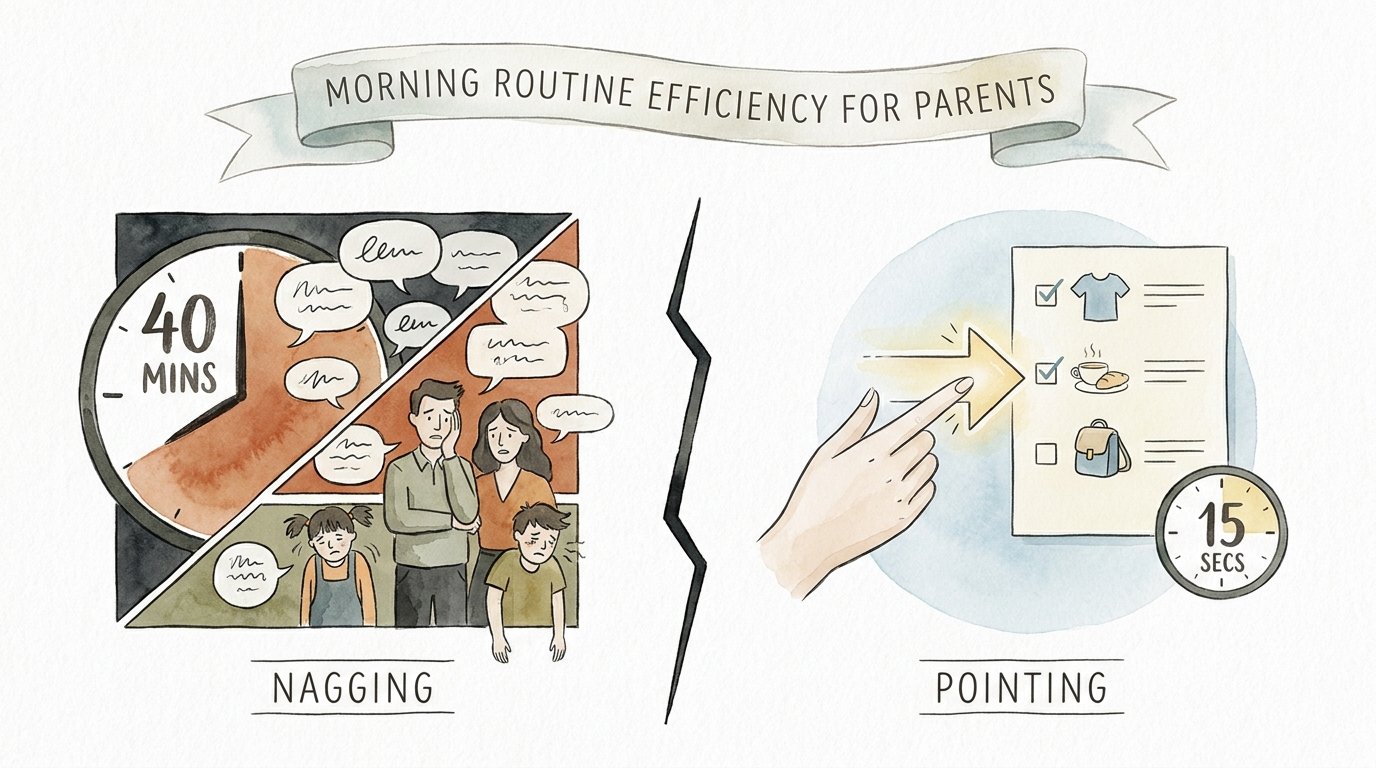
When you find yourself repeating “put on your shoes” for the fourteenth time, you aren’t just losing your voice; you are losing the opportunity to connect. Transitioning from a verbal-based morning to a visual-based one is the ultimate parenting hack for reclaimed sanity. It’s the difference between a high-friction battle of wills and a streamlined process where your only job is to provide the occasional 15-second point toward the next task.
Morning Routine Efficiency For Parents
Morning routine efficiency is the art of automating the repetitive tasks required to get a family out the door. It is a system designed to offload the cognitive burden of remembering steps—like packing a lunch or finding matching socks—from the parent’s brain onto a physical or digital external prompt. Instead of being a human alarm clock, you become the supervisor of a pre-set workflow.
This concept exists because the human brain, particularly the developing brain of a child, struggles with executive function under pressure. Executive function is the mental CEO that manages time, switches tasks, and organizes priorities. In the “morning rush,” this CEO often goes on strike. A routine chart acts as a prosthetic executive function, providing a visual roadmap that guides a child from “waking up” to “walking out” without the need for constant verbal redirection.
In real-world situations, this looks like a kitchen command center, a laminated checklist on a bedroom door, or a series of “puck lights” in the hallway that a child taps as they complete each step. It moves the focus from the parent’s demands to the child’s progress. Statistics show that families who prioritize structured morning rituals, such as eating together or following a predictable path, report significantly lower levels of morning anxiety and a higher likelihood of starting the school day in a positive headspace.
How to Build Your Morning Command System
Building a system that actually works requires more than just printing a generic list from the internet. It requires a deep understanding of your family’s specific friction points. Follow these steps to move from chaos to a “pointing-only” morning.
Identify the “Critical Path”
Every morning has a critical path—the sequence of events that must happen for the day to succeed. Sit down and list every tiny action required. Do not just write “Get Ready.” Break it down into “Pee, Brush Teeth, Put on Underwear, Put on Shirt, Put on Socks, Put on Shoes.” Vague instructions are the enemy of efficiency.
Pair and Stack Habits
Use the principle of habit stacking to create momentum. Pair a new or difficult habit with one that is already automatic. For example, if your child always goes to the kitchen for breakfast, place the routine chart right next to the cereal boxes. The act of eating becomes the cue to check the next step on the board. This leverages the power of association, making it easier for the brain to move from one task to the next.
Choose the Right Visual Medium
The medium must match the child’s developmental stage. For toddlers, use real photographs of them performing the task (e.g., a photo of them actually brushing their teeth). For school-aged kids, icons or clipart work well. For older children, a simple text-based checklist or a digital app may be more appropriate. The goal is to provide the least amount of information necessary for them to take the next step independently.
The “Board Introduction” Ceremony
Do not just hang the chart and expect it to work. Introduce it during a calm moment—never during the morning rush. Walk through the steps together like a game. Let them move the magnets, check the boxes, or tap the lights. This creates a sense of ownership. When the morning actually arrives, your role shifts. If they wander off-task, you don’t nag. You simply point to the chart and ask, “What does the board say is next?”
Benefits of a “Third-Party” Boss
Shifting the authority to a routine chart provides measurable benefits for both parent and child. It changes the household dynamic from one of “demand and resist” to “plan and execute.”
- Reduced Power Struggles: When the board says it’s time for socks, the child isn’t fighting you; they are following the system. This preserves your relationship and prevents you from becoming the “bad guy” before 8:00 AM.
- Developed Executive Function: Routines strengthen the brain’s ability to plan, prioritize, and self-regulate. Research indicates that children with consistent routines show improved working memory and better impulse control over time.
- Increased Independence: Checking off a task provides a hit of dopamine. This positive reinforcement encourages children to take pride in their autonomy, building confidence that carries over into their schoolwork and social lives.
- Lowered Parental Stress: You no longer have to hold the entire morning’s itinerary in your head. This frees up mental bandwidth to handle actual emergencies—like a forgotten permission slip or a spilled glass of orange juice—without a total meltdown.
Common Mistakes to Avoid
Even the best-designed systems can fail if implemented incorrectly. Most failures stem from a lack of consistency or over-complication.
Making the System Too Complex
A chart with 20 steps is not a routine; it’s a chore. Start small. If your child is struggling, simplify the visuals down to just two or three “anchor” tasks. You can always add more complexity once the foundation is solid. Success breeds success; if the board feels impossible to win, the child will stop looking at it.
Using the Chart as a Punishment
The routine chart should be a supportive tool, not a weapon. Avoid taking away “stars” or “checks” for unrelated bad behavior. If the chart becomes associated with shame or failure, the child will develop an emotional aversion to it. Keep it neutral and focused on task completion.
Becoming “The Human Chart”
This is the most frequent error. If the child stops looking at the board, parents often start narrating the steps again. This reinforces the idea that the child doesn’t need to check the system because “Mom will just tell me eventually.” Stay disciplined. If they get stuck, stay silent and point. The 15-second point is your most powerful tool for maintaining the system’s integrity.
Limitations and Environmental Constraints
While routine charts are powerful, they are not a universal panacea. There are situations where a system-based approach may need to be paused or modified.
Physical routines rely on a stable environment. If your family is traveling, experiencing a major life transition (like a move or a new sibling), or dealing with illness, the system may break down. During these times, the “cost” of maintaining the routine might exceed the benefit. It is better to temporarily simplify the routine than to force a complex system when the family’s emotional resources are depleted.
Furthermore, routine charts do not replace the need for connection. If a child is acting out because they need emotional reassurance, a checklist will not solve the problem. Systems handle the “what” and the “how,” but the parent still handles the “who” and the “why.” A chart is a tool to clear the clutter so you can focus on the human being in front of you.
Physical vs. Digital Routine Systems
Choosing between a physical board and a digital app depends on your child’s age and your family’s lifestyle.
| Feature | Physical Chart | Digital App |
|---|---|---|
| Best For | Toddlers and Elementary age | Tweens and Teens |
| Interactivity | Tactile (Velcro, magnets, stickers) | Gamified (Sounds, animations) |
| Maintenance | Low tech, but requires setup | Easy to update, requires charging |
| Distraction Risk | Zero | High (potential to wander to other apps) |
Practical Tips for Implementation
Ready to start? Use these best practices to ensure your new system sticks from day one.
- Use Visual Wins: For younger kids, use a “Done” bucket or a flip-chart. Physically moving a card from the “To Do” side to the “Done” side provides a concrete sense of accomplishment.
- Location is Strategy: Place the chart exactly where the friction happens. If the struggle is putting on shoes, the chart belongs by the front door, not in the kitchen.
- The “Beat the Timer” Game: If motivation is low, set a visual timer (like a sand timer) for a specific block of tasks. This turns the routine into a challenge against the clock rather than a chore given by a parent.
- Include a “Buffer” Task: Always include one task that the child loves at the end of the routine, such as “5 minutes of reading” or “pick a car for the ride.” This acts as a natural incentive to move quickly through the less-preferred tasks.
Advanced Considerations for Neurodivergent Kids
For children with ADHD or Autism, routine charts aren’t just helpful—they are essential scaffolding. These children often experience “time blindness,” making it difficult to gauge how long a task takes.
Advanced practitioners should consider adding visual countdowns or color-coded zones to their charts. Using high-contrast visuals and specific “sensory breaks” within the routine can prevent overstimulation. For these children, the “pointing protocol” is vital because verbal prompts can often be processed as background noise or even as painful “nagging” that triggers a fight-or-flight response. A silent point to a visual cue allows the brain to process the requirement at its own speed without the added pressure of social demand.
Real-World Scenario: The Morning Launch
Imagine a household with a 6-year-old who typically takes 40 minutes to get dressed because they stop to play with Legos every three minutes.
Old Way: The parent yells from the kitchen, “Get dressed!” Five minutes later, they go to the room and find the child in one sock. They yell again. The child cries. The parent ends up putting the shoes on the child themselves while everyone is frustrated and late.
The System Way: The parent points to the “Bedroom Checklist” on the door. The checklist has four photos: Underwear, Pants, Shirt, Socks. The parent says nothing. They walk back to the kitchen to finish their coffee. If the child comes out half-dressed, the parent simply points back toward the room. The child sees the “Socks” photo is still on the “To Do” side. They go back, finish the task, and move the magnet. The parent greets them with a high-five once they reach the “Breakfast” station. Total verbal output: Zero. Total time spent managing: 15 seconds.
Final Thoughts
The transition from nagging to system-building is a long-term investment in your child’s character. By providing a routine chart, you are not just making your mornings easier; you are teaching them how to manage their own lives. You are moving from a position of control to a position of empowerment.
Success won’t happen overnight. There will be mornings where the magnets are ignored and the shoes are nowhere to be found. But over weeks and months, the “third party” boss will become the new normal. You will find yourself standing in a quiet kitchen, sipping a warm cup of coffee, while the sound of the system working echoes through the house.
Experiment with different formats. Try different “hooks” and rewards. But most importantly, trust the system you built. When you stop being the loudest voice in the room, you finally give your child the space to hear their own voice of responsibility. Your future self—and your morning coffee—will thank you.
Sources
1 everblog.com | 2 autismlittlelearners.com | 3 kidsmentalhealthfoundation.org | 4 yourmomvillage.com | 5 waterford.org | 6 weemeditate.com | 7 socialemotionalworkshop.com | 8 campblue.com.au | 9 yourkidstable.com | 10 autismlabs.com | 11 missionmagnets.com.au | 12 smartkidswithld.org | 13 lizardcentre.com