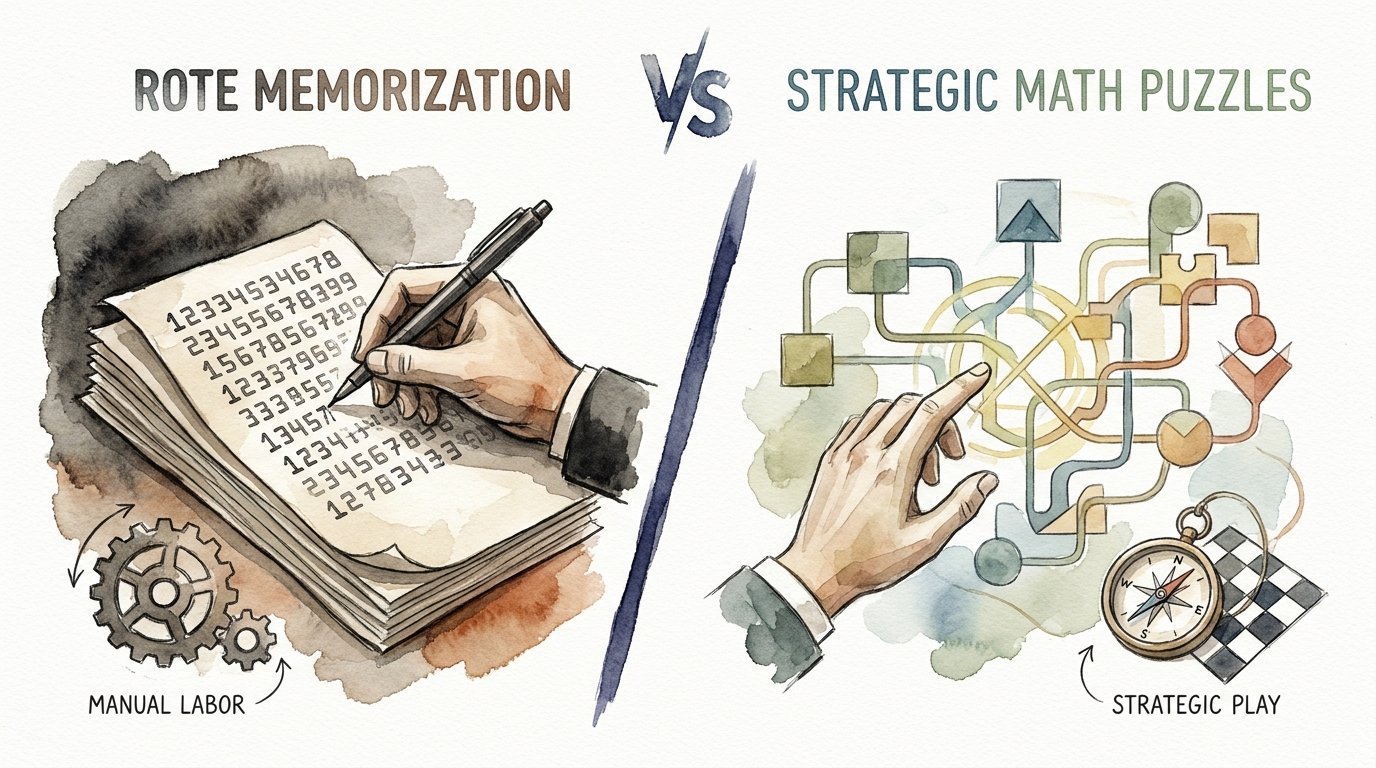
Strategic Math Puzzles Vs Rote Memorization
40 minutes of pencil pushing or 10 minutes of strategic breakthrough—which one builds a future engineer? We are training our kids to work hard at math, but are we training them to work smart? Manual repetition is the ‘digging a hole’ of education. Strategic cognitive activities are the ‘engineering a pulley’ phase. One exhausts the spirit; the other ignites a lifelong passion for systems and logic.
For decades, the math classroom has been a place of high-volume drilling. We’ve prioritized the “manual labor” of arithmetic over the “strategic play” of mathematical reasoning. But as technology evolves, the value of a human who can simply compute is plummeting. What the world needs now—and what your child needs to thrive—is the ability to look at a complex system and find the lever that moves it.
This shift from rote memorization to strategic math puzzles isn’t just a trend in education; it’s a fundamental change in how we develop the human brain. By moving away from the “industrial” model of learning, we can foster a generation of thinkers who don’t just solve for X, but ask why X exists in the first place.
Strategic Math Puzzles Vs Rote Memorization
Strategic math puzzles are challenges that require logical deduction, pattern recognition, and lateral thinking to solve. Unlike standard equations, they rarely have a “plug-and-play” formula. They are the cognitive equivalent of a sandbox where kids can experiment with rules and logic. Rote memorization, conversely, is the process of learning information through repetition until it can be recalled instantly without needing to understand the underlying mechanics.
In the real world, rote memorization is like a mechanic who knows exactly where every bolt goes on a specific 1998 sedan. Strategic math puzzles create the engineer who can look at a broken, experimental engine and deduce how it’s supposed to function based on the laws of physics. One is limited by what they have already seen; the other is empowered by what they can figure out.
Research from Stanford University has shown that while memorizing basic facts like multiplication tables is important for “freeing up” working memory, relying on it exclusively is a dead end. Students who engage in “productive struggle” through puzzles develop deeper conceptual understanding and higher long-term retention. They aren’t just storing facts; they are building a mental framework for problem-solving that applies to coding, financial modeling, and architectural design.
How Strategic Play Transforms Learning
When a child sits down with a strategic puzzle—be it Sudoku, a KenKen grid, or a logic-based “Magic Square”—the brain enters a state of high-intensity cognitive engagement. They aren’t just looking for an answer; they are looking for a system. This process involves several distinct phases of “Strategic Play” that are absent in rote drilling.
The Discovery Phase: Pattern Recognition
The first step in any strategic puzzle is identifying the constraints. In a “Which One Doesn’t Belong?” puzzle, a child might look at four different geometric shapes. Instead of reciting their names (rote), they must analyze their properties—number of sides, symmetry, or internal angles. This builds the fundamental skill of pattern recognition, which is the cornerstone of data science and high-level engineering.
The Hypothesis Phase: Trial and Iteration
Strategic math puzzles force kids to fail early and often. If a child places a “4” in a Sudoku cell that eventually breaks the row, they must backtrack and analyze where their logic went wrong. This is “strategic labor.” It teaches them that mistakes are data points, not failures. This iterative process is exactly how modern software is developed—through constant testing and debugging.
The Breakthrough Phase: Logical Deduction
The moment of “strategic breakthrough” occurs when a child realizes that because “A” and “B” are true, “C” must be impossible. This “if-then” logic is the bedrock of computer science. By training the brain to navigate these logical trees through play, we are teaching them to architect solutions rather than just follow instructions.
Benefits of the Strategic Approach
The shift toward strategic puzzles offers measurable advantages that go far beyond better test scores. It fundamentally alters the child’s relationship with mathematics and logic.
- Cognitive Flexibility: Strategic play forces the brain to switch between different rules and systems. This builds a “plastic” brain capable of adapting to new technologies and industries that don’t even exist yet.
- Executive Function: Puzzles require planning and self-regulation. A child must keep multiple variables in their “mental chalkboard” (working memory) while deciding their next move.
- Emotional Grit: Rote memorization can be boring and discouraging. Strategic puzzles, however, provide the “dopamine hit” of a solved mystery. This builds the persistence needed to tackle “wicked” problems in adulthood.
- Spatial Reasoning: Many strategic puzzles involving geometry or physical blocks (like Tangrams) improve a child’s ability to visualize 3D spaces, a critical skill for surgeons, pilots, and architects.
Challenges and Common Mistakes
Moving from a “manual labor” mindset to a “strategic play” mindset isn’t always seamless. Parents and educators often fall into traps that can derail the learning process.
Treating Puzzles Like Drills: The biggest mistake is turning a puzzle into a chore. If you set a timer and demand a child solve ten Sudokus in thirty minutes, you’ve just turned strategic play back into manual labor. The goal is the *thinking process*, not the volume of completed pages.
Providing the “Trick” Too Soon: When a child is struggling, the instinct is to show them the “shortcut.” However, research from Mind Research Institute suggests that “productive struggle” is where the actual learning happens. By giving away the strategy, you rob the child of the cognitive breakthrough that builds their brain’s architecture.
Neglecting the “Why”: Even when using puzzles, some kids will try to memorize patterns without understanding them. For example, in a “Magic Square,” a child might memorize where the numbers go rather than understanding the sum-based relationship between the cells. It’s crucial to ask, “How did you know that goes there?” to ensure the strategic logic is taking root.
Limitations: When Rote Is Actually Necessary
While strategic play is the “pulley” that moves the heavy lifting, you still need a solid foundation. It would be dishonest to say rote memorization has no place. In fact, a balanced approach is best. There are specific situations where “manual” recall is a prerequisite for “strategic” breakthroughs.
For example, if a child hasn’t memorized their basic addition and subtraction facts, their “mental chalkboard” (working memory) will be so cluttered with simple arithmetic that they won’t have room for the high-level logic of a complex puzzle. Think of rote memorization as the “keyboard shortcuts” of the mind. You don’t want to have to search the menu every time you want to copy and paste; you want that to be automatic so you can focus on the *content* you are creating.
Similarly, certain formulas in physics or chemistry must be memorized because they are the “constants” of the universe. The key is to memorize them *after* understanding why they exist, so the memorization serves the strategy, rather than replacing it.
Comparison: Manual Labor vs. Strategic Play
| Feature | Rote Memorization (Manual Labor) | Strategic Math Puzzles (Strategic Play) |
|---|---|---|
| Primary Goal | Speed and Accuracy of Recall | Conceptual Understanding and Logic |
| Brain Region | Procedural Memory (Basal Ganglia) | Working Memory & Reasoning (Prefrontal Cortex) |
| Longevity | Short-term (fades after the test) | Long-term (becomes part of cognitive toolkit) |
| Engagement | Passive / Often tedious | Active / Gamified |
| Real-World Skill | Data Entry / Calculation | Engineering / Systems Design / Coding |
Practical Tips for Implementing Strategic Math
Transforming your daily routine doesn’t require a total curriculum overhaul. It starts with small, consistent changes in how you present challenges.
- The 5-Minute Warm-Up: Start every study session with one logic puzzle. This “wakes up” the prefrontal cortex and sets a tone of curiosity.
- Ask “Why,” Not “What”: When a child gets a math problem right, don’t just say “Good job.” Ask, “What was your strategy for figuring that out?” This forces them to verbalize their internal logic.
- Use Physical Manipulatives: Use blocks, coins, or even a real clock to demonstrate modular arithmetic. Moving physical objects helps translate abstract logic into concrete understanding.
- Celebrate the “Almost”: If a child almost solves a complex puzzle but makes one small error, celebrate the 90% of strategic thinking that went into it. The “manual” error is easy to fix; the strategic vision is the part that’s hard to build.
Advanced Considerations for Future Engineers
For parents and teachers of students who show a high aptitude for logic, it’s important to bridge the gap between “fun puzzles” and professional-grade strategic thinking. This involves introducing concepts like **Big O Notation** (efficiency of logic) and **Game Theory**.
In competitive math like the *AMC (American Mathematics Competitions)*, the problems aren’t hard because the numbers are big; they are hard because the “manual” approach would take hours, while the “strategic” approach takes seconds. Serious practitioners should focus on “elegant” solutions—finding the path that requires the least amount of “pencil pushing.” This mindset is what separates a senior software architect from a junior coder.
Example Scenario: The Sock Drawer Logic
Imagine a child is given this classic puzzle: “You have 10 white socks and 10 black socks mixed in a drawer in a dark room. How many socks must you pull out to *guarantee* you have a matching pair?”
A “manual labor” learner might try to calculate probabilities or guess large numbers like 11 or 20. But a “strategic” learner looks at the constraints. If I pull out one sock, it’s one color. If I pull out a second, it’s either a match or the other color. If I pull out a third, it *must* match one of the first two. The answer is 3. This isn’t a calculation; it’s a strategic breakthrough based on the “Pigeonhole Principle.” By exposing kids to these scenarios, we teach them to look for the “3” in every complex problem.
Final Thoughts
We are currently at a crossroads in education. We can continue to exhaust our children with 40 minutes of pencil pushing, or we can empower them with 10 minutes of strategic breakthroughs. The “manual labor” of rote memorization had its place in the 20th-century factory model, but it is a poor preparation for the 21st-century innovation economy.
By prioritizing strategic math puzzles, we aren’t just making math “fun”—we are building the cognitive scaffolding for the next generation of engineers, scientists, and leaders. We are teaching them that logic is a tool to be wielded, not a set of rules to be followed. Encourage your kids to play with numbers, to challenge the “why,” and to find the pulleys that make the heavy lifting of life easier. The future belongs to the strategic, not just the hardworking.
Sources
1 bhanzu.com | 2 thehumanprojectfoundation.org | 3 theintentionalparentacademy.com | 4 worldwisetutoring.com | 5 mathwithbaddrawings.com | 6 mindeducation.org