Raising Producer Children Through Gift Giving
The thrill of the ‘buy’ lasts minutes, but the pride of the ‘make’ lasts a lifetime. We are raising a generation of expert consumers who know how to click ‘Buy Now’ but don’t know how to create. By shifting holiday traditions toward making, we aren’t just saving money—we’re building the neural pathways of mastery and the soul of a craftsman.

Modern childhood is often defined by a passive relationship with the world. Children are frequently positioned as the end-point of a massive global supply chain, trained to desire, select, and receive. This cycle creates a “consumer mindset” where value is found in the speed of acquisition rather than the depth of effort. When we pivot toward handmade gifts, we invite our children to step behind the curtain of creation.
Creating something for another person requires a profound shift in perspective. It demands that a child considers the recipient’s needs, manages their own frustration, and persists through the “messy middle” of a project. These experiences are the building blocks of a “producer mindset,” a way of moving through life with the confidence that they can shape their environment rather than just inhabit it.
This guide explores how to transform your gift-giving traditions into a masterclass in character and skill. We will look at the neurological benefits of handcrafts, the practical steps to set up a home workshop, and how to navigate the inevitable challenges of DIY holidays. Whether you are a seasoned maker or a total beginner, this journey will change the way your family views the act of giving.
Raising Producer Children Through Gift Giving
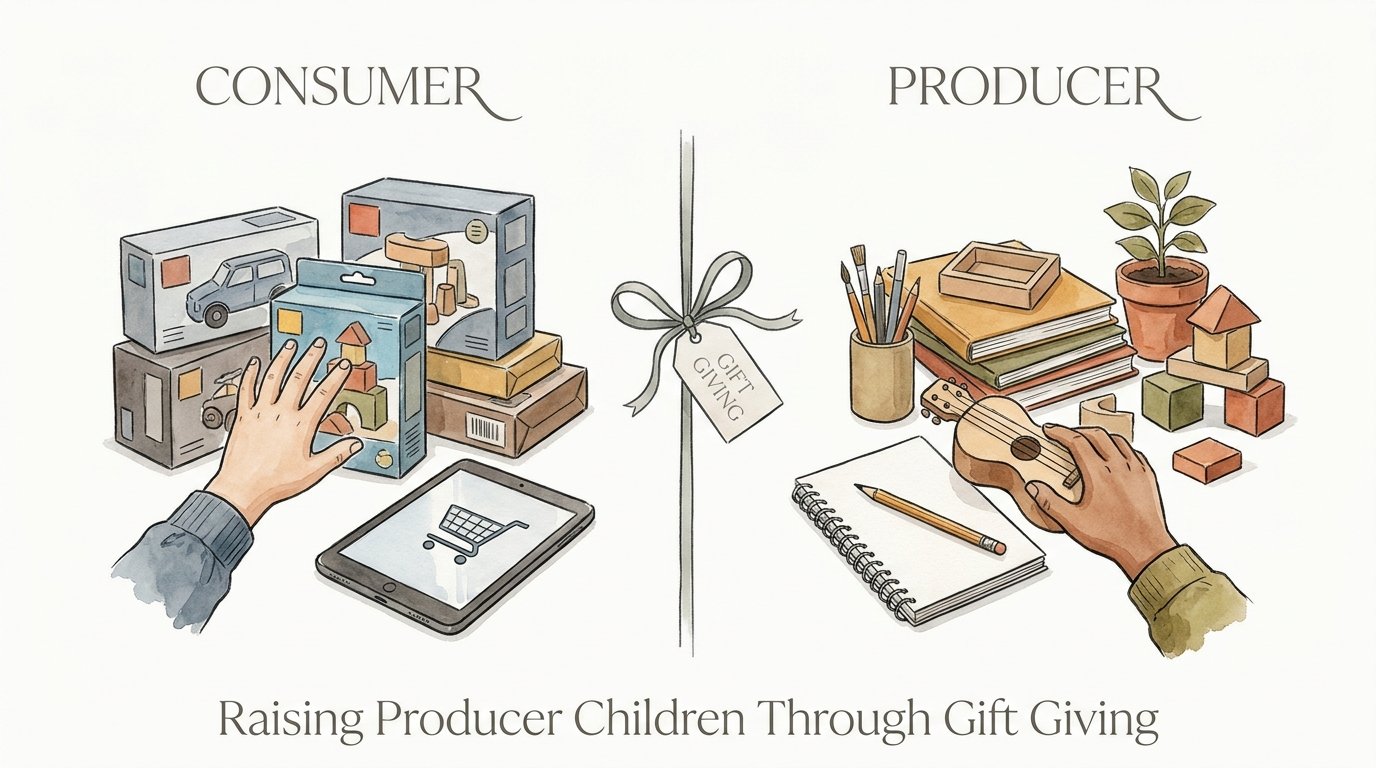
A producer child is one who looks at a problem and asks, “How can I build a solution?” or looks at a gift and thinks, “What can I create that would bless this person?” This is the opposite of the consumer child, who asks, “What can I get?” or “Where can I buy that?” Raising a producer is about instilling a sense of agency and resourcefulness that will serve them long after the holiday lights are packed away.
Gift-giving serves as the perfect training ground for this mindset because it anchors the creative process to empathy. To make a gift, a child must practice “Theory of Mind”—the ability to understand that other people have different perspectives and desires than their own. They have to think about what Grandma likes, which colors Aunt Sarah enjoys, or what kind of toy would make a younger sibling laugh. This moves the creative act from self-expression to an act of service.
In real-world terms, this transition often starts in the “leadership season” of parenting, typically between ages three and thirteen. During these years, children are developing the fine motor skills and cognitive patience required for craftsmanship. By replacing a trip to the mall with an afternoon of woodworking or knitting, you are teaching them that their time and talent have tangible value. They begin to see themselves as contributors to the family and the community, rather than just recipients of its bounty.
Analogies help clarify this distinction. A consumer is like a passenger on a cruise ship, waiting for the next meal to be served and the next show to begin. A producer is the chef in the kitchen or the engineer in the engine room. They are the ones making the experience happen for everyone else. When children make gifts, they are moving from the passenger deck to the bridge, taking responsibility for the joy of others.
The Mechanics of the Maker Mindset: How to Do It
Transitioning to a maker-focused holiday requires a system that supports creativity without causing burnout. You cannot simply announce a “handmade only” rule on December 20th and expect success. It requires a seasonal rhythm that prioritizes the process of making over the speed of shopping.
The first step is to establish a “Gift Brainstorming” session. Sit down with your children and list every person they want to give to. Instead of looking at catalogs, look at raw materials. Ask questions like, “What do we have in the scrap wood pile?” or “What can we do with the extra yarn from your last project?” This forces them to look at the world as a collection of possibilities rather than a list of products.
Next, match the project to the child’s current skill level while adding a “stretch goal.” If a child is a beginner at sewing, they might make a simple scented sachet for a cousin. If they have more experience, they could attempt a hand-stitched wallet. The goal is to provide enough challenge to trigger the “flow state” without causing a total meltdown. Use the following step-by-step framework to guide them:
- The Discovery Phase: Research techniques and look at examples of similar handmade items. This builds their visual library and helps them set realistic expectations.
- The Prototype: Encourage them to make a “test version” using scrap materials. This allows them to fail safely and understand the mechanics before using the “good” supplies.
- The Production Run: Set aside dedicated blocks of time for making. Put on some music, clear the table, and work alongside them. Your presence as a fellow maker is more encouraging than your role as a supervisor.
- The Finishing Touches: Teach them that the presentation is part of the gift. Making their own wrapping paper or writing a heartfelt note about the process completes the loop of the producer mindset.
As they work, focus your praise on their persistence and problem-solving rather than just the final product. When a stitch goes crooked or a board splits, treat it as a data point. Ask, “What did we learn about the grain of the wood there?” This reinforces the idea that mastery is a journey of many small corrections.
The Scientific Case for Hands-On Giving
The benefits of making go far beyond the sentimental value of a handmade card. Neuroscience shows that when a child engages in complex handcrafts, their brain lights up like a switchboard. This “full-brain activation” involves the prefrontal cortex for planning, the motor cortex for fine motor control, and the visual cortex for spatial awareness.
One of the most powerful chemicals involved in this process is dopamine. Every time a child solves a creative problem—like figuring out how to make a clay bowl stand up or how to tie a complex knot—their brain releases a hit of dopamine. This builds a “reward loop” that associates effort and perseverance with pleasure. Over time, this builds a growth mindset, teaching them that they can tackle difficult tasks through sustained focus.
Handcrafts also serve as a powerful tool for emotional regulation. The repetitive, rhythmic nature of activities like knitting, sanding, or weaving has a grounding quality. It helps lower cortisol levels and provides a “soothing” effect that can be incredibly helpful during the high-energy holiday season. Children who make things often report feeling calmer and more in control of their environment.
Furthermore, the development of fine motor skills through making has a direct impact on cognitive ability. Research suggests that using both hands to perform intricate tasks—especially those that cross the “midline” of the body—helps strengthen the connection between the left and right hemispheres of the brain. This improved neural connectivity can enhance their performance in other areas, such as mathematics and logic.
Navigating the Crafting Minefield
The path to a handmade holiday is rarely smooth. One of the most common mistakes parents make is “over-ambition.” We see a beautiful project on social media and assume our eight-year-old can replicate it in one sitting. When the reality of the mess and the difficulty sets in, everyone ends up stressed. To avoid this, always multiply your estimated project time by three.
Another pitfall is the “perfectionism trap.” It is tempting to step in and “fix” a child’s work so the gift looks better. However, when you take the tool out of their hand, you are sending a subtle message that their best isn’t good enough. This kills the producer mindset instantly. Instead, offer “hand-over-hand” guidance or demonstrate the technique on your own piece of scrap material.
Many parents also fail to plan for the “messy middle.” Every project reaches a point where it looks terrible, and the child wants to quit. This is the most important moment in the entire process. This is where resilience is built. Prepare for this by having a “mistake-friendly” environment. Keep extra materials on hand and celebrate “beautiful mistakes” that lead to new design ideas.
Finally, avoid turning the workshop into a chore. If making becomes a high-pressure obligation, the joy of giving is lost. Keep the sessions short and high-energy. If the child is clearly frustrated, give them permission to walk away for an hour. Boredom and frustration are often the precursors to a creative breakthrough, but only if they are managed with patience.
When Making Isn’t the Answer
While the producer mindset is invaluable, there are times when a strictly handmade approach may not be ideal. Realistic constraints such as time, skill gaps, and resource availability are part of life. Understanding these limitations actually strengthens your credibility as a guide for your children.
For example, a high schooler with a heavy load of extracurriculars might not have the thirty hours required to build a coffee table for their parents. In these cases, forcing the “producer” label can lead to resentment. A better approach might be “curated producing,” such as assembling a high-quality kit or designing a digital gift that leverages their existing skills without requiring massive physical labor.
Trade-offs are also a factor. Sometimes the cost of raw materials and specialized tools for a one-off project far exceeds the cost of buying a high-quality, ethically-made item. Teaching children about “Opportunity Cost” is a valid part of the producer mindset. It is okay to decide that your time is better spent elsewhere while still maintaining a creative spirit in other areas of the holiday.
Environmental and space limitations can also play a role. If you live in a small apartment without a dedicated workshop area, high-dust or high-odor projects like woodworking or resin casting may be impractical. In these situations, look for “clean” crafts like digital art, cooking, or textile work that can be done at a kitchen table.
Comparing the Two Worlds
To truly understand the value of the producer approach, it helps to compare it directly with the standard consumer model of gift-giving. While both have their place, they offer very different developmental outcomes for a growing child.
| Feature | Consumer Gift (Buy) | Producer Gift (Make) |
|---|---|---|
| Primary Skill Developed | Comparison shopping and selection. | Problem-solving and technical mastery. |
| Brain Activation | Dopamine spike at purchase (short-lived). | Sustained focus, flow state, and motor cortex engagement. |
| Perspective | Self-oriented (what I can find). | Other-oriented (what I can create for them). |
| Resilience Factor | Low; frustration leads to returning the item. | High; mistakes require troubleshooting and persistence. |
| Long-term Value | The item depreciates over time. | The skill gained appreciates and stays with the child. |
This table demonstrates that while buying is more efficient, making is more effective for building character. The consumer model treats the gift as a transaction, whereas the producer model treats it as a transformation—of both the material and the maker.
Master-Level Strategies for Parents
If you want to take your family’s maker traditions to the next level, focus on “skill stacking” and “resource management.” These best practices will help you move from simple crafts to genuine craftsmanship.
- The “One New Skill” Rule: Every year, choose one specific skill for the family to focus on, such as leatherworking, basic electronics, or sourdough baking. This prevents project overwhelm while ensuring steady growth over the years.
- Build a “Maker Pantry”: Don’t wait for December to buy supplies. Collect interesting jars, high-quality wood scraps, and diverse textiles throughout the year. Having a well-stocked pantry of raw materials makes it easier for children to be spontaneous with their creativity.
- Implement “Boredom Windows”: Creativity requires mental white space. Schedule time where screens are off and no specific activities are planned. This discomfort often forces children to pick up a tool or a sketchbook out of pure necessity.
- The Apprentice Model: If you have a skill, teach it. If you don’t, find a mentor. Take your child to a local potter or woodworker to see how a professional works. This connects their small projects to the larger world of mastery.
Optimization is also key. Help your children “batch” their work if they are making multiple similar items. Teaching them how to set up an assembly line for homemade candles or spice rubs introduces them to the concepts of efficiency and industrial design. It shows them that being a producer can also be a smart, systematic process.
From Hobbyist to Artisan: Advanced Considerations
For serious practitioners, the goal is to move beyond “gift-making” into “vocational exploration.” This is where the producer mindset becomes a life-long competitive advantage. Consider how a child’s holiday projects can evolve into deep mastery.
Scaling is one such consideration. A child who learns to make high-quality leather keychains for family may eventually want to sell them at a local craft fair or through an online shop. This introduces the next level of the producer mindset: entrepreneurship. They learn about cost of goods sold, marketing, and customer service. The holiday gift-making becomes the “minimum viable product” for a potential micro-business.
Advanced techniques also involve the integration of modern and traditional tools. A true “producer” in the 21st century can bridge the gap between a hand-plane and a 3D printer. Encourage your older children to use digital design tools to plan their physical builds. This hybrid approach—combining the soul of a craftsman with the power of technology—is the hallmark of the modern innovator.
Think about performance and durability. An advanced maker doesn’t just want something to look good; they want it to last. Teach your children about joinery, material science, and finishing. Why does one type of glue work better than another? How does humidity affect a wooden build? These deeper insights turn a simple activity into a scientific inquiry, providing a level of depth that keeps them engaged for years.
The Holiday Workshop in Action
Let’s look at a realistic scenario of how this looks in practice. Imagine the Miller family, who decided to focus on “The Year of the Woodshop.” Their ten-year-old son, Leo, wanted to give his grandfather a gift that would actually be used in his garden.
Instead of buying a generic birdhouse, Leo spent two weeks learning about the specific birds in his grandfather’s region. He discovered that bluebirds need a specific entrance hole size and a way to clean out the box. He and his father looked up plans, and Leo practiced measuring and marking the lumber. He made several mistakes, including cutting one board too short, which required him to re-evaluate his layout.
When the project was finished, Leo didn’t just have a birdhouse; he had a working knowledge of measuring, pilot holes, and weather-proofing. He felt a surge of pride when he explained the “fledgling ladder” he had added inside the box to help the young birds get out. The gift was more than an object; it was a testament to his effort and his Grandpa’s interests. This experience taught him more about engineering and empathy than any video game could offer.
Simple numbers help illustrate the impact. A store-bought birdhouse might cost $25 and take ten minutes to buy. Leo’s birdhouse cost $12 in cedar and took twelve hours of work. While the “consumer” view sees this as an inefficient use of time, the “producer” view sees a massive return on investment. For $12, Leo gained twelve hours of cognitive development, a stronger bond with his father, and a permanent increase in his technical confidence.
Final Thoughts
The journey from consumer to producer is one of the most important transitions a child can make. It shifts their identity from someone who is acted upon to someone who acts. By making holiday gifts the centerpiece of your family traditions, you are providing a safe, high-stakes environment for them to test their limits and discover their capabilities.
This process is not always easy. It involves sawdust on the floor, paint on the table, and occasional tears over a failed project. However, the result is a child who walks into adulthood with a “can-do” spirit and a deep appreciation for the effort behind every object in our world. They will understand that quality is earned, not just purchased.
Start small this season. Choose one person and one skill. Allow the process to be messy and imperfect. Encourage your children to look at their hands and realize that they have the power to create something out of nothing. This is the true spirit of the craftsman, and it is a gift that will last them a lifetime.
Sources
1 rocksolidfamilies.org | 2 fatherly.com | 3 markmerrill.com | 4 birdwingsforestschool.com | 5 tovlajr.com | 6 favoritefamilies.com | 7 snapdragonlife.com | 8 cubbyathome.com | 9 papericious.com