Handicrafts For Kids Benefits
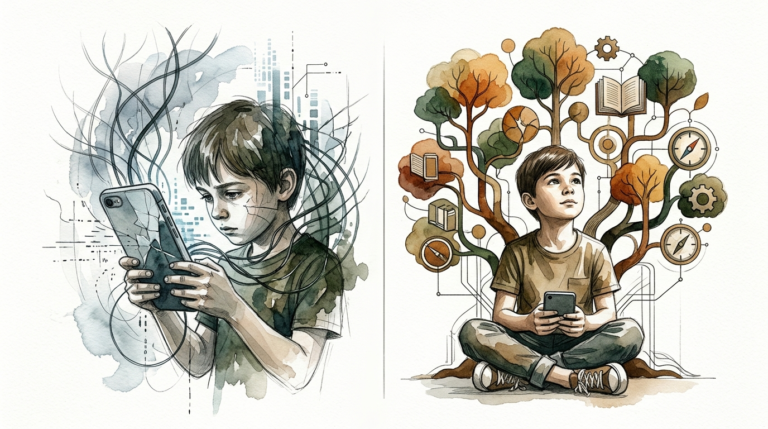
Is your child learning to watch someone else’s life, or build their own? The digital world wants our children to be the ultimate consumers. The real world needs them to be the ultimate producers. It starts with a simple craft.
The average child between the ages of 8 and 18 spends roughly 7.5 hours per day in front of a screen for entertainment alone. This adds up to 114 days a year spent in a state of passive intake. While the digital landscape offers information, it rarely offers the deep, tactile satisfaction of creation.
Handicrafts provide the antidote to this digital drift. When a child picks up a needle, a hammer, or a lump of clay, they transition from a spectator to a creator. They stop asking “What can I watch?” and start asking “What can I make?” This shift in mindset is the foundation of a resilient, capable adult.
Handicrafts For Kids Benefits
Handicrafts are more than just “arts and crafts.” In the classical sense, particularly within the Charlotte Mason philosophy, a handicraft is the creation of an object that is both beautiful and useful. It is not “busy work” or what some call “futilities”—temporary projects like gluing sugar cubes or paper mats that end up in the trash by Tuesday.
True handicrafts involve learning a skill that can be used for a lifetime. Think of woodworking, sewing, knitting, gardening, or pottery. These activities exist in the real world to solve problems and create value. When children engage in them, they are practicing the ancient art of industry.
The benefits of these activities go beyond the finished product. They provide a sense of agency. In a world where everything is “on-demand” and “automated,” handicrafts require time, effort, and manual dexterity. This teaches a child that their hands have the power to change their environment.
The Science of Making: How It Works
The process of learning a handicraft follows a specific neurological and developmental path. It begins with the development of fine motor skills. When a child uses scissors, needles, or small hand tools, they are strengthening the small muscles in their hands and fingers.
This physical development is directly linked to cognitive growth. Precise hand movements stimulate the prefrontal cortex, the area of the brain responsible for executive functions like planning and problem-solving. As the child navigates the steps of a project, they are building neural pathways that support logic and concentration.
The “How-To” of handicrafts generally follows an apprenticeship model. First, the child observes a master—or a parent—performing the task. Then, they attempt the task with heavy supervision. Finally, they move toward independent mastery. This slow, careful instruction prevents the “slipshod work” that often happens when children are left to figure out complex tasks alone.
The Psychological Shift: Producer vs. Consumer
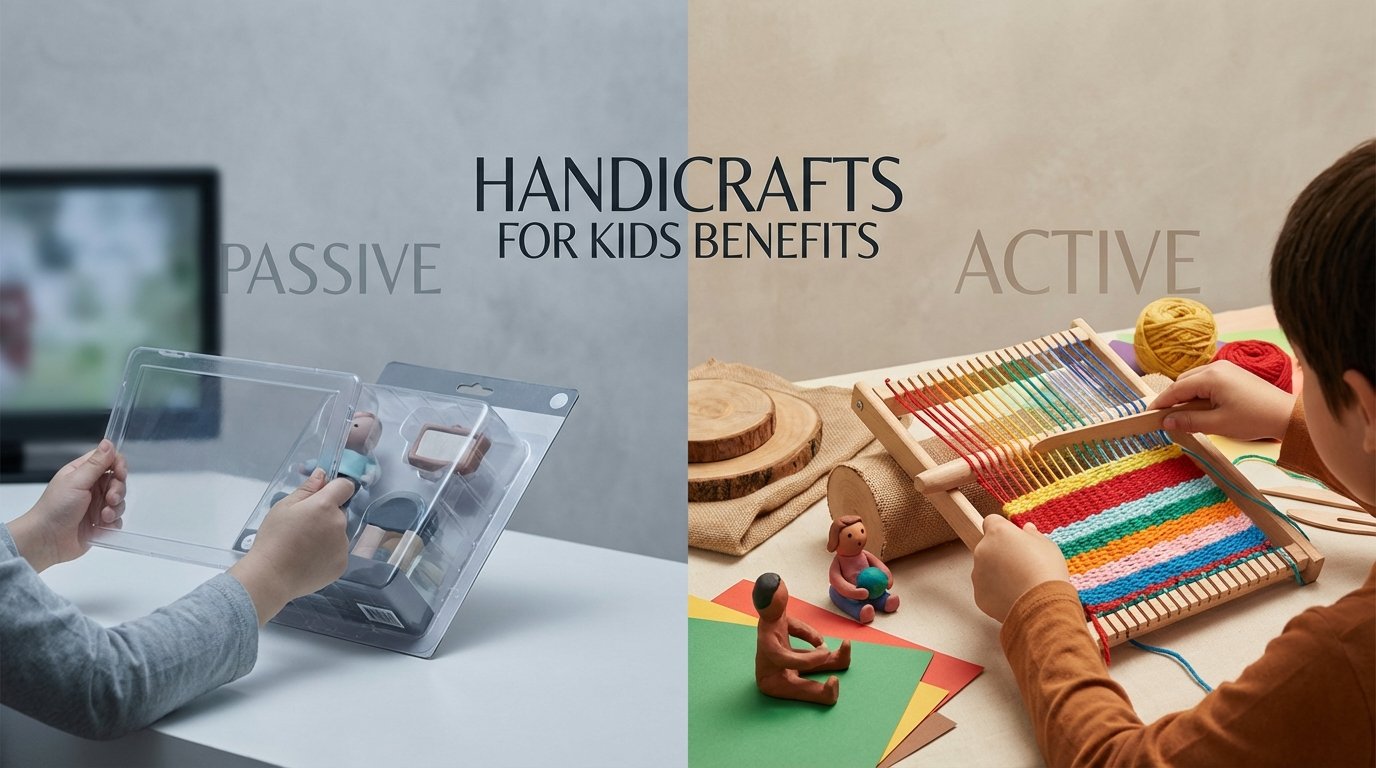
One of the most profound benefits of handicrafts is the internal shift from a passive consumer to an active producer. This is not just a change in activity; it is a change in identity.
The Passive Consumer is dependent. They wait for others to provide entertainment, solutions, and products. This mindset can lead to a sense of listlessness or boredom when the “feed” stops. The Active Producer is independent. They look at a piece of wood and see a spoon. They look at a ball of yarn and see a scarf.
This shift builds intrinsic self-worth. Confidence doesn’t come from being told they are great; it comes from looking at a tangible item and saying, “I made this.” This is measurable progress that no digital “badge” can replicate.
Age-Appropriate Projects: A Step-By-Step Guide
To successfully introduce handicrafts, you must match the skill to the child’s developmental stage. Pushing a child too fast leads to frustration, while holding them back leads to boredom.
Early Childhood (Ages 3–5)
Start with tactile exploration. Beeswax candle rolling is an excellent first handicraft. It requires no tools, only the warmth of the hands. Lacing cards and basic “paper sloyd” (folding and cutting paper with precision) help build the foundation for sewing.
Elementary Years (Ages 6–10)
This is the golden age for learning specific trades. Knitting, spool knitting, and basic embroidery are perfect for developing concentration. For those interested in building, simple woodworking like hammering nails into a soft pine block to create “string art” or assembling a birdhouse kit provides immediate satisfaction.
The Tween and Teen Years (Ages 11+)
Older children can handle tools that require more responsibility. This includes wood carving (whittling), machine sewing, leather tooling, and complex gardening. At this stage, the focus should shift toward utility. Can they mend their own clothes? Can they build a shelf for their books?
The Massive Benefits of Handicrafts
The practical, measurable benefits of handicrafts are extensive. They touch every part of a child’s development, from their physical health to their emotional resilience.
- Enhanced Concentration: Unlike the 15-second dopamine hits of short-form video, a handicraft takes hours or days. This builds the “concentration muscle” required for academic success.
- Patience and Resilience: Things will go wrong. A stitch will drop. A piece of wood will split. Handicrafts teach children to troubleshoot and try again rather than giving up.
- Hand-Eye Coordination: Activities like weaving or clay modeling require a high degree of synchronicity between what the eye sees and what the hand does.
- Appreciation for Quality: When a child knows how much effort it takes to make a quality item, they stop being satisfied with cheap, disposable goods.
Challenges and Common Mistakes
The biggest mistake parents make is prioritizing the “cute” factor over the “skill” factor. If the parent does 90% of the work so the project looks “perfect” for social media, the child learns nothing.
Another challenge is “the mess.” Handicrafts are inherently messy. Sawdust, scrap fabric, and clay smears are signs of a productive home. If you are too afraid of the mess, you will stifle the creativity. Designate a specific “maker space” where mess is allowed and expected.
Finally, avoid the trap of “easy” kits. While some kits are great for beginners, many are designed to be completed in five minutes with zero skill required. Look for projects that require the child to learn a technique, such as a specific knot or a type of stitch.
Limitations: When This May Not Be Ideal
Handicrafts require a significant investment of time and attention. If your schedule is packed from 6:00 AM to 9:00 PM with sports and extracurriculars, adding a complex handicraft might just add stress. These activities flourish in “white space”—the quiet afternoons where a child has time to get bored and pick up a tool.
Safety is also a boundary. You cannot hand a carving knife to a child who has not shown the ability to follow basic safety instructions. Handicrafts are a privilege that comes with the responsibility of handling real tools with respect.
Comparison: The Passive Consumer vs. The Active Producer
To understand the value of handicrafts, it helps to compare the two dominant ways children spend their free time today.
| Feature | Passive Consumer (Digital) | Active Producer (Handicrafts) |
|---|---|---|
| Attention Span | Short (seconds/minutes) | Long (hours/days) |
| Motor Skills | Minimal (swiping/clicking) | High (dexterity/strength) |
| Emotional State | Reactive / Overstimulated | Focused / “Flow” State |
| Output | Ephemeral / Nothing Tangible | Permanent / Useful Object |
| Self-Worth | Based on Likes/Feedback | Based on Tangible Competence |
Practical Tips for Success
If you want your child to stick with a handicraft, you must set them up for success. It’s not just about the craft; it’s about the environment.
- Use Real Tools: Don’t buy “toy” hammers or plastic needles that don’t work. Small, real tools are safer because they actually do the job they are supposed to do.
- Focus on Utility: Ask the child, “What does the house need?” Maybe it’s a new potholder or a wooden coaster. Making something that will actually be used increases the stakes.
- Accept Imperfection: The first scarf will be lumpy. The first birdhouse will be crooked. This is okay. Do not allow “slipshod” work (laziness), but do celebrate “honest” work (best effort).
- Model the Behavior: If you want your child to craft, you should craft too. Let them see you mending a sock or fixing a leaky faucet.
Advanced Considerations: Beyond the Basics
Once a child has mastered the basics, you can move toward “The Entrepreneurial Phase.” This is where the producer mindset really takes flight.
Encourage your child to sell their wares at a local craft fair or to family friends. This introduces them to the concepts of cost of materials, labor time, and profit margins. They learn that their skills have market value.
Scaling the skill is another consideration. If a child loves clay, don’t just stay with air-dry clay. Find a local pottery studio with a kiln. If they love woodworking, introduce them to different types of wood like oak or walnut. Mastery comes from constantly pushing the boundaries of the medium.
Examples and Scenarios
Consider two different afternoons.
In Scenario A, a child spends two hours scrolling through “satisfying” videos of people making pottery. They are entertained, but when the phone turns off, they feel a sense of emptiness and a slight headache. They have produced nothing.
In Scenario B, a child spends those same two hours at a table with a bag of clay. They struggle to center the clay, they fail three times, but eventually, they produce a small, lumpy bowl. It needs to dry and be painted. Every time they see that bowl on the shelf, they are reminded of their own persistence.
The lumpy bowl is a trophy of character. The scrolled video is a ghost of time.
Final Thoughts
Handicrafts for kids are not about creating professional-grade products. They are about creating professional-grade humans. By teaching a child to work with their hands, you are giving them the tools to navigate a world that is becoming increasingly disconnected from reality.
When a child learns to produce, they gain a level of independence that no app can provide. They learn that they are not victims of their environment, but architects of it. This confidence ripples out into their schoolwork, their relationships, and eventually, their careers.
Start small. Buy a ball of yarn or a piece of balsa wood today. Put away the screens and clear off the kitchen table. The digital world can wait; the real world is waiting to be built.
Sources
1 slicktext.com (https://www.slicktext.com/blog/2023/01/30-key-screen-time-statistics-for-2022-2023/) | 2 simplycharlottemason.com (https://simplycharlottemason.com/timesavers/handicrafts/) | 3 steemit.com (https://steemit.com/steemiteducation/@apanamamama/what-are-handicrafts-a-charlotte-mason-education-schoolhouse-saturday-by-a-panama-mama) | 4 treehouseschoolhouse.com (https://treehouseschoolhouse.com/blog/the-best-handcrafts-for-children) | 5 scholastic.com (https://www.scholastic.com/parents/klutz/benefits-of-crafting-for-kids.html) | 6 ourjourneywestward.com (https://ourjourneywestward.com/charlotte-mason-series-8-handicrafts-and-life-skills/) | 7 economicmotivation.blog (https://economicmotivation.blog/2020/07/28/consumer-vs-producer/) | 8 occupationaltherapy.com.au (https://occupationaltherapy.com.au/the-benefits-of-art-and-craft-for-childrens-skill-development/) | 9 wordpress.com (https://wholeheartedhomemaking.wordpress.com/2024/06/06/jack-of-all-trades-handicrafts-by-age/) | 10 unwind.studio (https://www.unwind.studio/blogs/unwind-studio-blog/6-amazing-benefits-of-crafts-for-kids) | 11 selfeducatingfamily.com (https://selfeducatingfamily.com/what-is-handicraft/) | 12 amblesideonline.org (https://www.amblesideonline.org/art-handicrafts) | 13 markmerrill.com (https://www.markmerrill.com/are-you-raising-producers-or-consumers-what-is-the-difference-and-why-does-it-matter/) | 14 benjweinberg.com (https://benjweinberg.com/2018/09/11/the-producer-vs-consumer-mindset/) | 15 imthecheftoo.com (https://www.imthecheftoo.com/blogs/stem-for-kids/15-creative-kids-diy-wood-projects-for-every-age) | 16 rocksolidfamilies.org (https://www.rocksolidfamilies.org/blogoriginal/2024/5/28/are-we-teaching-our-kids-to-be-consumers-or-producers) | 17 substack.com (https://debliu.substack.com/p/consumers-vs-producers) | 18 theopenflow.org (https://theopenflow.org/the-benefits-of-arts-and-crafts-for-kids/) | 19 monstermath.app (https://www.monstermath.app/blog/how-much-screen-time-are-kids-getting-in-the-us-in-2025) | 20 recordablebookbuddy.com (https://recordablebookbuddy.com/blogs/read-to-me/what-2025-research-says-about-kids-and-screens-and-why-screen-free-storytime-still-wins) | 21 mother.ly (https://www.mother.ly/child/child-learn-play/screen-time-for-kids-statistics-2025/) | 22 luriechildrens.org (https://www.luriechildrens.org/en/blog/screen-time-2025/) | 23 kidcreate.com (https://kidcreate.com/blog?post=how-art-encourages-child-development)