Unstructured Play Vs Structured App Time
Is their imagination living in a paved parking lot or a flourishing meadow? Apps are like ‘urban’ concrete—efficient, paved, and predictable. But a child’s brain needs the ‘wild’ of boredom and unstructured time to grow. Statistics show that children with more ‘unstructured’ time develop higher executive function. Don’t pave over their imagination with a screen.

Every parent wants to give their child the best start. We buy the latest “educational” apps and sign them up for every available extracurricular activity. We worry that a single minute of idle time is a wasted opportunity for growth. But what if the opposite is true? What if the very things we use to “build” our children’s futures are actually narrowing their potential?

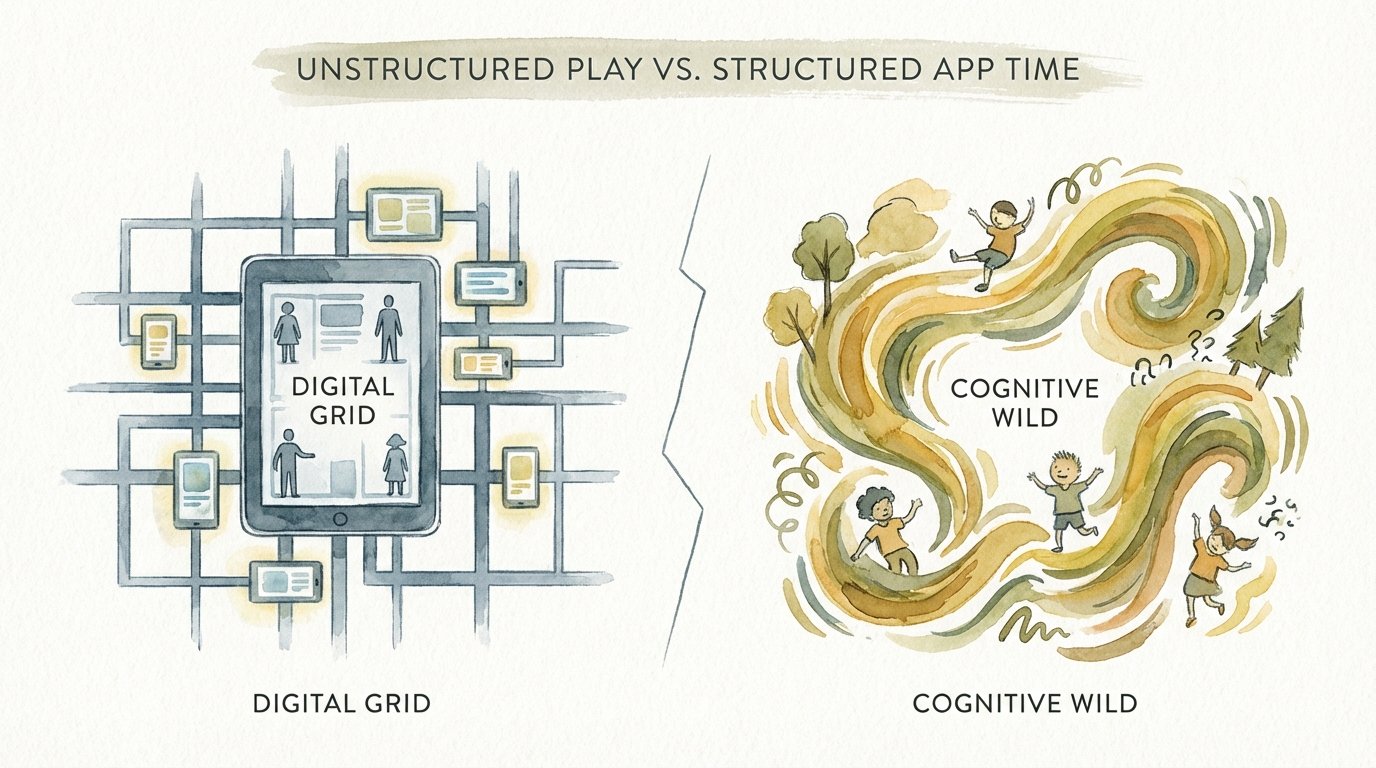
The modern childhood is increasingly defined by the Digital Grid. This is a world of pre-defined paths, instant rewards, and adult-led structures. It is efficient, but it is also restrictive. In contrast, the Cognitive Wild is where the real development happens. It is the messy, unpredictable, and often “boring” space where a child’s brain is forced to create its own structure.
Understanding the difference between these two worlds is the first step toward reclaiming your child’s cognitive liberty. It is not about throwing away the tablet. It is about recognizing that the “concrete” of apps should never fully cover the “meadow” of the mind.
Unstructured Play Vs Structured App Time
Unstructured play is any activity that is child-led and lacks a pre-determined goal or adult-imposed rules. Imagine a child in a backyard with a stick. There is no manual. There are no “levels” to clear. The stick might be a sword, a magic wand, or a tool for digging a hole to the center of the earth. This is the hallmark of the Cognitive Wild.
Structured app time is the exact opposite. Even the best educational apps operate within a Digital Grid. They provide the goals, the rewards, and the logic. The child is a passenger in a system designed by someone else. While they may be learning “facts,” they are not practicing the high-level skill of generating their own purpose.
Real-world research highlights this divide clearly. A landmark study by Jane Barker and colleagues at the University of Colorado found that children who spend more time in less-structured activities develop stronger self-directed executive function. These children are better at setting their own goals and figuring out how to achieve them without being told what to do next.
Conversely, children heavily involved in structured activities—like sports lessons or constant app usage—often struggle when the “adult” or “system” is removed. They have been trained to follow a path, not to forge one. This creates a dependency on external stimulation that can last a lifetime.
How the Brain Builds Itself in the Wild
The brain does not just grow; it sculpts itself based on use. When a child is “bored,” a specific neural network called the Default Mode Network (DMN) kicks into high gear. This system is responsible for daydreaming, self-reflection, and imaginative “mental wandering.” It is the engine of creativity.
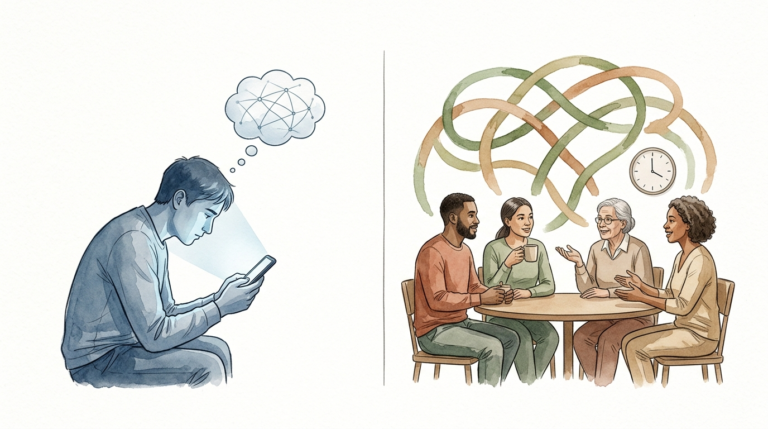
Apps often suppress the DMN. They provide a constant stream of “bottom-up” stimulation. This means the screen is capturing the child’s attention rather than the child directing it. Over time, this can lead to a baseline of dopamine dependence. A child used to the high-frequency rewards of a tablet finds the physical world “too slow” and “boring.”
The Role of Executive Function
Executive function is the “CEO” of the brain. It handles working memory, cognitive flexibility, and inhibitory control. These are the skills that predict success more accurately than IQ. Unstructured play is the primary gymnasium for these skills.
When a child plays “make-believe,” they are constantly exercising executive function. They must remember the rules of their imaginary world (working memory), adapt when a playmate changes the story (flexibility), and resist the urge to quit when things don’t go their way (inhibitory control). An app handles all of this for them, essentially “outsourcing” the brain’s hardest work to a silicon chip.
White Matter and Connectivity
Recent MRI studies, such as those led by Dr. John Hutton, have shown that excessive screen time in preschoolers is associated with lower integrity in white matter tracts. These are the “information highways” that connect different parts of the brain responsible for language and literacy.
The Cognitive Wild encourages the growth of these connections. By engaging with the 3D world—touching, building, falling, and trying again—the brain builds robust, multi-sensory maps. The Digital Grid is 2D and low-sensory. It provides a “paved” experience that, while easy to navigate, leaves the surrounding “neural forest” thin and underdeveloped.
The Measurable Benefits of Being Bored
Boredom is not a problem to be solved; it is a developmental threshold. When a child hits the wall of boredom, they are standing at the edge of the Digital Grid. What happens next determines their cognitive future. If they are handed a screen, they retreat into the “concrete.” If they are left to struggle, they enter the “wild.”
Creativity and Innovation: Research shows that boredom is a precursor to creative problem-solving. When the brain lacks external input, it starts making internal connections. This is where original ideas are born. A child who can entertain themselves with nothing but their thoughts is a child who will one day be able to innovate in the workplace.
Resilience and Emotional Regulation: Sitting with the discomfort of boredom builds frustration tolerance. Life is not always exciting. Children who learn to manage “quiet time” without a digital pacifier are far more resilient when facing real-world challenges. They don’t panic when the “reward” isn’t immediate.
Self-Awareness: Constant digital input drowns out the internal voice. Unstructured time allows a child to hear their own thoughts. They begin to discover what they actually like, rather than what an algorithm tells them to like. This builds a strong sense of identity and internal “locus of control.”
Challenges and Common Pitfalls
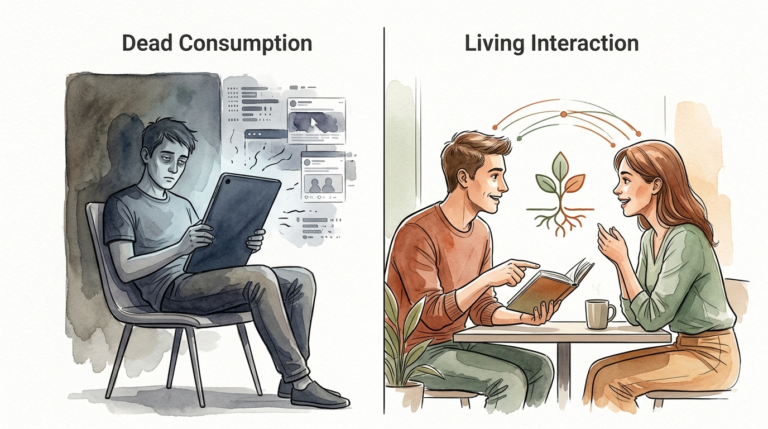
The biggest challenge is the “Convenience Trap.” It is infinitely easier to give a child an iPad during a long car ride or a doctor’s visit than it is to manage their restlessness. We have been conditioned to believe that a quiet child is a “good” child. But a child quieted by a screen is often in a state of “passive consumption,” not active growth.
The Parental Guilt Cycle
Many parents feel guilty when their child complains of boredom. They feel like they are failing to provide an “enriched” environment. This leads to the “Resume Building” childhood, where every hour is scheduled with enrichment classes. Ironically, this over-scheduling can lead to burnout and a decrease in actual learning efficiency.
Persuasive Design in Apps
We must recognize that apps are not neutral tools. They are built using “persuasive design” techniques—the same ones used in slot machines. Variable reward schedules, bright colors, and “streaks” are designed to keep the user engaged for as long as possible. A child’s developing prefrontal cortex is no match for a team of Silicon Valley engineers.
Common Mistakes Include:
- Using screens as the primary “cooldown” tool after a tantrum.
- Equating “educational” content with “good” developmental content.
- Fearing that a child will “fall behind” if they aren’t constantly stimulated.
- Intervening too quickly when a child says, “I’m bored.”
Limitations: When the Wild Isn’t Ideal
It is important to maintain a balanced perspective. The “Cognitive Wild” requires a safe environment to be effective. In some urban settings, outdoor play is limited by safety concerns or lack of green space. In these cases, unstructured time must be fostered indoors with open-ended materials like blocks, art supplies, or even household items.
Furthermore, structured time is not “bad” in moderation. Organized sports teach teamwork and discipline. Academic tutoring can bridge specific gaps. The problem arises when these structured activities consume 100% of the child’s waking hours. The “Digital Grid” and the “Cognitive Wild” can coexist, but the wild must be protected as the primary habitat for growth.
Specific developmental conditions also play a role. Children with certain neurodivergent profiles may find completely unstructured time overwhelming and may need a “scaffolded” version of free play. In these instances, the goal is still to move toward autonomy, but the starting point may require more adult support.
Digital Grid vs. Cognitive Wild
How do these two approaches compare across the metrics that matter most for long-term development?
| Feature | Digital Grid (Apps/Structured) | Cognitive Wild (Free Play) |
|---|---|---|
| Cognitive Load | Low (Externally managed) | High (Self-directed) |
| Dopamine Baseline | High (Instant rewards) | Normal (Delayed gratification) |
| Executive Function | Passive (Following rules) | Active (Creating rules) |
| Cost | Medium to High (Devices/Subs) | Zero to Low (Sticks/Boxes) |
| Skill Level Required | Low (Tap and swipe) | High (Imaginative synthesis) |
Practical Tips for Rewilding the Mind
Transitioning from a screen-heavy schedule to a “wilder” one doesn’t have to happen overnight. It is about creating space for the brain to breathe.
The 10-Minute Boredom Gap: When your child asks for a screen, tell them they have to wait 10 minutes. Don’t provide an alternative. Just let them sit with the boredom. Frequently, by the time the 10 minutes are up, they have found something to do with their hands or their mind.
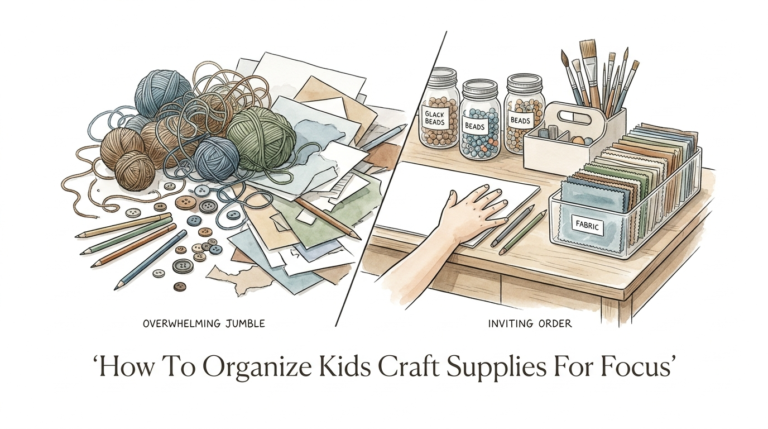
The “Boredom Box”: Fill a bin with open-ended materials. Cardboard tubes, old fabric, string, masking tape, and plastic containers. These are “low-structure” toys that require “high-structure” imagination.
Enforce “Digital Sunsets”: Shut down all screens at least two hours before bed. This allows the brain’s baseline to reset and encourages the DMN to activate before sleep, which can lead to better dream processing and memory consolidation.
Go Outside Without a Goal: Take your child to a park or a woods and don’t lead the way. Let them wander. Let them find a bug or a strange rock. Resist the urge to turn it into a “lesson.” The lesson is the wandering itself.
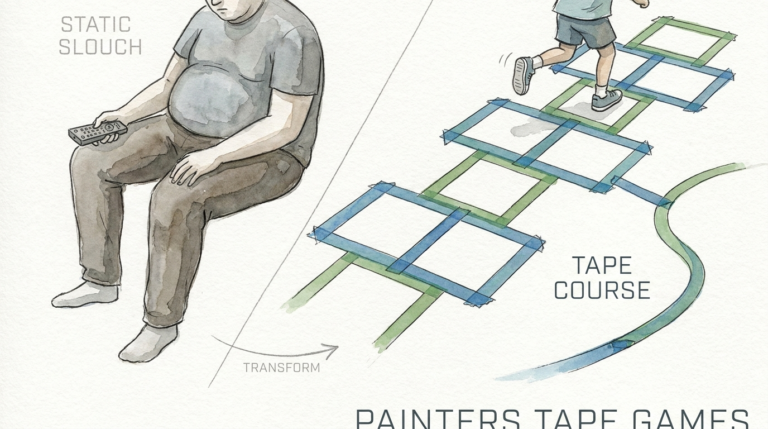
Stop Starting Every Sentence With “Let’s”: Instead of suggesting activities (“Let’s play blocks”), simply sit in the room and be present without directing. Wait for them to initiate. This shifts the “executive” burden from you to them.
Advanced Considerations: Neuroplasticity and the Long Game
The human brain remains plastic throughout life, but the windows for fundamental executive function development are narrowest during early childhood and adolescence. This is when the “myelination” of the brain is at its peak—the process of insulating neural pathways to make them faster and more efficient.
If we pave over the mind during these windows with the Digital Grid, we aren’t just losing a few hours of play. We are potentially “hard-wiring” a brain that is optimized for consumption rather than creation. A brain that requires external “pings” to feel engaged.
Serious practitioners of “cognitive rewilding” look at the environment as a “third teacher.” They analyze the physical space to see if it encourages movement and risk-taking. They understand that a “messy” room is often a sign of a highly active executive function center. Scaling this approach means moving away from a culture of “efficiency” and toward a culture of “depth.”
Example: The Cardboard Box vs. The iPad Game
Consider two scenarios. In the first, a child is given a “City Builder” app. They drag and drop pre-made buildings onto a grid. The graphics are great. The app gives them “coins” for every house they build. They stay focused for 40 minutes. At the end, they have a digital city that looks like everyone else’s city.
In the second scenario, the child is given a large cardboard box and some markers. For the first 10 minutes, they complain. They say it’s just a box. Then, they draw a window. Then, they decide it’s a submarine. They have to figure out how to make a “periscope” out of a paper towel roll. They have to decide where the “engine” is.
In the first scenario, the child practiced zero self-directed executive function. In the second, they practiced all of it. They were the architect, the engineer, and the storyteller. They built their city on the Cognitive Wild, and the neural connections they made will still be there long after the app is deleted.
Final Thoughts
The Digital Grid is a powerful tool, but it is a poor master. When we allow structured time and screen-based media to dominate a child’s life, we are trading long-term cognitive depth for short-term convenience. We are paving over the very meadows where innovation, resilience, and self-awareness grow.
Reclaiming the Cognitive Wild isn’t about rejecting technology; it’s about protecting the “wild” spaces in the human mind. It’s about having the courage to let your child be bored. It’s about trusting that their imagination is more powerful than any algorithm ever written.
Encourage your child to step off the paved path. Let them find their own way through the meadow. The future doesn’t belong to those who can follow a grid, but to those who have the executive function to build a new world from scratch. Give them the stick, the box, and the time to dream. Their brain will do the rest.
Sources
1 braintasticscience.com (https://www.braintasticscience.com/post/the-neuroscience-of-boredom-why-doing-nothing-is-good-for-brain-development) | 2 ufl.edu (https://blogs.ifas.ufl.edu/fycsdept/2014/07/14/let-em-play-how-unstructured-time-benefits-your-child/) | 3 nih.gov (https://pubmed.ncbi.nlm.nih.gov/25071617/) | 4 safariltd.com (https://www.safariltd.com/blogs/toys-that-teach/the-benefits-of-boredom-for-kids-unlocking-creativity-building-resilience-and-cultivating-life-skills) | 5 cpha.ca (https://www.cpha.ca/sites/default/files/uploads/resources/play/play_10perceptions_vs_fact_infographic_e.pdf) | 6 buildingbrains.ca (https://www.buildingbrains.ca/blog/the-science-behind-boredom-why-kids-need-down-time) | 7 integratedcareclinic.com (https://integratedcareclinic.com/blog/the-healing-power-of-boredom-why-kids-and-teens-need-to-be-bored-sometimes/) | 8 childrenandnature.org (https://research.childrenandnature.org/research/unstructured-activities-improves-childrens-self-directed-executive-functioning-2/) | 9 learningrx.com (https://www.learningrx.com/reston/5-benefits-of-being-bored/) | 10 solutionhealth.org (https://www.solutionhealth.org/2024/06/04/overbooked-kids-the-overscheduled-epidemic/) | 11 nih.gov (https://pmc.ncbi.nlm.nih.gov/articles/PMC11592547/) | 12 colorado.edu (https://www.colorado.edu/today/2014/06/18/kids-whose-time-less-structured-are-better-able-meet-their-own-goals-says-cu-boulder) | 13 cam.ac.uk (https://www.jbs.cam.ac.uk/2024/how-digital-media-impacts-child-development/) | 14 psychologytoday.com (https://www.psychologytoday.com/us/blog/play-and-imitation/202103/the-incredibly-high-value-free-play) | 15 srcd.org (https://www.srcd.org/news/young-toddlers-may-learn-more-interactive-noninteractive-media)