Screen Time And Sensory Processing In Kids
The ‘screen-crash’ isn’t bad behavior—it’s a sensory system that has forgotten how to calibrate to the real world. Standard parenting fights the tantrum; Pro parenting understands the dopamine drop. When a child’s screen use crosses the line, their nervous system literally loses its ‘brakes’. Here is how to recalibrate their world.

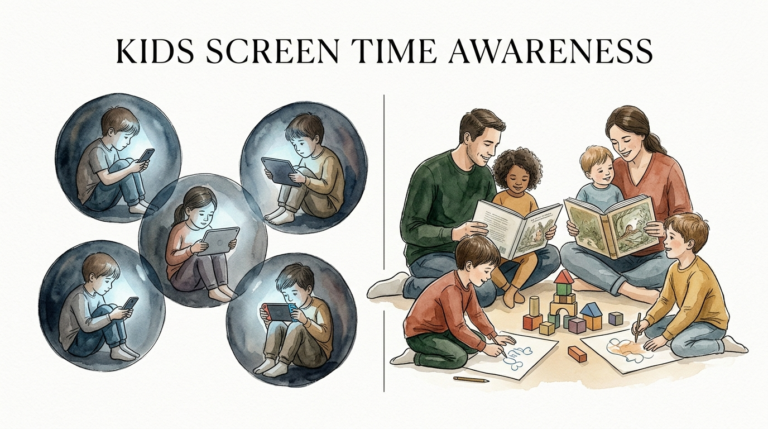
Every parent knows the feeling of dread when it is time to turn off the tablet. You see the glazed eyes, the slumped posture, and the sudden, explosive rage the moment the screen goes dark. This isn’t just a child being “difficult.” It is a physiological event happening inside their developing brain.

Digital environments are designed to be hyper-stimulating. They provide a level of sensory input and reward that the physical world simply cannot match. When we pull a child out of that high-octane environment, we aren’t just changing activities; we are forcing their nervous system to undergo a rapid, often painful decompression.
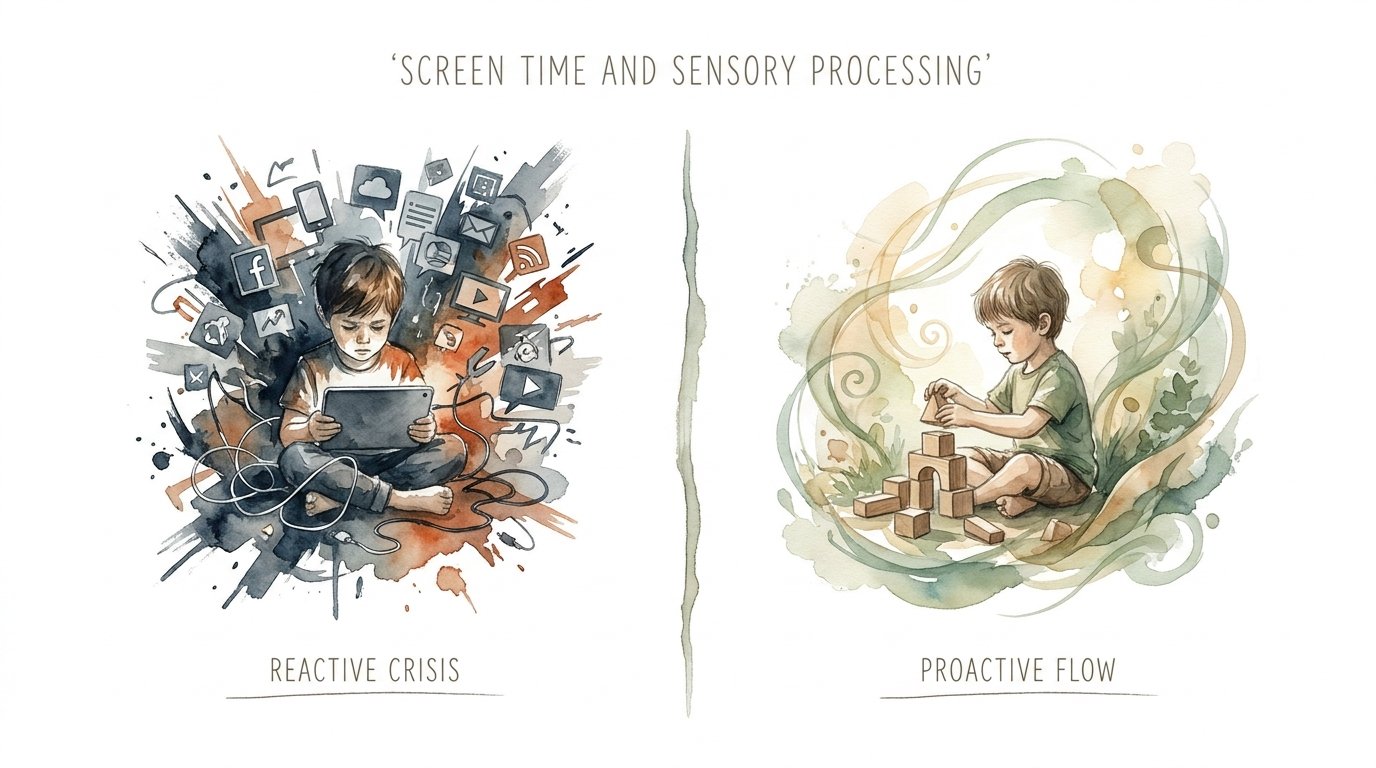
Understanding the “why” behind the screen-crash changes everything. It moves us from a state of reactive crisis to a proactive flow. Instead of battling the behavior, we begin to support the nervous system. This article dives deep into the science of screen-induced dysregulation and provides a roadmap for bringing your child back to reality without the meltdown.
Screen Time And Sensory Processing In Kids
Sensory processing is the way the nervous system receives messages from the senses and turns them into appropriate motor and behavioral responses. Think of it like a central dispatch station in the brain. It takes in sight, sound, touch, and movement, organizes it, and tells the body how to react.
Screens act like a massive, high-speed input filter that overwhelms this dispatch station. Research indicates that early and excessive screen exposure is linked to atypical sensory processing tendencies. Children may become “sensory seekers,” needing more intense stimulation to feel “normal,” or they may develop “low registration,” where they seem disengaged from the real world because it isn’t “loud” enough compared to their favorite game.
The digital world provides super-stimuli. Colors are brighter, sounds are more frequent, and rewards (dopamine hits) are instantaneous. In contrast, the real world is slow. Gravity requires effort. Social cues are subtle. When a child spends hours in a high-intensity digital environment, their sensory “thermostat” gets set to a level that the real world cannot meet.
This creates a disconnect. The child’s brain becomes calibrated to the rapid-fire visuals and instant gratification of a screen. When the device is removed, the sudden drop in stimulation feels like a physical shock. The nervous system enters a state of “fight or flight” because it is no longer receiving the high-intensity input it has been trained to expect.
How the Screen-Crash Happens: The Dopamine Drop
To fix the problem, we have to understand the chemistry. The primary driver of screen addiction and the subsequent crash is dopamine. This neurotransmitter is responsible for motivation and reward. Video games and social media apps are engineered to trigger massive dopamine spikes.
As a child plays, their brain is flooded with “pleasure” signals. To protect itself from this overstimulation, the brain eventually becomes less sensitive to dopamine. This is known as down-regulation. The child needs more screen time and more intense content just to feel “even.”
When the screen is turned off, several things happen simultaneously:
- Dopamine Withdrawal: The sudden cessation of the reward loop causes dopamine levels to plummet below the baseline. This leaves the child feeling irritable, anxious, and physically uncomfortable.
- Prefrontal Cortex Shutdown: The prefrontal cortex is the “CEO” of the brain, responsible for impulse control and emotional regulation. During high-intensity screen use, this area often goes quiet. When the screen stops, the “brakes” aren’t ready to work yet.
- Sensory Under-load: The real world feels “gray” and “slow.” The child’s eyes, ears, and body are searching for the high-intensity input that just vanished, leading to frantic, often aggressive behavior as they try to “wake up” their system.
This is why “one more minute” never works. You aren’t negotiating with a rational mind; you are negotiating with a brain in the middle of a neurochemical emergency.
Benefits of Proactive Sensory Calibration
Moving toward a sensory-informed approach to screen time provides immediate and long-term advantages for the entire family. By focusing on regulation rather than just rules, you change the atmosphere of the home.
The primary benefit is a reduction in transition meltdowns. When you use “sensory bridges” to move a child from a screen to the real world, the nervous system has time to adjust. You aren’t “yanking” them out; you are guiding them through a controlled descent.
Additional benefits include:
- Improved Emotional Resilience: Children learn how to manage the “boredom” or “slowness” of real life without needing a digital crutch.
- Better Sleep Quality: By managing blue light exposure and evening arousal levels, you protect the production of melatonin, leading to faster sleep onset and deeper rest.
- Stronger Social Connection: A regulated child is more capable of eye contact, turn-taking, and empathetic communication.
- Restored Attention Span: Reducing the constant “dopamine hits” allows the brain to re-calibrate, making it easier for the child to focus on schoolwork or creative play.
Challenges and Common Mistakes
The biggest mistake parents make is using the “Cold Turkey Yank.” Walking into a room and simply taking the device away without warning is a recipe for disaster. This triggers a survival response in the brain, making the child feel attacked rather than directed.
Another common pitfall is negotiating the end-time mid-game. Once a child is in the “flow state” of a game, their executive functions are offline. They will agree to anything to keep playing, but they won’t remember the agreement when the time is up. This leads to the “But you promised!” cycle of arguments.
Failing to provide a “sensory bridge” is also a frequent error. If you transition a child from a high-energy video game directly to a low-energy task like “sit down and do your homework,” the gap is too wide. Their brain is still “vibrating” at 100 mph while the task requires 10 mph. They will inevitably “spin out.”
Finally, many parents ignore their own digital habits. Children are biologically wired to mimic their caregivers. If we are constantly “micro-scrolling” on our phones, we are signaling to their nervous system that this high-intensity input is the most important thing in the environment.
Limitations and Realistic Boundaries
It is important to acknowledge that sensory calibration isn’t a “magic wand.” For children with diagnosed Sensory Processing Disorder (SPD), ADHD, or Autism, the screen-crash may be more intense and harder to manage. In these cases, screens aren’t just entertainment; they may be used as a maladaptive tool for self-regulation.
Environmental factors also play a role. If you live in an apartment with no outdoor space, “getting some green time” is harder. If you are a single parent working from home, screens may be a necessary tool for your own survival. Perfection is not the goal; progress is.
Additionally, some content is simply more “addictive” than others. Rapid-cut videos (like TikTok or YouTube Shorts) and “infinite loop” games (like Roblox) are harder to transition away from than a 20-minute episode of a slow-paced show. Understanding the “arousal level” of the content is just as important as the time spent on it.
Reactive Crisis vs. Proactive Flow
Most screen time management is reactive. We wait for the problem to happen, then we punish the behavior. Proactive management anticipates the sensory needs of the child and builds the solution into the routine.
| Factor | Reactive Crisis | Proactive Flow |
|---|---|---|
| Ending Screen Time | Abruptly taking the device. | Visual timers and “Sensory Bridges.” |
| Communication | Shouting from another room. | Eye contact and “Touch Warnings.” |
| Transition Activity | High-demand tasks (Homework). | Proprioceptive input (Heavy work). |
| Parental Role | The “Enforcer” or “Police.” | The “Navigator” or “Coach.” |
| Goal | Compliance and obedience. | Regulation and connection. |
Practical Tips for a Smooth Transition
To successfully “land the plane,” you need to provide the brain with what it is missing: Heavy Input. This is officially known as proprioceptive input. It is the “input to the muscles and joints” that tells the brain where the body is in space. It is incredibly grounding and acts as a natural “brake” for the nervous system.
- The 5-Minute Warning with Touch: Don’t just yell “five minutes.” Walk over, put a hand on their shoulder, wait for them to look at you, and then say, “Five minutes until we do our bear crawls to the kitchen.” This grounds them in the physical world.
- Use a Visual Timer: Children (especially those with ADHD) often have “time blindness.” A visual timer that shows the red disappearing helps the brain prepare for the end.
- The Sensory Bridge: Immediately after the screen goes off, engage in 2–5 minutes of “heavy work.” This could be pushing a laundry basket, doing wall push-ups, or jumping on a trampoline. This provides the “big” input their system is craving.
- The “Human Burrito”: If your child is already melting down, wrap them snugly in a heavy blanket. This deep pressure provides calming signals to the nervous system and helps lower cortisol levels.
- Crunchy Snacks: The act of chewing something crunchy (carrots, pretzels, apples) provides proprioceptive input through the jaw, which is highly regulating for the brain.
Advanced Considerations: Content and Timing
Serious practitioners of “digital hygiene” should look beyond the clock. Content density matters more than minutes. A child watching a slow-paced nature documentary will have a much easier time transitioning than a child playing a fast-paced “battle royale” game.
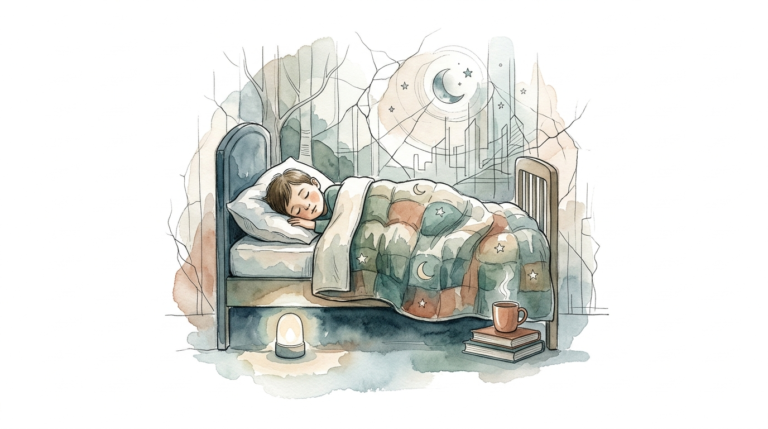
Consider the circadian rhythm. Screen use in the hour before bed is exponentially more damaging than screen use in the morning. The blue light suppresses melatonin, but the “mental engagement” of the content keeps the brain in a state of high arousal. This leads to “tired but wired” syndrome, where the child is exhausted but cannot shut down.
You can also utilize “Smart Screen Time” strategies. Encourage “active viewing” where the child has to move while watching. For example, “Every time the character jumps, you jump.” This keeps the vestibular and proprioceptive systems engaged, making the gap between the screen and the real world smaller.
Example Scenario: The Minecraft Transition
Imagine your 8-year-old is deep into building a Minecraft world. Dinner is in ten minutes. Instead of shouting from the kitchen, you walk into the room. You sit next to them for 60 seconds and ask, “What are you building?” This joins their world and makes you a partner rather than an adversary.
You set a visual timer for 5 minutes. You say, “When the red is gone, we are going to see how many ‘Spider-Man’ wall climbs you can do before we wash hands.” You are announcing the sensory bridge before the screen even turns off.
When the timer beeps, you help them save their game. If they grumble, you ignore the verbal protest and immediately start the wall climbs. You provide high-intensity physical input that replaces the high-intensity digital input. By the time they get to the table, their dopamine has stabilized, and their “brakes” are back online.
Final Thoughts
The “screen-crash” is a physiological reality of the modern world. We cannot expect a child’s developing brain to handle the most addictive technology in human history without support. When we stop viewing tantrums as “bad behavior” and start seeing them as a cry for regulation, our parenting becomes much more effective.
By using sensory bridges, heavy work, and proactive timing, you can protect your child’s nervous system from the digital roller coaster. You aren’t just managing their screen time; you are teaching them the vital life skill of self-regulation. This is how we raise children who can navigate a high-tech world without losing their connection to the real one.
Start small. Pick one transition today—perhaps the one before bed—and try a 2-minute “heavy work” bridge. Watch how their system responds. You may find that the “battle” was never about the screen at all; it was about a nervous system that just needed a little help finding its way home.
Sources
1 childrenandscreens.org | 2 senseationalspaces.com | 3 childcareed.com | 4 potsdam.edu | 5 thejacobsladdergroup.org | 6 healthywithin.com | 7 holista.care | 8 thenoteninjas.com | 9 speechblubs.com | 10 speechblubs.com