Signs Of Screen Overuse Vision Impact
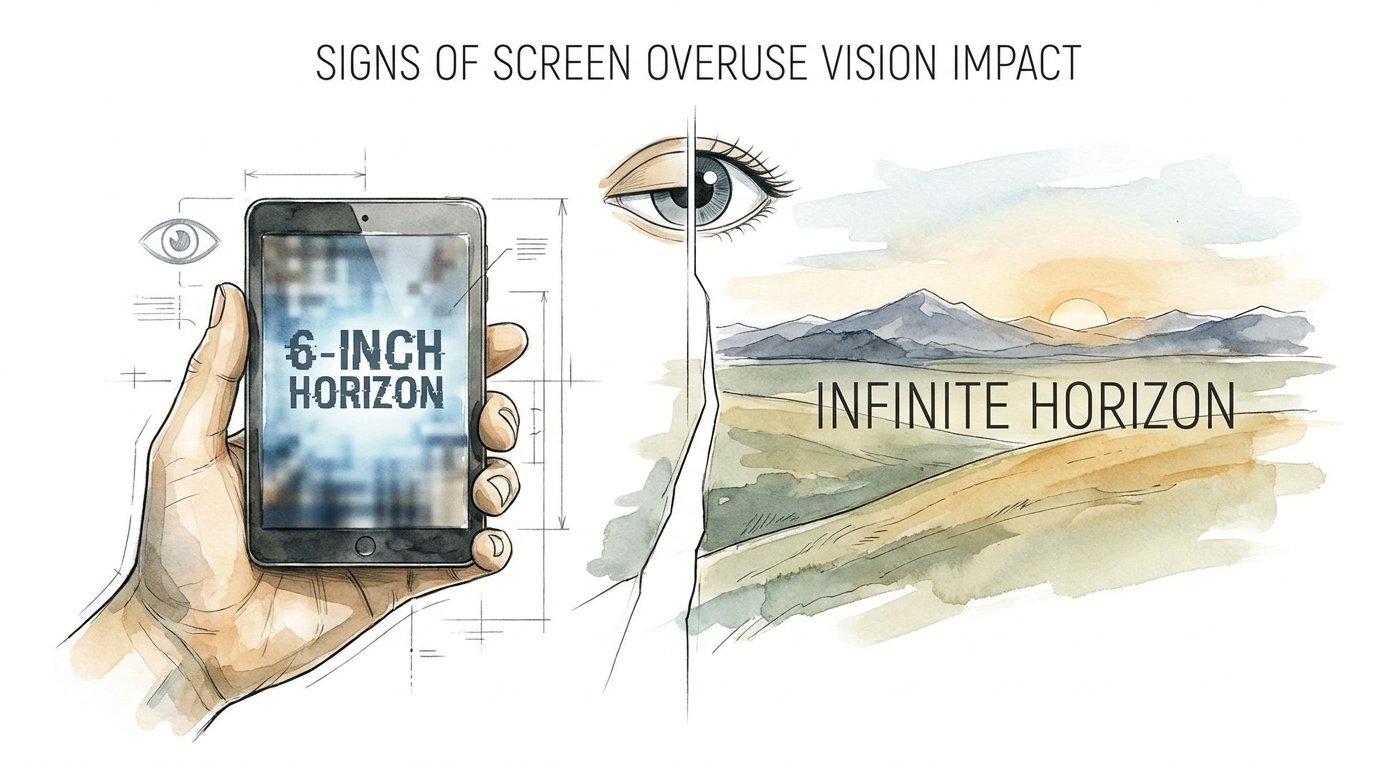
When the world further than arm’s length starts to look blurry, your child’s ‘habit’ has become a biological burden. We were designed to scan horizons, not stare at pixels. One of the first signs of overuse isn’t just behavioral—it’s the physical loss of the ‘far-off’ look. Here is how the 6-inch horizon is reshaping our children’s vision and how to reclaim the view.

The modern childhood is increasingly defined by the glow of a screen. Whether it is for school, socializing, or play, children are spending more time than ever in a “near-work” environment. This shift has profound implications for their physical development. Our eyes evolved to interact with a vast, three-dimensional world where focus shifts constantly from a nearby leaf to a distant mountain. Today, that range has collapsed into a flat, 6-inch plane.
This phenomenon is more than just a lifestyle change; it is a global health crisis. Researchers estimate that by 2050, nearly half the world’s population will be myopic. In some parts of East Asia, these rates already exceed 80% among young adults. The “6-inch horizon” isn’t just a metaphor for limited perspective. It is a literal description of the visual cage we have placed around a generation of developing eyes.
Protecting your child’s vision requires a deep understanding of how these devices interact with the biology of the eye. It isn’t about banning technology. It is about balancing the digital “6-inch horizon” with the biological necessity of the “infinite horizon.”
Signs Of Screen Overuse Vision Impact
Screen overuse manifests through a variety of physical and behavioral signals. Recognizing these early is crucial for preventing long-term damage like axial elongation. When a child stares at a screen for hours, the ciliary muscles in the eye remain in a state of constant contraction. This leads to what clinicians call digital eye strain or computer vision syndrome.
Common signs of vision impact include frequent squinting when looking at objects across the room. You might notice your child rubbing their eyes more often than usual, especially after a gaming session or homework. This is often a response to dry eye syndrome. Blinking rates drop significantly during screen use—from a normal 18 blinks per minute to as few as 3.6 blinks. This causes the tear film to evaporate, leading to irritation and redness.
Other symptoms include:
- Frequent Headaches: Often felt in the brow or temple area after prolonged near work.
- Difficulty Focusing: A child may complain that the TV or whiteboard looks blurry immediately after putting down a tablet.
- Holding Devices Closer: If a child keeps bringing the screen closer to their face, it is a sign their eyes are struggling to accommodate.
- Eye Fatigue: A general sense of tiredness or “heavy eyes” that disappears after a nap or outdoor play.
These signs are the body’s way of saying the visual system is overtaxed. If left unaddressed, this strain can transition from a temporary discomfort to permanent nearsightedness. In some cases, children develop “pseudomyopia,” where the focusing muscle gets stuck in a near-focus spasm. While this is reversible, it often mimics true myopia and can lead to unnecessary prescriptions if not evaluated by a professional.
The Biological Blueprint: How Near Work Elongates the Eye
The human eye is not a static organ. It is a dynamic, growing part of the body that responds to environmental cues. During childhood and adolescence, the eye naturally grows to match its focusing power. This process is called emmetropization. However, sustained near work—staring at a screen just inches away—disrupts this delicate balance.
When we focus on a nearby object, the eye must accommodate. If the focus is held too close for too long, a phenomenon called “accommodative lag” occurs. The image doesn’t focus perfectly on the retina; instead, it falls slightly behind it. This creates a “growth signal.” The eye, sensing that the image is behind the retina, begins to physically elongate to catch the focus. This elongation is known as axial length growth.
Axial elongation is the physical basis of myopia. Once the eyeball grows too long, light from distant objects can no longer reach the retina. It focuses in front of it instead. This makes the world beyond arm’s length appear blurry. Research shows that for every additional hour of screen time, the odds of developing myopia can increase by as much as 21%. In children aged 6 to 8, the prevalence of myopia surged by 1.4 to 3 times during periods of heavy screen-based lockdown.
How to Reclaim the View: The 20-20-2 Rule
Reversing the trend of myopia requires a proactive approach to visual hygiene. While many parents have heard of the 20-20-20 rule, modern research suggests we need to go further. Experts now recommend the **20-20-2 rule** as a more comprehensive strategy for children.
This system is easy to remember and apply:
- 20 Minutes of Near Work: After every 20 minutes of screen time or reading, the eyes need a break.
- 20 Seconds of Far Focus: During that break, the child must look at something at least 20 feet away for 20 seconds. This allows the ciliary muscles to relax completely.
- 2 Hours of Outdoor Time: This is the most critical addition. Children should spend at least two hours outdoors every day.
Outdoor time is the most powerful modifiable factor in preventing myopia. Natural light is hundreds of times brighter than indoor lighting. This intensity triggers the release of dopamine in the retina. Retinal dopamine acts as a “brake” on eye growth, preventing the eyeball from elongating excessively. Even 14 hours of outdoor time per week can nearly neutralize the genetic risk of myopia if both parents are nearsighted.
Benefits of Reclaiming the Infinite Horizon
Balancing screen time with distant viewing offers measurable benefits for a child’s development. The primary advantage is the prevention of high myopia. High myopia isn’t just about thicker glasses; it significantly increases the risk of serious eye diseases later in life, including retinal detachment, glaucoma, and macular degeneration. Every millimeter of axial length prevented is a massive win for long-term health.
Beyond physical eye health, reclaiming the “infinite horizon” improves cognitive focus. Screens offer high-frequency, dopamine-driven stimulation that can shorten attention spans. Transitioning to outdoor environments encourages “soft fascination”—a type of attention that allows the brain to rest and recover.
Practical benefits include:
- Better Sleep Quality: Natural light exposure during the day helps regulate circadian rhythms.
- Reduced Digital Fatigue: Regular breaks mean less irritability and fewer headaches.
- Improved Spatial Awareness: Moving through a 3D environment helps develop depth perception and coordination.
Challenges and Common Mistakes
One of the biggest mistakes parents make is relying on “blue light glasses” as a cure-all. While these lenses may reduce glare and help with sleep cycles, they do nothing to prevent myopia. Myopia is caused by the *distance* of the task, not the *color* of the light. Giving a child blue light glasses while letting them stare at a tablet for six hours does not protect their vision.
Another common pitfall is the “indoor-outdoor trap.” Many parents think that playing in a brightly lit indoor playroom is the same as being outside. It isn’t. Indoor light levels rarely exceed 500 lux, while a cloudy day outside provides over 10,000 lux. The eye needs that high-intensity light to trigger the chemical signals that stop excessive growth.
Challenges include:
- Educational Demands: Schoolwork is increasingly digital, making it hard to limit near work.
- Weather Constraints: Finding ways to get two hours of outdoor time in winter or rainy climates.
- Device Portability: Small screens like smartphones are held closer than laptops, increasing the strain.
Limitations: When Habits Aren’t Enough
While lifestyle changes are powerful, they have limitations. Genetics still play a significant role. If both parents are highly myopic, a child is at a much higher risk regardless of screen habits. In these cases, the “6-inch horizon” simply accelerates a process that was already predisposed.
Environmental habits are most effective at *preventing* the onset of myopia. Research suggests that once a child is already myopic, outdoor time may have a more modest effect on slowing its progression. At that stage, lifestyle changes must be combined with clinical interventions. You cannot “exercise” your way out of an elongated eyeball; once the eye has grown too long, it cannot shrink back.
Visual Environments: 6-Inch vs. Infinite Horizon
Understanding the difference between these two environments helps in making better daily choices for your child.
| Feature | 6-Inch Horizon (Screen) | Infinite Horizon (Outdoors) |
|---|---|---|
| Light Intensity | Low (approx. 100-500 lux) | High (10,000 to 100,000+ lux) |
| Muscle State | Constantly contracted (Strain) | Relaxed and dynamic |
| Blink Rate | Severely reduced (Dryness) | Normal and frequent |
| Dopamine Release | Low (Promotes growth) | High (Inhibits elongation) |
| Focus Range | Fixed, 2D plane | Vast, 3D depth |
Practical Tips for Managing Screen Time
Implementing better habits doesn’t require a total tech ban. It requires smarter integration. Start by optimizing the physical setup of screen use. Ensure that the screen is at least an arm’s length away. This is often called the “elbow rule”—your child should not be closer to the screen than the distance from their knuckles to their elbow.
Use the “Harmon Distance” for reading and writing. This is the distance between the elbow and the middle knuckle. Maintaining this gap reduces the accommodative demand on the eyes. Additionally, increase the font size on devices. Larger text allows the child to sit further back without straining to read.
Other best practices include:
- Screen Height: Position monitors so the child is looking slightly downward. This exposes less of the eye surface, reducing evaporation and dry eye.
- Brightness Matching: The screen should be roughly the same brightness as the surrounding room. Staring at a bright screen in a dark room increases glare and strain.
- Outdoor Meals: If the weather permits, have lunch or snacks outside to rack up those daylight hours.
- Audio-Only Options: Encourage audiobooks or podcasts for entertainment to give the visual system a complete rest.
Advanced Considerations: Myopia Management
For children whose vision is already deteriorating, basic habits may not be enough. This is where myopia management comes into play. Optometrists now have tools to actively slow down the elongation of the eye rather than just correcting the blur with standard glasses.
One common intervention is **low-dose atropine drops**. These eye drops, used at night, can reduce myopia progression by up to 50% with minimal side effects. They work by interacting with the chemical signaling pathways that control eye growth.
Another advanced option is **Orthokeratology (Ortho-K)**. These are specialized hard contact lenses worn only at night. They gently reshape the cornea while the child sleeps. In the morning, the lenses are removed, and the child can see clearly all day without glasses. More importantly, Ortho-K creates a specific type of peripheral focus that signals the eye to stop growing longer.
Multifocal contact lenses and specialized “DIMS” (Defocus Incorporated Multiple Segments) spectacle lenses are also becoming standard. These technologies focus the central image clearly while simultaneously providing peripheral defocus that inhibits axial elongation. If your child’s prescription is changing every six months, it is time to ask your eye doctor about these advanced management strategies.
Scenario: A Day in the Life of a Healthy Visual System
Imagine a typical school day. In the morning, your child spends 45 minutes on a tablet for an educational app. Following the 20-20-2 rule, they take two breaks to look out the window at a bird feeder. During lunch, instead of staying in the cafeteria, they spend 30 minutes playing tag on the playground. This provides a burst of high-intensity natural light and allows the ciliary muscles to relax into the “infinite horizon.”
After school, they have an hour of homework. You set a timer for 20 minutes. When it dings, they walk to the backyard for a 5-minute break. In the evening, instead of another hour of TV, the family takes a 20-minute walk around the block as the sun sets. This routine doesn’t eliminate technology, but it creates “visual breathing room.” The cumulative effect of these small choices is a significant reduction in the stimulus for axial elongation.
Final Thoughts
The “6-inch horizon” is a byproduct of our digital age, but it does not have to be your child’s permanent reality. By understanding that vision is a biological process influenced by light and distance, you can take control of their eye health. The transition from a blurry world to a clear one begins with reclaiming the infinite view.
Focus on the 20-20-2 rule and make outdoor time a non-negotiable part of the daily routine. These habits are free, effective, and offer benefits that extend far beyond just vision. They foster a connection with the physical world and protect the intricate machinery of the eye from the burdens of overuse.
Encourage your child to look up and look far. The world is much bigger than a screen, and their eyes were built to see all of it. Start today by setting a timer for their next screen session and planning an extra hour of outdoor play. Their future self will thank you for the clarity of the view.
Sources
1 brighteroutlookvision.com | 2 clearvieweyes.com | 3 theguardian.com | 4 eyesoneyecare.com | 5 nih.gov | 6 theguardian.com | 7 nih.gov | 8 myopiaprofile.com | 9 mykidsvision.org | 10 downtownvisionnv.com | 11 nuwavevision.com | 12 nih.gov | 13 lens.com | 14 anu.edu.au | 15 insightvisionoc.com | 16 parksideeyecare.com | 17 arvojournals.org | 18 reviewofmm.com | 19 allaboutvision.com | 20 20-20-2.org | 21 nih.gov | 22 tsosugarland.com | 23 moorestowneye.com | 24 cellnatsci.com