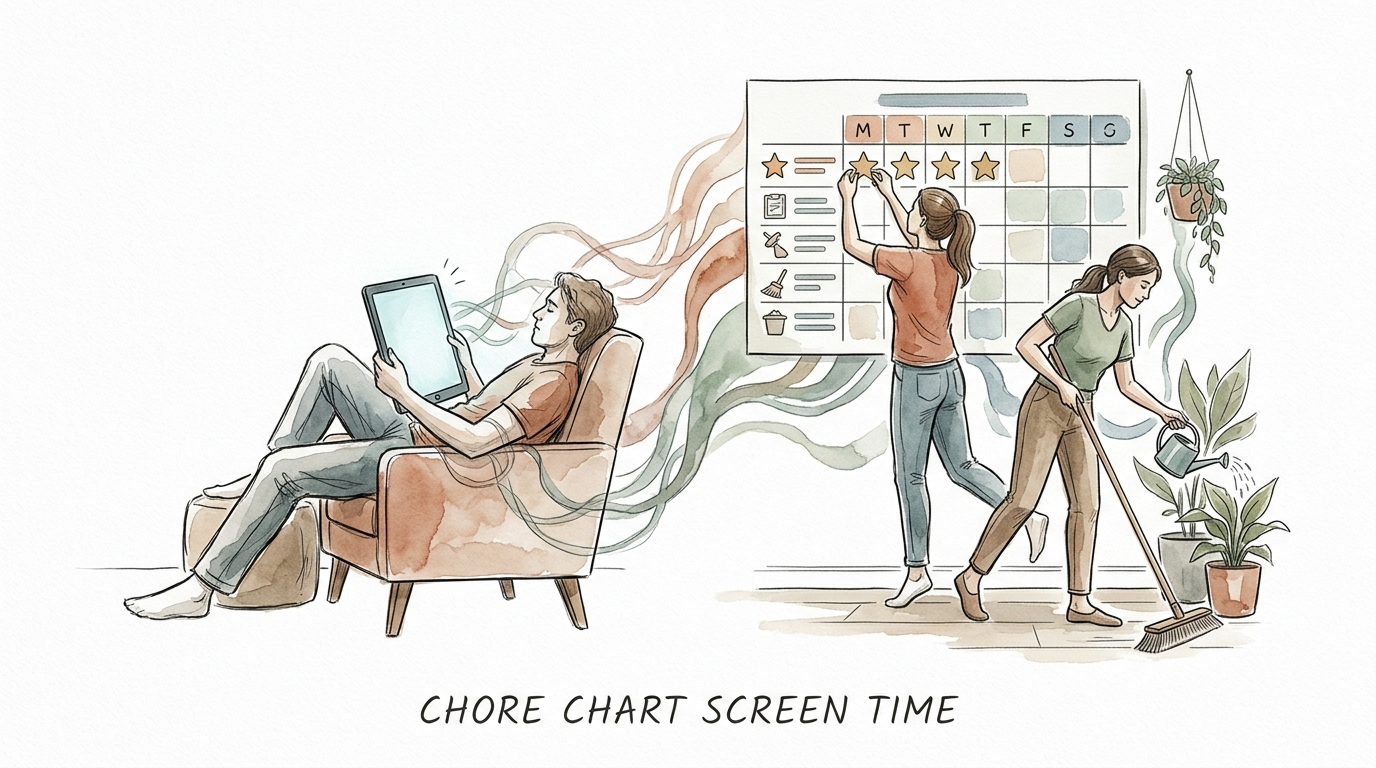
chore chart screen time
Switch the focus from what they ‘get’ to what they ‘give’. Stop the ‘I’m bored’ whining. When screen time is linked to active contribution around the house, kids value their entertainment more and learn the power of hard work.
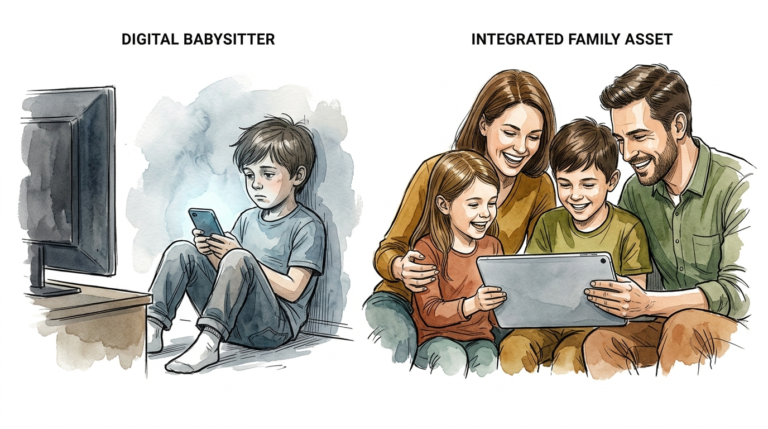
Parenting in a digital world feels like a constant negotiation. One minute you are enjoying a quiet coffee, and the next, you are defending your decision to limit Minecraft. It is a cycle of Passive Consumption vs Active Contribution that many families struggle to balance.
We often think of screens as the enemy. In reality, they are just the modern version of a shiny toy. The problem is not the device itself. The problem is the expectation that entertainment should be free and infinite.
Changing the narrative starts with one simple tool. You can turn every “Can I have my tablet?” into a lesson in responsibility. This guide will show you how to build a system that actually works without making you the family drill sergeant.
chore chart screen time
A chore chart screen time system is a structured framework where digital privileges are earned through household contributions. It moves away from arbitrary limits and toward a performance-based model. Instead of a parent saying “no” because they feel like it, the system says “not yet” because the work is not finished.
This concept exists because the “unlimited access” model often leads to behavioral issues, including screen time tantrums and reduced attention spans. Research shows that children who have regular household responsibilities develop stronger relationships, better work ethics, and higher life satisfaction as adults [1.2.3]. By linking these responsibilities to the thing they want most—their devices—you create an immediate incentive for contribution.
In the real world, this looks like a physical or digital list of tasks. For example, a child might need to clear the table, feed the dog, or finish their homework before the Wi-Fi password is handed over. It transforms screens from a “right” into a “privilege” [1.1.7]. This shift is crucial for helping children understand the value of their time and the necessity of maintaining their environment.
How to Design Your Screen Time Reward System
Building a system that sticks requires more than just a piece of paper on the fridge. You need a strategy that matches your family’s rhythm. Here is how to set it up step by step.
Choose Your Currency
There are three main ways to track progress. Pick the one that fits your child’s age and your patience level.
- The Token Economy: Kids earn physical tokens (marbles, poker chips, or stickers) for every task. They “spend” these tokens to buy minutes of screen time. This teaches them to save and budget their time [1.4.1, 1.4.2].
- The Time Bank: This is a 1:1 or 1:2 ratio. For every 15 minutes of “active” work (cleaning, reading, playing outside), they earn a set amount of digital time [1.1.3].
- The “Checklist First” Method: Screens are completely off limits until a daily checklist is complete. Once the “work” is done, they get a flat block of free time. This is often the easiest for parents to manage [1.1.5, 1.5.1].
Identify Age-Appropriate Tasks
A system fails if the chores are too hard or too easy. Match the effort to the reward.
- Ages 3-5: Picking up toys, putting dirty clothes in the hamper, and helping set the table. Rewards should be immediate, like 10-15 minutes of a favorite show [1.1.7, 1.3.3].
- Ages 6-9: Making the bed, emptying the dishwasher, and feeding pets. They can handle “saving up” tokens for a longer gaming session on the weekend [1.3.2].
- Ages 10+: Taking out the trash, vacuuming, or doing their own laundry. These kids can manage more complex “time banks” where they track their own minutes [1.1.3, 1.3.1].
Set the Baseline Rules
Standard kindness and basic hygiene should not always be rewarded with “pay.” Things like brushing teeth or being polite are baseline expectations. Use the chore chart for “extra” contributions to the household family unit [1.3.1]. This prevents children from refusing to be kind unless they get a reward.
The Major Benefits of Earning Screen Time
The most obvious benefit is a cleaner house. However, the psychological benefits go much deeper.
1. Builds Executive Function
Managing a chore chart requires planning, focus, and time management. These are the building blocks of the brain’s executive functioning system [1.2.3]. Kids learn to prioritize a boring task (cleaning) to get to a preferred one (gaming).
2. Eliminates Parent Nagging
When the rules are on the wall, you stop being the “bad guy.” If your child asks for the iPad, you simply point to the chart. The burden of proof shifts from you to them. If the boxes aren’t checked, the screen stays off. This significantly reduces power struggles and tantrums [1.1.5, 1.3.2].
3. Teaches the Value of Hard Work
Screens are highly stimulating and provide instant gratification. Chores are the opposite. By making the high-dopamine activity (screens) the result of a low-dopamine activity (chores), you teach delayed gratification. This helps rewire the “I want it now” mindset that digital consumption often fosters [1.1.5, 1.6.3].
4. Fosters Empathy and Awareness
When children participate in the upkeep of the home, they become more aware of what it takes to maintain a lifestyle. They stop seeing the clean house as a “given” and start seeing it as a result of effort. This builds gratitude for what others do for them [1.2.3].
Common Mistakes That Break the System
Many parents start a chore chart with high hopes, only to see it fail within a week. Avoid these traps.
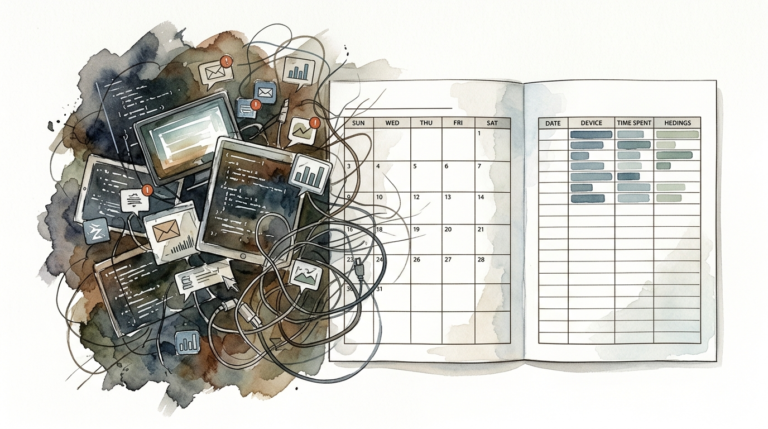
- Making the Chart a “Chore” for You: If you have to spend an hour every night updating a complex spreadsheet, you will quit. Keep it simple. Use a whiteboard, a jar of sticks, or a basic printable [1.1.5, 1.5.3].
- Lack of Consistency: If you give in on a “rough day” and let them have the tablet without finishing their chores, the system is dead. Kids are experts at finding the cracks in your armor. You must hold the line.
- Rewarding “Baseline” Behavior: If you pay them screen time for things they should be doing anyway (like homework or being nice), you risk destroying their internal motivation [1.3.1, 1.6.2].
- Vague Tasks: “Clean your room” is too broad. To a kid, that means “shove everything under the bed.” Be specific. Use tasks like “put all books on the shelf” or “put dirty clothes in the basket” [1.3.1].
Limitations and Realistic Boundaries
Is a chore chart a magic bullet? No. There are situations where this approach might need adjustment.
The “Digital Reward” Trap
Some experts warn that using screen time as the only reward makes it seem like the ultimate prize [1.2.2, 1.6.3]. It can create a “habit loop” where the brain only values the work because of the digital hit at the end. To balance this, occasionally offer non-digital rewards like choosing the family movie, an extra bedtime story, or a trip to the park [1.1.8, 1.3.4].
Neurodivergent Needs
For children with ADHD or Autism, traditional chore charts can sometimes feel overwhelming. They may need more visual cues, smaller steps, or more frequent “mini-rewards” to stay on track. A rigid system that works for a neurotypical child might lead to a total meltdown for a child who struggles with transitions or executive dysfunction.
The “Buy-In” Factor
If the child feels the system is being “done to them” rather than “with them,” they will resist. Involvement is key. Let them help pick the chores or design the chart. When they have a say in the process, they are more likely to respect the rules [1.2.3].
Digital vs. Physical Chore Charts
Should you use an app or a piece of paper? Both have pros and cons.
| Feature | Physical Chart (Fridge) | Digital App (Choreio/GoHenry) |
|---|---|---|
| Visibility | High (always on display) | Low (hidden in phone) |
| Ease of Use | Simple (just a marker) | Moderate (requires setup) |
| Interactivity | Tactile (stickers/magnets) | High (pings/notifications) |
| Cost | Free or low cost | Often requires a subscription |
Practical Tips for Long-Term Success
Start small. Do not assign ten chores on day one. Start with two and build up as they get used to the habit. Consistency is your best friend.
The “Wi-Fi Password” Trick
Change the Wi-Fi password every morning. Do not give it to the kids until the morning checklist is verified. This creates a natural “gate” that they cannot bypass [1.5.1].
The “Double Minutes” Bonus
For chores that are done exceptionally well or without being asked, offer a “bonus” of double minutes. This encourages quality work rather than just rushing to finish [1.3.7].
Schedule Screen-Free Zones
Even if they have earned five hours of time, have rules about when it can be used. No screens at the dinner table or an hour before bed are standard best practices for healthy sleep and family connection [1.5.1, 1.6.6].
Advanced Strategy: “Create Before You Consume”
For older kids or those who are very tech-savvy, you can elevate the system. Introduce the “Create Before Consume” rule. Before they can watch YouTube or play games (consuming), they must spend 30 minutes doing something creative. This could be practicing an instrument, writing, drawing, or building with LEGOs [1.5.6].
This teaches them that screens are for more than just passive watching. It shifts their identity from a “user” to a “maker.” When combined with a chore chart, you are building a well-rounded individual who understands that effort leads to reward.
Scenario: A Typical Saturday Morning
Imagine a Saturday without a system. You wake up to the sound of tablets blaring. You spend the next three hours nagging them to get dressed and eat. By noon, everyone is grumpy.
Now, imagine the “Chore Chart Screen Time” Saturday.
- 8:00 AM: The kids wake up. They know the Wi-Fi password hasn’t been shared yet.
- 8:30 AM: They eat breakfast and put their plates in the dishwasher (10 minutes earned).
- 9:00 AM: They tidy their rooms and feed the cat (20 minutes earned).
- 10:00 AM: They go outside to play for an hour (30 minutes earned as a bonus for “touching grass”).
- 11:00 AM: They have earned 60 minutes of gaming time. They use it guilt-free, and you get an hour of peace knowing the house is in order [1.1.5, 1.4.3].
Final Thoughts
Linking screens to chores is not about being a “mean” parent. It is about preparing your children for a world that does not give rewards for doing nothing. It replaces the “I’m bored” whining with a sense of purpose. When they contribute to the family, they feel like a valued part of the team.
Start with a simple checklist. Be consistent. Be firm. Over time, you will notice the shift from Passive Consumption to Active Contribution. You might even find that once the chores are done, they are more interested in playing outside than staring at a screen.
The goal isn’t just a clean kitchen—it is a child who understands that work comes before play, and that their contributions truly matter. Experiment with these systems, find what fits your family’s unique personality, and reclaim your home from the screen time struggle.
Sources
1 betterscreentime.com | 2 betterscreentime.com | 3 betterscreentime.com | 4 betterscreentime.com | 5 betterscreentime.com | 6 3blmedia.com | 7 medium.com | 8 uhhospitals.org | 9 makerkids.com | 10 yourmodernfamily.com | 11 ryeandryebrookmoms.com | 12 ryeandryebrookmoms.com | 13 quirkycatholickids.com | 14 mybrightwheel.com | 15 lovetoknow.com | 16 yourmodernfamily.com