Toy Rotation Benefits For Focus
Too many choices kill creativity; see how subtraction actually multiplies your child’s focus. When kids see a mountain of toys, they see a chore they can’t handle. When they see a curated selection, they see a mission. The secret to long-term independent focus isn’t buying more toys—it’s creating more space between them.
Most parents believe a full playroom is a sign of a happy childhood. We buy the latest gadgets, the giant sets of blocks, and the bins full of figurines. Yet, we still hear the dreaded phrase: “I’m bored.” It feels like a paradox. How can a child with a hundred options feel like they have nothing to do?
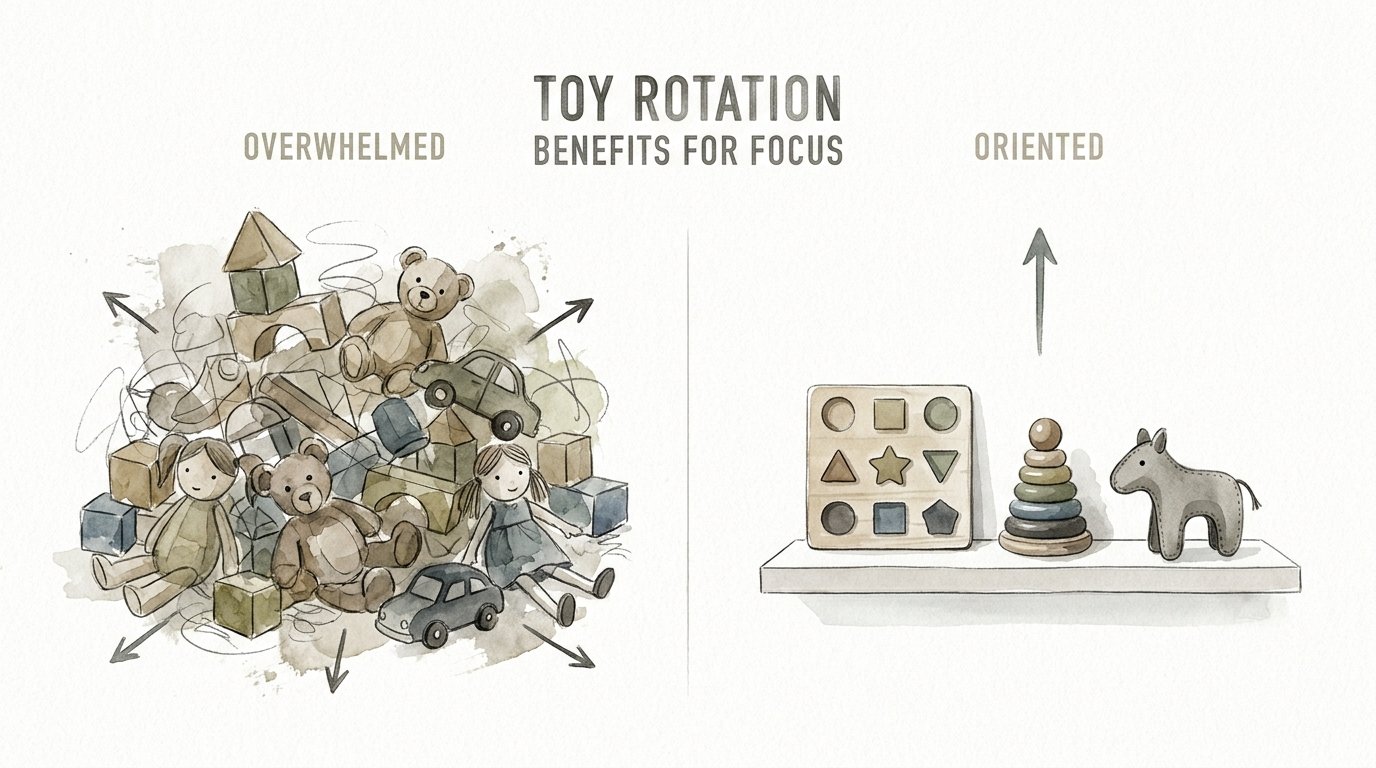
This phenomenon happens because the young brain isn’t built for a “buffet” of options. It is built for depth. When a child is ORIENTED toward a specific task, they thrive. When they are OVERWHELMED by a sea of plastic, they shut down. Toy rotation is the bridge that takes your child from “toy hopping” to deep, immersive play.
Toy Rotation Benefits For Focus
Toy rotation is the systematic practice of displaying only a small selection of toys while storing the rest out of sight. It is not about deprivation. It is about curation. In a world of constant digital and physical noise, your child’s playroom should be a sanctuary of clarity.
Think of it like a museum. Museums don’t put every painting they own on the wall at the same time. They rotate their exhibits so visitors can appreciate the nuances of each piece. When your child has access to everything at once, they appreciate nothing. They simply move from one thing to the next, never staying long enough to reach the “flow state” where real learning happens.
Real-world research supports this. A landmark study from the University of Toledo observed toddlers in two environments: one with 4 toys and one with 16. The results were staggering. In the room with 4 toys, the children played twice as long with each item. They didn’t just play more; they played better. They used the toys in more creative ways, showing higher levels of cognitive engagement and imaginative problem-solving.
This system creates a “new toy” feeling every few weeks without you spending a single dime. It transforms “old” forgotten items into exciting discoveries. It also shifts the burden of organization from the child to the environment. When there are only five things to choose from, the decision is easy. The focus is immediate.
How To Set Up Your Rotation System
Setting up a toy rotation system requires an initial investment of time, but it pays dividends in hours of independent play later. You are building a “Toy Library” that you will manage as the head librarian. Follow this step-by-step process to reclaim your floor and your child’s attention.
Step 1: The Great Toy Gathering
Gather every single toy in your house and put them in one central location. This includes the ones under the couch, in the car, and at the bottom of the closet. Seeing the sheer volume of stuff is often the wake-up call parents need. It helps you see the scale of the “mountain” your child has been facing every day.
Step 2: The Ruthless Purge
Before you rotate, you must reduce. Throw away anything broken. Donate anything your child has clearly outgrown. If a toy only does one thing (like a plastic phone that only makes one sound), consider if it truly adds value. Focus on keeping “open-ended” toys that can be used in multiple ways. A set of blocks is a castle today and a spaceship tomorrow. A battery-operated robot is always just a robot.
Step 3: Categorize Your Collection
Sort the remaining toys into logical categories. This ensures each rotation is balanced and stimulating. Common categories include:
- STEM/Construction: Blocks, Magnatiles, LEGOs, or gears.
- Imaginative/Pretend: Dolls, kitchen sets, dress-up, or animal figurines.
- Fine Motor/Puzzles: Shape sorters, lacing beads, or traditional puzzles.
- Gross Motor/Active: Indoor tunnels, balance boards, or soft balls.
- Art/Sensory: Playdough, crayons, or sensory bins.
- Language/Books: A small selection of books that match the current theme.
Step 4: Create Your Bins
Divide your categories into sets. For example, if you have 4 sets of blocks, put one in Bin A, one in Bin B, and so on. Do this for every category. The goal is to have several bins that each contain a “balanced meal” of play—one item from each category. Most families find that 4 to 6 bins are the sweet spot.
Step 5: The Display Phase
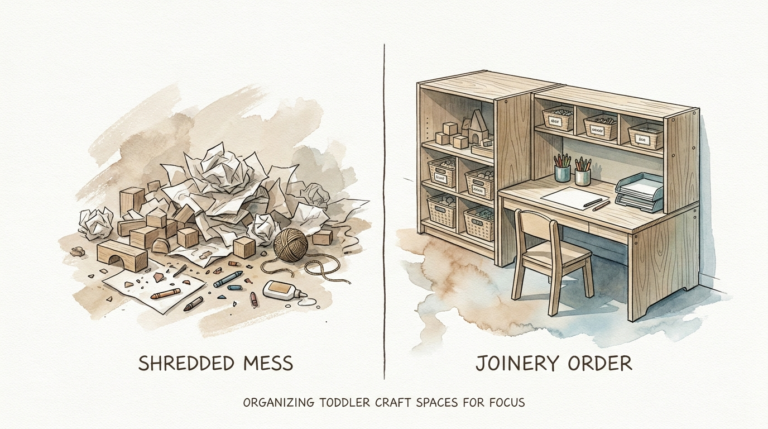
This is the most important part. Do not just dump the contents of Bin A into a giant toy chest. Use low, open shelves. Place one toy or one activity in a basket or on a tray. Leave plenty of physical space between items. This “white space” is what allows your child’s eyes to settle on a choice without getting distracted by the item next to it.
The Measurable Benefits Of Rotation
The primary advantage of toy rotation is the development of executive function. When a child isn’t distracted by clutter, they practice “sustained attention.” This is a foundational skill for school and life. They learn to see a task through from beginning to end because there isn’t a flashier toy competing for their attention every thirty seconds.
Creativity also skyrockets. When a child only has a few items, they are forced to find new ways to use them. A silk scarf becomes a cape, then a river, then a roof for a fort. This “divergent thinking” is the hallmark of high-level intelligence. In a room full of specialized toys, the toy does the thinking for the child. In a rotated room, the child does the thinking for the toy.
Parents also experience a massive reduction in stress. Cleanup time drops from thirty minutes to three. Because there are fewer items out, the child can often handle the cleanup themselves. This fosters a sense of responsibility and ownership. The home feels like a living space again, rather than a storage unit for a toy store.
Common Challenges And Pitfalls
The biggest mistake parents make is rotating too many items at once. If you put out twenty toys, you haven’t solved the problem; you’ve just organized the overwhelm. Aim for 8 to 12 items for a toddler and even fewer for an infant. Quality always beats quantity in the world of development.
Another pitfall is “The Transition Tantrum.” If your child is used to a mountain of toys, they might feel a sense of loss when the shelves look empty. They might wander around saying they have nothing to play with. This is normal. Resist the urge to bring out more toys. This “boredom” is the fertile soil where creativity begins to grow. Give them 15 minutes of boredom, and watch what happens.
Storage can also be a challenge. If you live in a small apartment, finding room for 5 large bins is difficult. Use vertical space. Store rotation bins on the top shelves of closets or under the bed. Use opaque bins so the child can’t see the “hidden” toys, which prevents them from constantly asking for things that are out of rotation.
Limitations Of The Method
Toy rotation is not a magic wand for every behavioral issue. If a child is overstimulated by screen time or a frantic schedule, reducing toys will help, but it won’t be a total cure. The environment is only one piece of the puzzle. Connection and parental engagement still matter more than any organizational system.
This method also requires “Open-Ended” toys to be truly effective. If your rotation consists entirely of single-purpose, battery-operated toys, the novelty will wear off in minutes. These toys have a “low play value.” Once the child figures out the one thing the toy does, they are finished with it. Rotation works best with “high play value” items like blocks, play silk, and basic figurines.
Finally, certain items shouldn’t be rotated. Large-scale items like play kitchens, indoor climbing triangles, or reading nooks usually stay as “anchors” in the room. Rotating these is often more work than it’s worth and can disrupt the child’s sense of “home base” in their play area.
Mountain Of Toys vs. Curated Shelf
| Feature | Mountain of Toys (Overwhelmed) | Curated Shelf (Oriented) |
|---|---|---|
| Decision Speed | Slow (Choice Paralysis) | Instant (Clarity) |
| Play Depth | Shallow (Toy Hopping) | Deep (Immersive) |
| Cleanup Time | 20-40 Minutes | 2-5 Minutes |
| Creativity Level | Low (Reactive) | High (Active) |
| Novelty Factor | Fades quickly | Renewed every rotation |
Practical Tips For Immediate Application
Start small. You don’t have to overhaul your entire house in one afternoon. Start with just the living room or just the bedroom. Put 75% of the toys in a closet and leave out only the “greatest hits.” Observe your child for three days. You will likely notice they don’t even ask for the missing items.
Use the “Invitation to Play” technique. When you set up a rotation, don’t just put the blocks in a basket. Build a tiny tower or set out a few figurines as if they are about to have a meeting. This small visual prompt acts as a hook for your child’s imagination. It lowers the barrier to entry for play.
Establish a rotation schedule that works for you. Some parents like a strict “New Toy Sunday” every week. Others prefer a more organic approach, rotating only when they notice play becoming “destructive” or “bored.” When kids start throwing toys or just dumping bins without playing, it is a clear signal that the current selection has lost its spark and it is time for a change.
Advanced Considerations For Growth
As your child gets older, the way you rotate should evolve. For preschoolers and school-aged children, you can involve them in the process. Ask them, “Which toys would you like to ‘put to sleep’ for a while?” This gives them a sense of autonomy and teaches them the value of a tidy, focused environment.
Consider “Skill-Based Rotation.” If your child is currently working on their fine motor skills, include more puzzles and lacing activities. If they are in a “maximum effort” phase where they want to move heavy things, include more gross motor equipment. Use your observations of their “schemas”—repetitive patterns of play like transporting, enveloping, or rotating—to choose the right toys for the bin.
Seasonal rotations are another way to keep things fresh. Bring out the “nature tray” with pinecones and acorns in the fall. Bring out the “snow dough” and white blocks in the winter. Aligning play with the natural world outside helps children feel more connected to their environment and builds their seasonal vocabulary.
Example Scenarios
The Toddler Transition: Imagine a 2-year-old named Leo. His playroom is a sea of cars, blocks, and flashing plastic. Leo spends most of his time running from one side of the room to the other, dumping bins, and then crying for a snack. His mother implements a rotation. She puts out exactly 6 items on a low shelf: a basket of 5 cars, a wooden stacker, a small doll, a set of 10 blocks, a puzzle, and a ball. Within two days, Leo is sitting on the floor for 15 minutes at a time, trying to fit the cars into the block “garage” he built. The dumping has stopped.
The Grade School Reset: Maya is 6 and has a massive collection of LEGOs and art supplies. She rarely creates anything new; she just complains that she can’t find the pieces she needs. Her parents move 80% of the LEGOs to a “backstock” bin and 80% of the art supplies to a high shelf. They leave out one specific LEGO set and a tray with three colors of paint and two types of paper. Maya spends the entire afternoon painting a detailed map and building a house for her characters. The limitation of resources sparked a specific project that wouldn’t have happened in the chaos of “too much.”
Final Thoughts
Toy rotation is more than a cleaning hack. It is a fundamental shift in how we view childhood development and the “job” of play. By reducing the physical noise in our children’s lives, we give them the mental quiet they need to think, create, and focus. We move from being “Managers of Mess” to “Curators of Discovery.”
Your child doesn’t need more toys to be happy. They need better access to the toys they already have. They need an environment that respects their developing brain by providing clarity instead of clutter. Every time you “subtract” a toy from the room, you are “adding” a layer of focus to your child’s mind.
Start your first rotation tonight. Clear a shelf, pick five items, and hide the rest. Watch the magic of “less” transform your home into a space of intentional, deep, and joyful play. Your child’s focus is waiting—you just need to make room for it.
Sources
1 babylist.com | 2 consciouslyclearedandcontained.com | 3 kidkraft.com | 4 bumbutoys.com | 5 psychologytoday.com | 6 lovevery.com | 7 childup.com | 8 tumama-kids.com | 9 cbsnews.com | 10 dannicowoodworks.com | 11 detroitmom.com