screen time kids illustration
Why are we paying a premium to rob our children of their imagination? We spend hundreds on devices only to watch our kids’ creativity stall. Meanwhile, the best childhood memories are being made for free in the dirt. Which investment are you prioritizing today?
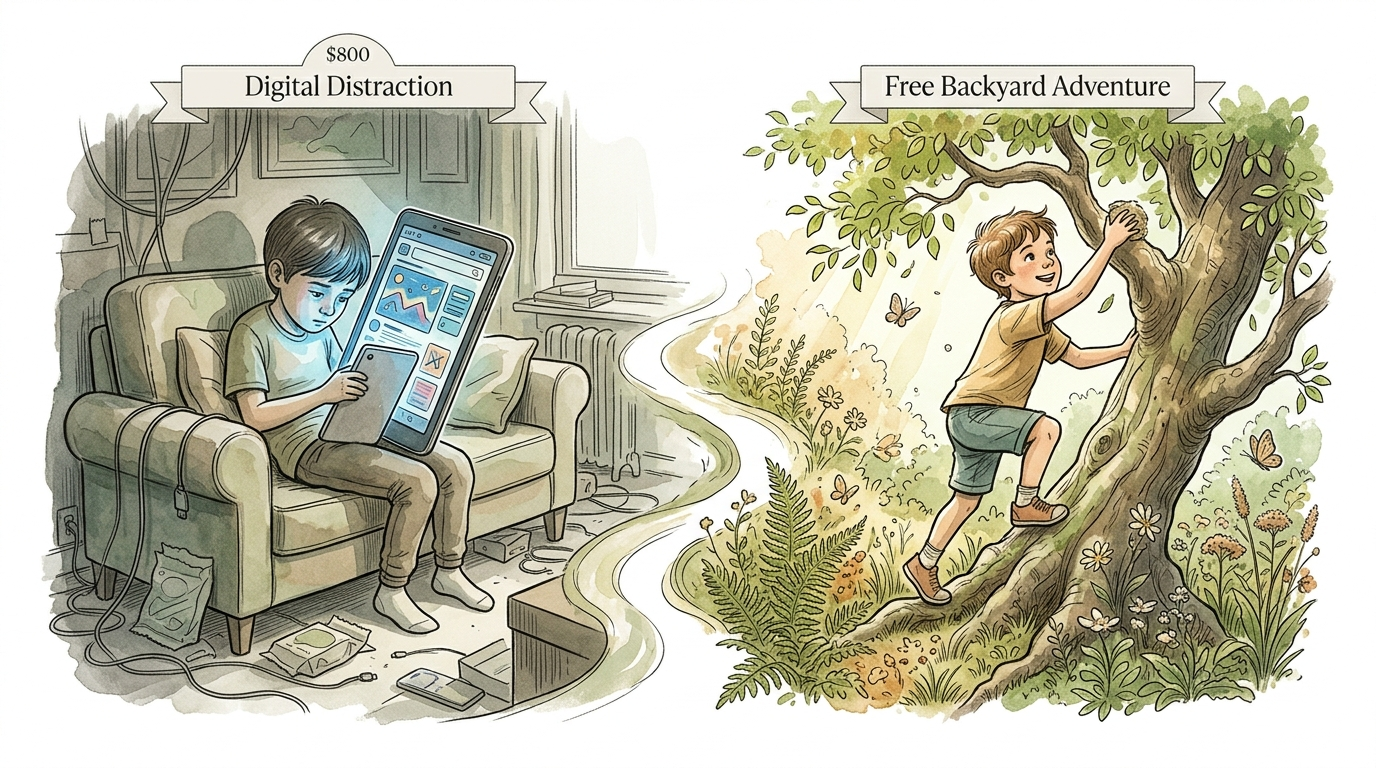
Parenting in the digital age feels like a constant negotiation between convenience and conscience. We want our children to be tech-savvy for the future, yet we feel a pang of guilt when we see them hunched over a glowing rectangle for hours. This tension isn’t just in your head; it is a fundamental shift in how childhood is experienced. Choosing between an $800 Digital Distraction and a Free Backyard Adventure is about more than just money. It is about the raw materials we provide for a child’s developing brain.
screen time kids illustration
The term “screen time” has evolved from a simple measurement of TV minutes into a complex web of digital interactions. Today, it serves as a stand-in babysitter, an educational portal, and a social lifeline. Recent data shows that 49% of parents rely on screens daily to manage their responsibilities, often because affordable childcare is out of reach. By the age of eight, one in four children owns a personal smartphone, and nearly half of all preschoolers have their own tablet.
This digital saturation creates a specific “illustration” of modern childhood: a sedentary, indoor-focused lifestyle where sensory input is limited to sight and sound. In the real world, this looks like a child who can navigate a complex app interface but struggles to climb a tree or negotiate the rules of a tag game. Screens provide pre-fabricated worlds. They offer high-definition graphics and instant rewards, but they leave little room for the “blank canvas” play that historically defined being a kid.
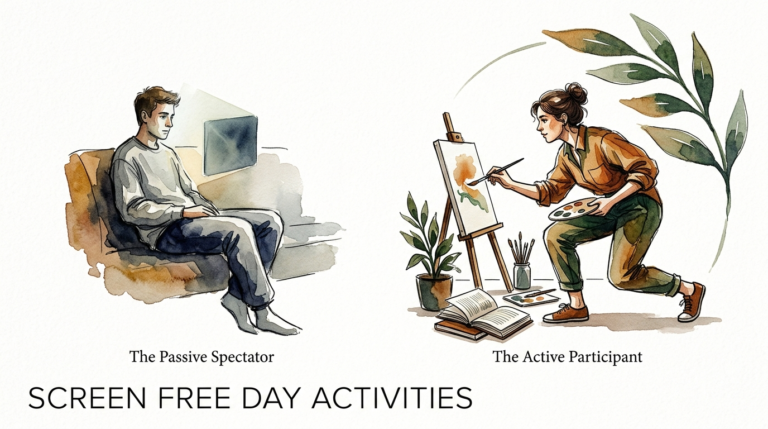
Real-world usage often falls into two categories: passive and interactive. Passive use involves endless scrolling or video watching, which researchers link to shorter attention spans and lower emotional regulation. Interactive use, like creative gaming or video chatting with family, can have some benefits, but it still lacks the multi-sensory depth of the physical world. Understanding this distinction is the first step in moving from digital distraction to meaningful engagement.
The Mechanics of Play: How Screens vs. Nature Affect the Brain
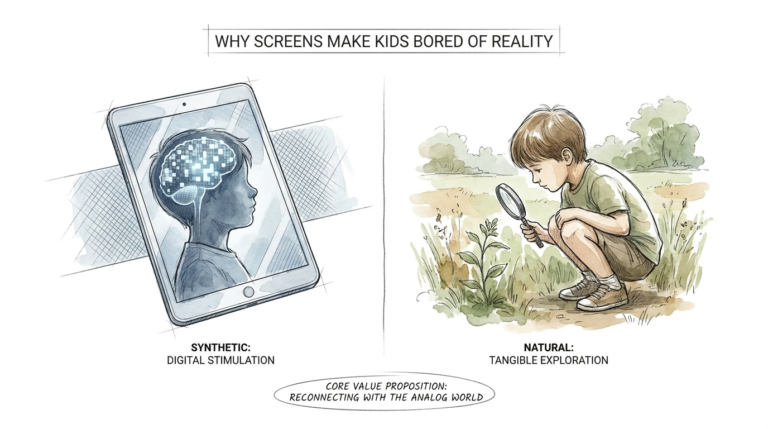
The human brain is an organ of adaptation. It wires itself based on the stimuli it receives most frequently. When a child engages with a screen, the brain enters a high-arousal, low-effort state. Digital content is designed to be “sticky,” using variable reward schedules—much like slot machines—to keep the user engaged. This floods the brain with dopamine, creating a feedback loop that makes real-world activities feel “boring” by comparison.
In contrast, unstructured outdoor play operates on a “low-arousal, high-effort” principle. There are no flashing lights to tell a child where to look. Instead, the child must use their executive function to decide what to do. Finding a stick and deciding it is a sword requires complex cognitive processing. It involves symbolic thought, planning, and imaginative projection. This is the “muscle work” of the pre-frontal cortex.
Nature provides what psychologists call “soft fascination.” This is a type of attention that is restorative rather than draining. Watching clouds or observing a line of ants allows the brain’s “directed attention” muscles to rest. This is why children often seem more focused and calmer after spending time outside. They aren’t just burning off energy; they are resetting their neurological focus.
Benefits of Choosing the Backyard Over the Screen
The advantages of prioritizing outdoor play are measurable and lifelong. Physical health is the most obvious beneficiary. Running, jumping, and climbing build gross motor skills and cardiovascular health. Exposure to natural sunlight regulates circadian rhythms, leading to better sleep. Studies even suggest that time spent outdoors can reduce the risk of nearsightedness (myopia) because the eyes are practicing long-range focus rather than staring at a close-up screen.
Cognitive benefits are equally profound. Unstructured play is the primary way children develop executive function. This includes the ability to self-regulate, follow multi-step instructions, and solve problems independently. In the backyard, a child learns physics by building a dam in the mud. They learn social hierarchy and negotiation by deciding who gets to be the “captain” of the fort.
Key Benefits Include:
- Enhanced Creativity: Nature offers “loose parts”—sticks, stones, and dirt—that can become anything.
- Emotional Resilience: Outdoor play often involves “risky play,” such as climbing or balancing, which teaches children how to manage fear and evaluate their own limits.
- Social Skills: Without a screen to mediate, children must use verbal and non-verbal cues to communicate with peers.
- Stress Reduction: Direct contact with green spaces is proven to lower cortisol levels in both children and adults.
Challenges and Common Mistakes in Managing Screen Time
The biggest pitfall for modern parents is the “all-or-nothing” trap. We often flip-flop between total digital bans and complete surrender. Total bans often backfire, making the device a “forbidden fruit” and leaving the child without the digital literacy they will eventually need. On the other hand, unlimited access leads to the displacement of essential developmental activities.
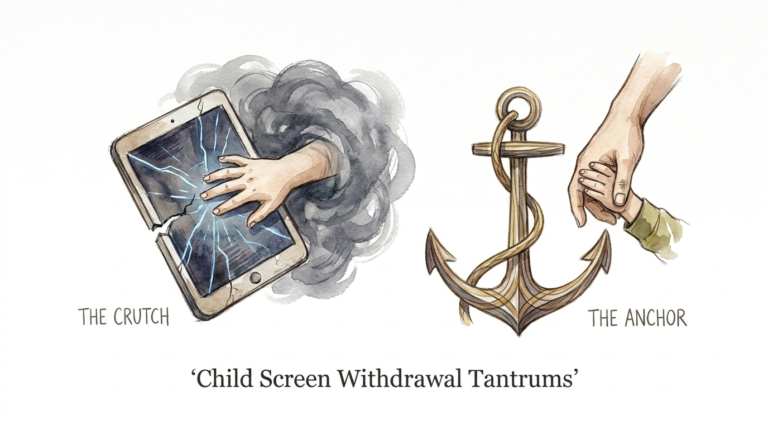
Another mistake is using screens as a primary tool for emotional regulation. If a child is given a tablet every time they have a tantrum in public, they miss the opportunity to learn how to self-soothe. They become dependent on a digital “pacifier.” This prevents the development of “daily living skills”—the ability to exist in a space without constant external stimulation.
Common Pitfalls to Avoid:
- The “Babysitter” Trap: Relying on screens for every moment of parental busy-ness rather than encouraging “boredom,” which is the precursor to creativity.
- Inconsistent Boundaries: Setting screen limits but failing to enforce them, which leads to “negotiation fatigue.”
- Ignoring Quality: Focusing only on the *amount* of time rather than the *content*. Passive scrolling is far more detrimental than creative digital building.
Limitations: When the Backyard Isn’t Enough
We must acknowledge that the “Free Backyard Adventure” is a privilege not every family shares. Urban environments often lack safe, accessible green spaces. Families living in “play deserts” face significant hurdles. For these parents, screens may be the safest way to keep a child occupied while they manage a household in a high-traffic or high-crime area.
Weather and seasonal changes also impose limits. In extreme heat or freezing winters, indoor time is inevitable. Furthermore, digital literacy is a real-world requirement. A child who has never used a computer may find themselves at a disadvantage in a modern classroom. The goal is balance, not total elimination. We need to recognize when the environment doesn’t support outdoor play and find “indoor-nature” alternatives, like sensory bins or indoor gardening.
Comparing the Investment: $800 Device vs. Free Adventure
When we look at the ROI (Return on Investment) of childhood experiences, the data is striking. An $800 tablet depreciates the moment you open the box. It requires constant updates, protective cases, and monthly subscription fees. A backyard adventure requires zero capital and pays dividends in the form of neural connections and physical health.
| Factor | $800 Digital Distraction | Free Backyard Adventure |
|---|---|---|
| Initial Cost | High ($400 – $1,200) | Zero (Free) |
| Ongoing Cost | Subscriptions, Apps, Repairs | None |
| Child’s Role | Consumer (Passive) | Creator (Active) |
| Cognitive Impact | Dopamine-driven, high arousal | Executive function, focus-driven |
| Physical Benefit | Sedentary, eye strain | Gross motor, Vitamin D, sleep |
| Durability | Obsolescence in 2-3 years | Lifelong memories and skills |
Practical Tips: Reclaiming Childhood from the Screen
Starting the transition from screen-heavy to nature-heavy doesn’t have to be a battle. Small, consistent shifts are more effective than drastic overhauls. The “1,000 Hours Outside” movement is a great framework for this, challenging families to match their screen time with green time over the course of a year.
Actionable Strategies:
- Create a “Yes Space” Outdoors: Designate a corner of the yard or a balcony where the child is allowed to get as messy as they want with dirt, water, and sand.
- The 20-20-20 Rule: If screens are necessary, ensure the child looks 20 feet away for 20 seconds every 20 minutes to reduce eye strain.
- Nature Scavenger Hunts: Use the “hunter-gatherer” instinct. Give the child a list: “Find something smooth, something round, and something that makes a sound.”
- Establish Screen-Free Zones: The dinner table and bedrooms should be strictly device-free to prioritize connection and sleep hygiene.
Advanced Considerations: Digital Minimalism in Parenting
For those looking to dive deeper, the concept of “Digital Minimalism” offers a philosophical approach to technology. This isn’t about being a Luddite; it’s about being intentional. It means choosing tools that enhance your values rather than ones that merely entertain. For a child, this might mean replacing a tablet with a digital camera or a basic music player—tools that encourage creation or appreciation without the “pull” of social media or addictive games.
Serious practitioners also look at “Nature-Deficit Disorder.” While not a medical diagnosis, this term describes the psychological cost of being alienated from the natural world. Symptoms include diminished use of the senses and attention difficulties. Reversing this requires “ecological literacy”—teaching children to recognize local plants, birds, and weather patterns. This fosters a sense of stewardship and belonging that a digital world can never provide.
Example Scenario: The Rainy Day Transition
Imagine it is a Saturday afternoon. The rain is pouring, and the “I’m bored” whines have started. The default move is to hand over the iPad for a two-hour movie marathon. While this provides immediate peace, it often leads to a “screen hangover”—irritability and lethargy when the device is finally taken away.
Try a “Low-Tech Sensory Transition” instead. Lay out a large sheet or tarp on the living room floor. Give the child a bowl of water, some measuring cups, and a bag of dried beans or rice. This “indoor mud kitchen” engages the tactile senses. Within ten minutes, the child is usually deep in a flow state, inventing a “restaurant” or a “construction site.” You’ve traded a passive digital experience for a complex, imaginative one, all for the cost of a bag of rice.
Final Thoughts
We are currently conducting a massive, unplanned experiment on the human brain by replacing nature with pixels. While technology is a powerful tool, it makes for a poor foundation for childhood. The most sophisticated $800 device cannot replicate the cognitive complexity of a pile of dirt and a handful of sticks.
True investment in our children isn’t found in the latest hardware. It is found in the time we allow them to be “unproductive” in the eyes of the digital world. By prioritizing the backyard over the screen, we aren’t just saving money; we are saving their ability to think, create, and regulate themselves.
Start small. Open the door. Let them get dirty. You might find that the best way to prepare your child for a high-tech future is to give them a high-nature present. Experiment with these boundaries this week and watch how their focus and mood begin to shift. The best memories of their lives are waiting to be made—and they don’t require a Wi-Fi password.
Sources
1 ncsu.edu | 2 monstermath.app | 3 luriechildrens.org | 4 childrenshospital.org | 5 ebazagardens.com | 6 inhf.org | 7 compasschildcare.com | 8 compasschildcare.com | 9 apa.org | 10 helpmegrowmn.org | 11 communikids.com | 12 childrenandnature.org | 13 berkeley.edu | 14 biglifejournal.com