kids screen time awareness
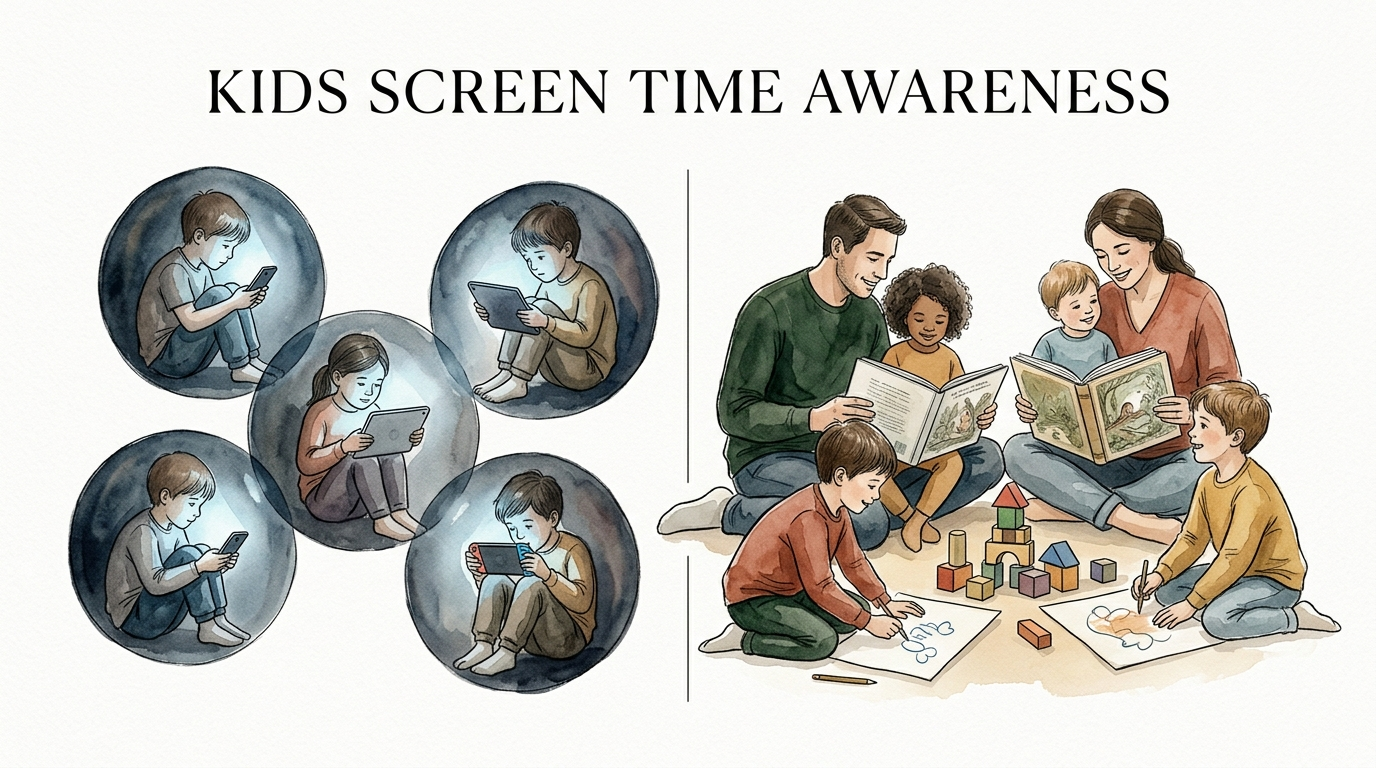
Are you living together, or just charging your devices in the same room? Awareness starts with noticing the silence. When everyone is ‘connected’ to the web, they are disconnected from the home. Let’s fix it.
Modern family life often feels like a series of glowing rectangles. We share a roof, but we are often miles apart in our own digital worlds. This shift happened slowly, then all at once. Now, we find ourselves navigating a landscape where the dining table has become a charging station rather than a hub for conversation.
You might notice your toddler knows how to swipe before they can tie their shoes. Or perhaps your teenager’s mood seems tethered to the likes on their latest post. These are the markers of our new reality. Understanding the impact of these habits is the first step toward reclaiming your family’s presence.
Integrated family life is about more than just banning tablets. It is about creating a space where technology serves the family, not the other way around. We want to move away from isolated digital silos and toward a shared, vibrant experience. This guide will help you understand the stakes and give you the tools to rebuild that connection.
kids screen time awareness
Kids screen time awareness is the conscious practice of monitoring and evaluating the digital consumption of children. It is not just about counting minutes on a clock. It is about understanding what they are watching, why they are watching it, and how it affects their developing brains.
In the real world, this awareness acts as a filter. It helps parents distinguish between educational engagement and mindless scrolling. For example, a child using a tablet to learn coding is having a vastly different experience than a child watching repetitive “unboxing” videos for three hours. Awareness allows you to see the difference.
Currently, the statistics are eye-opening. Reports from 2024 and 2026 indicate that the average American teen spends nearly nine hours a day on screens for entertainment alone. Even children as young as two are often spending over an hour a day with digital media. This is no longer a small part of their day; it is the majority of their waking life.
Why does this matter? Because screens are designed to be “sticky.” They use algorithms and variable reward systems to keep eyes on the glass. Kids do not yet have the executive function or impulse control to resist these psychological hooks. That is where parental awareness becomes the necessary external “prefrontal cortex” for the child.
How to Implement a Digital Balance Strategy
Creating a balanced digital environment requires a systematic approach. You cannot simply pull the plug and expect a smooth transition. You need a plan that replaces digital consumption with meaningful alternatives. Start by auditing your current habits without judgment.
Follow these steps to build a sustainable family media plan:
- Perform a baseline audit. Track how much time everyone spends on devices for one week. Use built-in tracking tools on phones and tablets to get honest data.
- Define your “Why.” Sit down as a family and discuss why you want to change. Is it to have more fun together? To sleep better? To reduce arguments?
- Establish clear zones. Designate certain areas of the home as “Tech-Free Zones.” The kitchen table and all bedrooms are excellent places to start.
- Create a “Tech Bedtime.” Set a time when all devices go to a central charging station in a common area. This should happen at least one hour before actual sleep.
- Focus on Content Quality. Move away from “Passive” consumption (scrolling) and toward “Creative” or “Educational” use.
The underlying principle here is displacement. You are not just taking away screens; you are making room for other things. When you remove a two-hour gaming block, you must have books, board games, or outdoor options ready. Without an alternative, the vacuum will quickly be filled by conflict or boredom.
Consistency is your best friend. Kids will test the boundaries. They want to know if the “No phones at dinner” rule applies every night or just when you are in a good mood. Stick to the plan to build the habit. Over time, the resistance will fade as the new routine becomes the baseline.
Benefits of Digital Awareness
The rewards of high digital awareness are both immediate and long-term. You will notice a shift in the household atmosphere almost instantly. Silence that used to be filled by the hum of videos will be replaced by the sounds of play and conversation.
One major benefit is improved sleep quality. Research shows that every hour of nighttime screen use can lead to 15 to 25 minutes of lost sleep. By removing screens from bedrooms, you help your child’s brain produce the melatonin needed for deep, restorative rest. Better sleep leads to better moods and higher academic performance.
Cognitive development also sees a significant boost. When kids spend less time on fast-paced, algorithmic content, their attention spans begin to recover. They learn to handle “boredom,” which is actually the birthplace of creativity. Instead of being fed constant entertainment, they start to invent their own fun.
Social skills are another area of massive improvement. Face-to-face interaction requires reading body language, tone, and social cues. Screens strip these away. By prioritizing in-person connection, you are giving your children the emotional intelligence they need to succeed in the real world.
Family bonding becomes more intentional. Instead of being in “Isolated Digital Silos”—where everyone is in the same room but in different universes—you move toward an “Integrated Family Life.” You start to notice the small things again, like a funny story from school or a shared laugh over a clumsy moment.
Challenges and Common Mistakes
The path to digital balance is rarely a straight line. You will face hurdles, often from your own habits as much as your children’s. One of the most common mistakes is the “Hypocrisy Trap.” If you tell your kids to get off their phones while you are mid-scroll on Instagram, the message is lost.
Peer pressure is a massive external challenge. Your child might feel like an outcast if they aren’t on the latest trending app. This FOMO (Fear Of Missing Out) is real and painful for adolescents. Validating their feelings while holding the boundary is essential for maintaining trust.
Another pitfall is using screens as a “Digital Pacifier.” It is incredibly tempting to hand over a phone during a long car ride or a busy restaurant meal. While this provides short-term peace, it prevents the child from learning how to regulate their own emotions or cope with minor frustrations. Over-reliance on this tool often leads to “rebound” tantrums when the screen is eventually taken away.
Mistakes often happen during times of stress. If you’re tired, you might let the rules slide for “just one night.” That one night often turns into a week, and then you’re back at square one. To avoid this, automate your limits using parental control apps that shut down devices at a set time. This takes the “villain” role off your shoulders and puts it on the technology.
Limitations and Realistic Constraints
We live in a digital world, and it is impossible to be “off-grid” entirely. School-aged children often require devices for homework, research, and communication with teachers. This “Required Tech” can blur the lines of your screen time limits. You have to be flexible enough to allow for productivity while firm on entertainment.
Environmental factors also play a role. If you live in an area with limited safe outdoor spaces or during a harsh winter, indoor activities are naturally more restricted. In these cases, your screen time “allowance” might need to shift. The goal is balance, not total deprivation.
Different ages require different approaches. A plan that works for a five-year-old will fail miserably for a fifteen-year-old. Older children need more autonomy and “buy-in” for the rules to stick. If you try to control a teen’s digital life through force alone, they will simply find ways to hide their usage. The limitation here is the child’s growing need for independence.
Finally, technology changes faster than we can study it. We are often reacting to trends that have already taken root. This means our strategies must be fluid. What was a safe app yesterday might be a privacy nightmare today. You cannot set a plan once and forget it; it requires ongoing education and adjustment.
Isolated Digital Silos vs. Integrated Family Life
Understanding the difference between these two states of being is crucial for long-term success. It is the “What” versus the “How” of family technology use. Use the table below to see where your family currently stands.
| Feature | Isolated Digital Silos | Integrated Family Life |
|---|---|---|
| Communication | Mostly via text/apps even when in the same house. | Primary connection is face-to-face and vocal. |
| Presence | Physically present, mentally elsewhere (Technoference). | Active engagement and shared attention. |
| Conflict | Arises when devices are taken away abruptly. | Managed through clear, pre-agreed boundaries. |
| Shared Activity | Rare; family members “parallel play” on separate devices. | Frequent; involves board games, sports, or co-viewing. |
| Sleep | Delayed by “one more video” syndrome. | Regulated by tech-free wind-down routines. |
The complexity of moving from the middle column to the right column depends on your starting point. It requires a shift in mindset from seeing tech as a “babysitter” to seeing it as a “tool.” Maintenance of an integrated life is an active process, but it pays dividends in family harmony.
Practical Tips for Immediate Success
You don’t need to overthink the start. Small, immediate actions create momentum. These tips can be applied today to begin shifting the energy in your home.
- The “First Hour” Rule: Keep the first hour of the day completely screen-free for everyone. This prevents the “dopamine hit” of notifications from setting the tone for the day.
- Model “Phone Parking”: When you come home, put your phone in a basket by the door. If you need to check it, you have to go to the basket. This makes phone use intentional rather than a reflex.
- Narrate Your Tech Use: If you must use your phone in front of your kids, tell them what you are doing. “I’m just checking the weather for our walk,” or “I’m answering a work email so I can be done for the night.” This shows them that tech has a specific purpose.
- Gamify the Reset: Have a “Screen-Free Saturday” once a month. The family member who comes up with the best non-tech activity gets to pick the next one.
- Use Gray-Scale Mode: Switch your kids’ (and your own) phones to gray-scale. Removing the vibrant colors makes the apps far less stimulating and easier to put down.
Remember that “boredom” is a feature, not a bug. When your child complains that they have nothing to do, resist the urge to provide a digital solution. Their brain is just looking for a low-effort stimulus. Give it ten minutes, and you will be amazed at what they find to do with a box, some markers, or a pile of Lego.
Advanced Considerations for Digital Wellness
For those who want to go deeper, look into the “Five C’s” framework: Content, Context, Connection, Community, and Control. This helps you move beyond just “time” and into the “health” of the interaction. If the content is creative and the connection is positive, the “time” limit matters less.
Optimization of your home’s digital environment can also include hardware changes. Consider a router that allows for “profiles.” You can set the internet to automatically turn off for the kids’ devices at 8:00 PM while yours stays on. This removes the nightly argument because the “internet just went to sleep.”
Educate your children on how algorithms work. For older kids, understanding that a multi-billion dollar company is spending millions to keep them scrolling is eye-opening. When they realize they are the “product” being sold to advertisers, they often develop a rebellious streak against the tech companies. This intrinsic motivation is far more powerful than any parental rule.
Performance improvements in your child’s cognitive function can be tracked. Monitor their ability to focus on a book or a craft. If they can only manage two minutes before asking for a phone, their “attention muscle” is weak. Use focused, non-digital activities to “re-train” the brain’s reward system away from instant gratification.
Realistic Scenario: The Weekend Reset
Let’s look at how this works in a real-world scenario. Imagine the Miller family. They noticed that on Friday nights, everyone was in a separate room scrolling. The house was quiet, but everyone was irritable. They decided to implement a “Friday Night Unplug.”
At 6:00 PM, all devices went into the “Phone Garage” (a decorated shoebox). They ordered pizza and played a simple card game. The first hour was awkward. The kids complained. The parents felt a phantom itch to check their pockets. But by 7:30 PM, the atmosphere changed. They were actually talking. The kids started a wrestling match on the living room floor. The parents sat on the couch and just… talked.
By Saturday morning, the kids didn’t immediately reach for tablets. They went outside to see if the neighbor was out. Because they weren’t “pre-stimulated” by screens, they found the real world interesting again. They still used tech later that afternoon to watch a movie together, but it was a shared experience—an integrated use of tech rather than an isolated one.
This simple shift didn’t cost a dime. It didn’t require a master’s degree in psychology. It just required awareness and a small amount of courage to face the initial discomfort of the silence.
Final Thoughts
Building screen time awareness is one of the most important parenting skills of the 21st century. It is not about being “anti-tech.” It is about being “pro-human.” Technology is a wonderful servant but a terrible master. By taking control of the digital landscape in your home, you are giving your children the gift of their own attention.
This process is a marathon, not a sprint. There will be days when the rules fall apart, and that is okay. The goal is to keep noticing the silence and keep inviting your family back into the room. Every hour you reclaim from a screen is an hour added back to your child’s childhood and your family’s history.
Start small. Pick one “Tech-Free Zone” today. Put your phone away first. Watch how the energy in the house begins to shift. You might be surprised at how much you’ve been missing while you were “connected.” Let’s stop charging our devices in the same room and start living in it again.
Sources
1 thechildunplugged.com | 2 demandsage.com | 3 mobicip.com | 4 screenbuddyapp.com | 5 ccrcca.org | 6 newcanaanpediatrics.com | 7 meetcircle.com | 8 mayoclinic.org | 9 cacfp.org | 10 tinylearns.com