Diy Non-electric Fridge For Kids
When the grid goes down, the physics of a clay pot can still give you a cold drink. While the rest of the world is fighting over the nearest outlet, your backyard has a secret cooling system. The Zeer Pot is an ancient masterpiece of thermodynamics. By nesting two clay pots and using wet sand, you create a natural refrigerator powered entirely by evaporation. It’s the ultimate summer science project that actually keeps your snacks cold while you play.
Living without electricity sounds like a nightmare for modern kitchens. We rely on humming compressors and chemical refrigerants to keep our milk from souring. However, humans solved the cooling problem thousands of years ago without a single wire. This method uses the power of the sun and the wind to pull heat away from your food. It is simple, effective, and completely silent.
You are about to learn how to harness the latent heat of vaporization. This process turns a hot afternoon into a cooling engine. Whether you are prepping for an emergency or just want a cold soda at a campsite, this technique delivers. Let’s dive into the mechanics of the “pot-in-pot” refrigerator.
Diy Non-electric Fridge For Kids
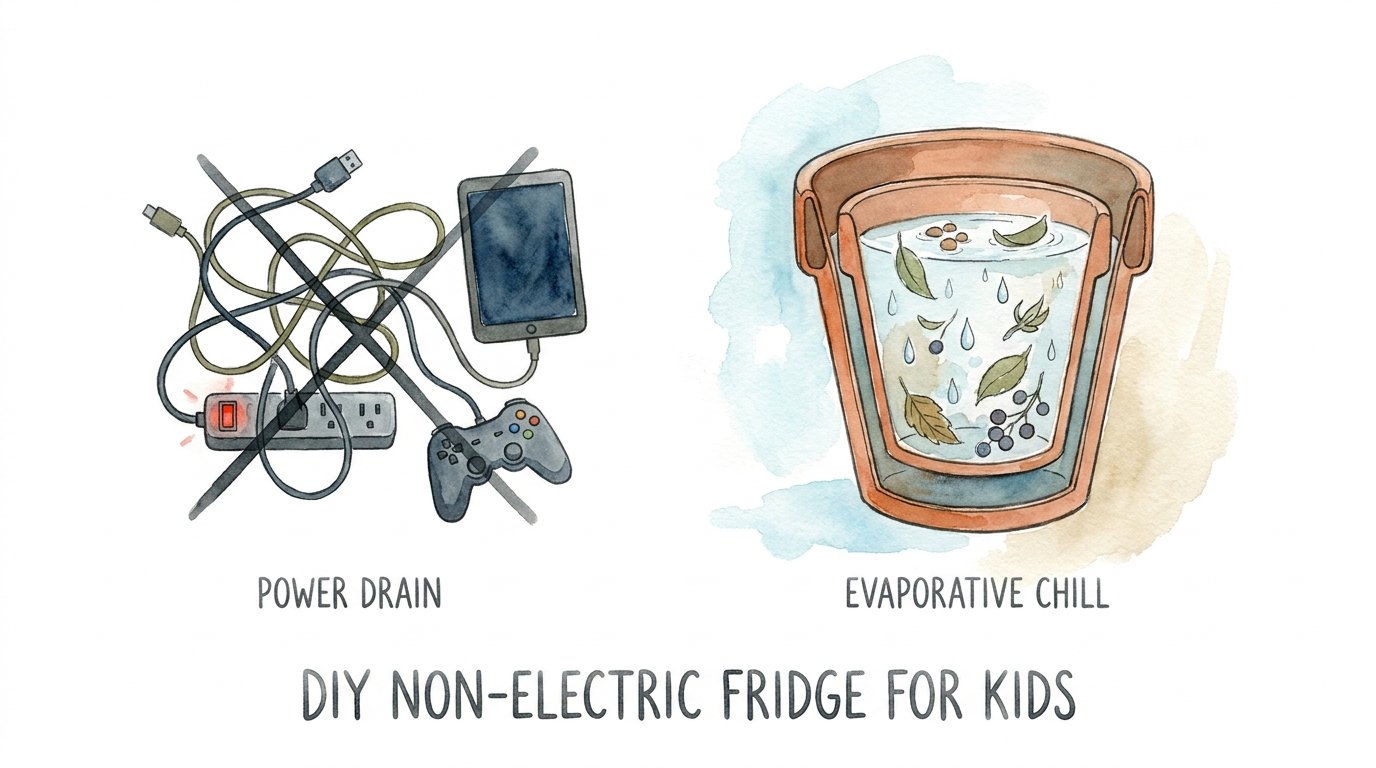
The Zeer Pot is a low-tech refrigerator that stays cold using only water and air. People also call it a “pot-in-pot” cooler. It consists of a small clay pot placed inside a larger clay pot. The space between them is filled with sand, which acts as a reservoir for water. As the water evaporates through the porous clay of the outer pot, it carries heat away from the inner chamber. This leaves the inside of the smaller pot significantly cooler than the surrounding air.
This invention gained modern fame through the work of Mohammed Bah Abba in Nigeria. He realized that farmers were losing their crops to heat and rot within days. He distributed these clay coolers to help families preserve tomatoes, peppers, and eggplant for weeks instead of hours. In many parts of the world, this device is a literal lifesaver. It bridges the gap between harvest and the market, ensuring food security for those without access to a power grid.
Think of it as a radiator for your vegetables. It works exactly like the human body does when it sweats. When you get hot, your skin releases moisture. As the breeze hits that moisture, it evaporates and chills your skin. The Zeer Pot is a “sweating” fridge. It is an ideal project for kids because it demonstrates complex physics with items you can find at a garden center. It turns abstract science into a tangible, cold snack.
How to Build Your Zeer Pot Cooler
Building this system requires specific materials to work correctly. You cannot use just any pot from the store. The success of the project depends on the porosity of the material. Follow these steps to ensure your cooler actually drops in temperature.
Step 1: Gather Your Materials
You need two unglazed terracotta pots. Ensure one pot is small enough to fit inside the other with at least one to two inches of space around the sides. Do not buy glazed or painted pots. Glaze seals the clay and prevents water from seeping through, which kills the evaporation process. You also need a bag of clean sand, a gallon of water, and a heavy cloth or burlap sack to use as a lid.
Step 2: Seal the Drainage Holes
Most garden pots have a hole at the bottom for water drainage. You must plug these holes to keep the sand and water inside. Use cork, waterproof putty, or even a large flat stone covered in clay. If the inner pot leaks, your food will get soggy. If the outer pot leaks, you will lose your water supply too quickly. Ensure the seal is tight and permanent.
Step 3: Creating the Base
Pour about two inches of sand into the bottom of the larger pot. Level it out so the smaller pot sits evenly. This layer of sand ensures that the bottom of the inner pot also receives the cooling effects of evaporation. Check the height by placing the smaller pot inside; the rims of both pots should be roughly level with each other.
Step 4: Filling the Gap
Position the smaller pot in the center of the larger one. Carefully pour sand into the gap between the two pots. Fill it all the way to the top, but leave a tiny bit of room so the sand doesn’t spill into your food chamber. Tamp the sand down gently to remove large air pockets. Air pockets act as insulation, which we want to avoid. We want a solid thermal bridge of wet sand.
Step 5: Charging the System
Slowly pour cold water onto the sand. Keep pouring until the sand is completely saturated and cannot hold any more liquid. You will see the outer pot begin to darken as it absorbs the moisture. This is a sign that the system is “charging.” Place your food or drinks inside the inner pot. Finally, cover the top with a wet cloth or a lid. A wet burlap sack works best because it adds even more surface area for evaporation.
Benefits of Evaporative Cooling
The primary advantage is the total lack of moving parts. There are no motors to break and no batteries to charge. This makes it a “set it and forget it” solution for off-grid living. It is incredibly cheap to build, often costing less than twenty dollars for a full setup. Compare that to the price of a high-end camping cooler or a portable electric fridge, and the savings are massive.
Environmental impact is another huge win. Traditional refrigerators use refrigerants like HFCs which can be harmful if they leak. The Zeer Pot uses only water. It is a 100% sustainable technology. Once the pots break or are no longer needed, they can be crushed and returned to the earth as clay. This creates a circular lifecycle that modern appliances cannot match.
Food quality often improves in these pots. Refrigerators are notoriously dry environments, which can wilt leafy greens and dry out fruits. The Zeer Pot maintains a slightly higher humidity level within the inner chamber. This prevents dehydration in produce. Your carrots stay crunchy and your tomatoes stay firm for much longer than they would sitting on a counter in the heat.
Challenges and Common Mistakes
The most frequent error is choosing the wrong type of pot. Many people buy “clay” pots that have a clear seal or decorative glaze on them. If the pot feels smooth or shiny, it will not work. The water must be able to migrate through the clay wall to reach the outside air. Test your pot by splashing water on it; if the water beads up, the pot is useless for cooling. If the pot absorbs the water and turns a darker shade, it is perfect.
Location choice is another pitfall. You might think putting the pot in a dark, enclosed pantry is best. This is actually the worst place for it. Evaporative cooling requires airflow. If the air around the pot becomes stagnant and humid, evaporation stops. The pot should be placed in a breezy, shaded area. Placing it in direct sunlight can sometimes overwhelm the cooling effect, so a covered porch with a steady wind is the “goldilocks” zone.
Neglecting the water levels will cause the system to fail within hours. The sand must stay wet. Depending on the temperature and wind, you may need to add water two or three times a day. If the sand dries out, the inner pot will quickly warm up to match the outside temperature. Think of the water as the “fuel” for your fridge. Without fuel, the engine stops running.
Limitations and Environmental Constraints
Geography plays a massive role in how well a Zeer Pot performs. This technology relies on low ambient humidity. In a desert like Arizona or the Sahara, the air is thirsty for moisture. It pulls water out of the pot rapidly, creating a massive temperature drop. In these conditions, you can see the internal temperature drop by 30 degrees Fahrenheit or more.
Humid climates like Florida or Southeast Asia are much more difficult for the Zeer Pot. When the air is already saturated with water (high humidity), evaporation slows down significantly. If the water cannot evaporate, the cooling effect vanishes. People in tropical areas may find the pot only cools by a few degrees, which might not be enough to preserve meat or dairy. It is essential to check your local “wet bulb” temperature before relying on this for critical food storage.
Size is also a constraint. You are limited by the size of available terracotta pots. While you can find very large garden pots, they become extremely heavy once you add wet sand. A fully loaded Zeer Pot is not something you want to move around frequently. It is a stationary appliance. Furthermore, it is not a freezer. It will never reach temperatures below 32 degrees Fahrenheit, so it cannot be used to store ice or long-term frozen goods.
Comparison: Power Drain vs. Evaporative Chill
Comparing a standard electric cooler to a Zeer Pot reveals a trade-off between convenience and reliability. Electric systems offer precise temperature control but require a constant energy source. The Zeer Pot offers zero-cost operation but requires manual maintenance. Below is a breakdown of how these two approaches compare in a field environment.
| Feature | Electric Portable Fridge | Zeer Pot (Evaporative) |
|---|---|---|
| Initial Cost | $300 – $1,000 | $15 – $40 |
| Operating Cost | High (Battery/Solar) | Zero (Just water) |
| Maintenance | Low (Plug and play) | Medium (Refilling water) |
| Reliability | Subject to circuit failure | Virtually indestructible |
| Ideal Climate | Anywhere | Arid / Low Humidity |
The choice between these systems depends on your goal. If you are in a permanent off-grid cabin in a dry climate, the Zeer Pot is a fantastic primary or secondary fridge. If you are traveling through a humid jungle, you might need to find a way to power a compressor-based system. Most survivalists keep a pair of pots ready as a backup for when solar panels fail or fuel runs out.
Practical Tips and Best Practices
Maximize your cooling by increasing the airflow. Placing your pot on a stand that allows air to circulate underneath the base can help. If you have a small solar fan, pointing it at the pot will accelerate evaporation and drop the temperature even further. Air movement is the secret ingredient that most beginners forget.
Use the cleanest water possible. Over time, minerals in hard water can clog the pores of the clay. This is known as “scaling.” If you notice white, crusty deposits on the outside of your pot, scrub them off with a stiff brush and some vinegar. This keeps the “breathability” of the clay at its peak. Using distilled or filtered water can prevent this issue entirely, though it is not always practical in the wild.
Group your items wisely. Place items that need the most cooling at the very bottom of the inner pot. Cold air is denser and will settle at the base. You can also add a layer of charcoal to the sand. Charcoal has a massive surface area and can help hold moisture while preventing the growth of algae or mold in the sand. It also helps filter out odors.
- Keep the lid wet at all times to prevent heat from entering from the top.
- Place the pot in a “wind tunnel” area, such as between two buildings or in a hallway.
- Don’t overstuff the inner pot; leave room for air to circulate around the food.
- Check the sand moisture every time you go to grab a snack.
Advanced Considerations: Scaling and Materials
Serious practitioners often build multi-stage systems. You can nest three pots instead of two to create extra insulation and evaporation zones. This “Triple Zeer” setup can reach even lower temperatures, though it becomes significantly bulkier. It also requires a more careful balance of water distribution to ensure the middle layer doesn’t become a swamp.
Material science offers other options besides sand. Some users experiment with perlite or vermiculite. These materials are lighter than sand and hold a high volume of water. However, sand provides better thermal mass, which helps maintain a steady temperature even if you forget to water it for an hour. The weight of the sand also keeps the inner pot from shifting or floating if too much water is added at once.
Optimization of the outer surface area is another advanced tactic. You can wrap the outer pot in a layer of burlap that wicks water from the sand reservoir. This increases the “sweating” surface area. Some people even use unglazed ceramic tiles to build square versions of this fridge, though the round shape of pots usually offers better structural integrity and airflow characteristics.
Example Scenario: The Desert Garden
Imagine a gardener in the high desert of New Mexico. The afternoon sun regularly hits 95 degrees Fahrenheit. Without a fridge, their harvested lettuce and spinach would wilt into a mushy mess within thirty minutes. They set up a large Zeer Pot under the shade of a mesquite tree where the wind is constant.
The gardener fills the gap with coarse desert sand and douses it with well water. Inside the pot, the temperature quickly drops to a steady 65 degrees. While 65 degrees isn’t “ice cold” by modern standards, the 30-degree difference is enough to keep the produce fresh for the entire day. By the next morning, the night air has helped the pot drop even further, often reaching 55 degrees. This simple clay device saves the gardener from having to run an expensive electric cooler in the middle of a field.
Another scenario involves a school science fair. A student builds a mini Zeer Pot using two small flower pots. They place a thermometer inside the clay pot and another thermometer on the table next to it. Within an hour, the class watches as the internal thermometer dips lower and lower while the room temperature stays the same. It is a visual, measurable demonstration of energy being used to change the state of water from liquid to gas.
Final Thoughts
Mastering the Zeer Pot is a rite of passage for anyone interested in self-sufficiency. It teaches you to look at the environment as a source of energy rather than just a challenge to be overcome. This technology is a testament to human ingenuity, showing that we can achieve comfort and food safety using nothing but the earth under our feet.
Experimenting with these pots will give you a better understanding of thermodynamics than any textbook. You will start to notice how humidity, wind, and shade interact in your local climate. This knowledge is priceless when the power goes out or when you are exploring the great outdoors. The Zeer Pot is more than just a cooler; it is a lesson in living in harmony with physics.
Take the time to build one this weekend. Even if you never need it for survival, it makes for a fantastic conversation piece at a backyard barbecue. There is something deeply satisfying about pulling a crisp, cool apple out of a pot that has been sitting in the summer heat. It feels like magic, but it is just the beautiful reality of science at work.