How Screen Time Affects Child Melatonin Levels
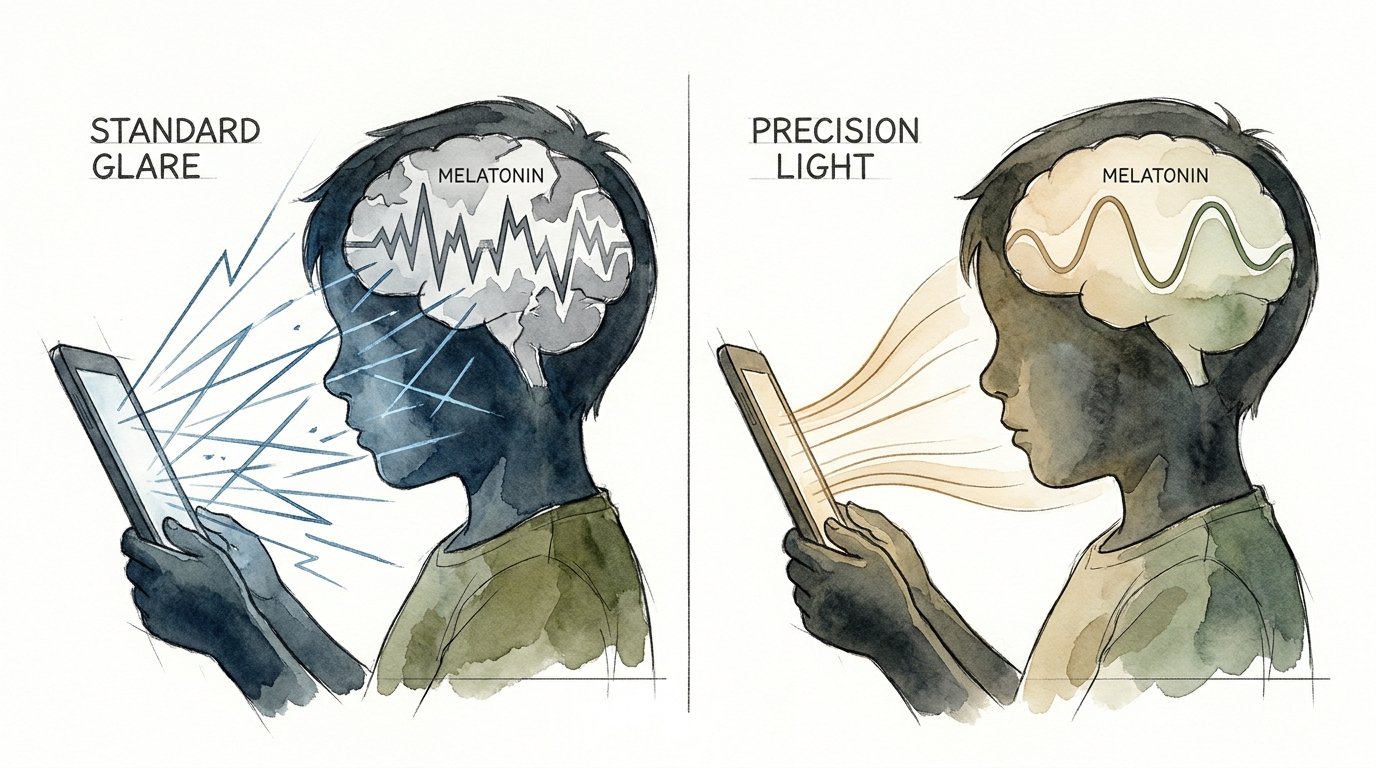
Their brain thinks it is high noon at 8 PM because of the light we are feeding them. Screen overuse isn’t just a habit; it’s a biological disruption. When we flood a child’s eyes with standard digital glare, we stop the precision timing of their internal clock. If your child is wide awake and irritable at bedtime, the screen isn’t just a distraction—it’s a hormone blocker.
Modern parenting often feels like a constant battle against the glow of the tablet. We use screens for education, for quiet time, and for staying connected with family across the country. However, there is a hidden cost to this digital convenience that goes far beyond simple behavior issues. It reaches deep into the very chemistry of your child’s brain.
Every time a child stares at a high-intensity LED screen, their body receives a powerful signal. This signal tells the brain that the sun is still high in the sky. This biological confusion triggers a cascade of effects that can ruin a night of sleep before it even begins. Understanding this process is the first step toward reclaiming your family’s rest and health.
Standard glare is everywhere, from the living room TV to the smartphone in your pocket. This article explores why children are uniquely vulnerable to this light and how we can use precision light strategies to protect them. Let’s look at the science behind the screen and the simple changes that can transform your child’s sleep quality.
How Screen Time Affects Child Melatonin Levels
Melatonin is often called the “vampire hormone” because it only comes out at night. It is produced by the pineal gland in response to darkness. For a child, melatonin is the signal that tells every cell in their body to slow down, repair, and rest. When this hormone is suppressed, the body remains in a state of high alert, even if the child is physically exhausted.
Screens emit a specific type of high-energy visible light known as blue light. This light falls within the 450 to 480-nanometer range, which is exactly the frequency our eyes use to detect daylight. In nature, blue light is strongest at midday. When a child looks at a screen at 7 PM, their brain interprets that blue light as a “stay awake” command.
Recent studies have shown that children are significantly more sensitive to this light than adults. Because children have larger pupils and clearer lenses, more light reaches the back of their eyes. Research indicates that a child’s melatonin levels can drop by as much as 88% after evening light exposure, while adults may only see a 46% drop. This means the same screen that makes you a little restless could be completely shutting down your child’s ability to fall asleep.
This disruption creates a “biological delay.” Even after the screen is turned off, the brain needs time to realize it is actually dark. This is why many parents experience the “second wind” phenomenon, where a child seems suddenly hyperactive right at bedtime. Their body is confused, and their internal clock has been shifted by hours.
How the Biological Disruption Works
The process starts in the retina, where specialized cells called intrinsically photosensitive retinal ganglion cells (ipRGCs) live. These cells don’t help us see shapes or colors. Instead, they contain a pigment called melanopsin that is hyper-sensitive to blue light. Their only job is to tell the brain whether it is day or night.
When blue light hits these cells, they send a direct signal through the retinohypothalamic tract to the Suprachiasmatic Nucleus (SCN). The SCN is the master clock of the human body. Once the SCN receives the “daylight” signal from a tablet or phone, it immediately tells the pineal gland to stop producing melatonin. This effectively keeps the child’s internal system in “daytime mode.”
This isn’t just about falling asleep; it’s about the quality of that sleep. Melatonin helps regulate the transitions between different sleep stages. When levels are low, children often experience less REM sleep, which is critical for memory consolidation and emotional processing. This is why a screen-heavy evening often leads to a grumpy, forgetful child the next day.
The content matters too, but the light is the primary driver. While a fast-paced video game adds psychological arousal, the standard glare from the screen provides the physiological roadblock. Together, they create a perfect storm of wakefulness. Using precision light—light that is shifted toward warmer, redder tones—can help mitigate the physiological side of this equation.
The Hidden Benefits of Optimized Light Exposure
When you align your child’s environment with their biological needs, the benefits are almost immediate. Transitioning from standard glare to a more natural light progression allows the pineal gland to function as intended. Parents often report that bedtimes become faster and less combative within just a few days of making these changes.
Improved Emotional Regulation: Better sleep leads to a more resilient nervous system. Children who get sufficient, high-quality sleep are better equipped to handle frustration and manage their emotions. Melatonin doesn’t just help with sleep; it plays a role in overall hormonal balance and mood stability.
Enhanced Learning and Memory: During deep sleep, the brain flushes out toxins and cements the day’s lessons. By protecting melatonin levels, you are directly supporting your child’s academic performance. They wake up with a “clean slate,” ready to absorb new information without the fog of sleep deprivation.
Stronger Immune System: Sleep is the primary time for the body to repair tissues and strengthen immune responses. Chronic melatonin suppression can lead to a weakened defense against common illnesses. A well-rested child is often a healthier child, spending less time on the sidelines with colds and flu.
Challenges and Common Mistakes
One of the biggest mistakes parents make is relying solely on “Night Mode” or “Blue Light Filters” on devices. While these features shift the color slightly, they often don’t reduce the light intensity enough to stop melatonin suppression. The screen is still a concentrated light source aimed directly at the eyes, which can be enough to trigger the SCN.
The “One More Video” Trap: We often use screens as a reward or a way to wind down. However, the stimulating nature of modern apps—with their bright colors and quick cuts—overrides the child’s natural tiredness. This creates a cycle where the child needs more stimulation to stay awake, further delaying their rest.
Ignoring Room Lighting: Many parents focus on the tablet but forget about the bright LED bulbs in the ceiling. Standard overhead lighting can be just as disruptive as a screen. If the house stays at “office brightness” until 8 PM, the child’s brain won’t start the wind-down process regardless of whether they have a tablet in their hand.
Inconsistency: The circadian rhythm thrives on routine. Allowing late-night screen use on weekends can “jet lag” a child’s system. This makes Monday mornings a nightmare as their body tries to shift its clock back by several hours. Consistency is the key to maintaining a healthy internal rhythm.
Limitations and Environmental Constraints
We live in a world that is fundamentally designed to be bright. From streetlights outside the window to the glow of household appliances, total darkness is hard to achieve. It is important to recognize that you cannot control every photon. The goal is mitigation, not perfection.
Some children have underlying neurological conditions, such as ADHD or Autism, that naturally alter their melatonin production. In these cases, light management is still crucial, but it may not be a “silver bullet.” These families may need to work closely with pediatricians to develop a more comprehensive sleep strategy that includes behavioral and environmental interventions.
Winter months and high-latitude living also present challenges. When the sun sets at 4 PM, keeping a child in “night mode” for six hours before bed is unrealistic. In these environments, using precision light—such as lamps that mimic the sunset or red-shifted evening bulbs—becomes essential to bridge the gap between sunset and bedtime.
Comparison: Standard Glare vs. Precision Light
| Feature | Standard Glare (Unfiltered LED) | Precision Light (Circadian Optimized) |
|---|---|---|
| Primary Wavelength | 450-480nm (High Blue) | 600nm+ (Warm/Red Shifted) |
| Brain Signal | High Noon / Stay Alert | Sunset / Prepare for Rest |
| Melatonin Impact | Up to 88% Suppression | Minimal to No Suppression |
| Pupil Response | High strain, larger intake | Relaxed, soothing effect |
| Best Use Case | Daytime work and focus | Evening relaxation and bedtime |
Practical Tips and Best Practices
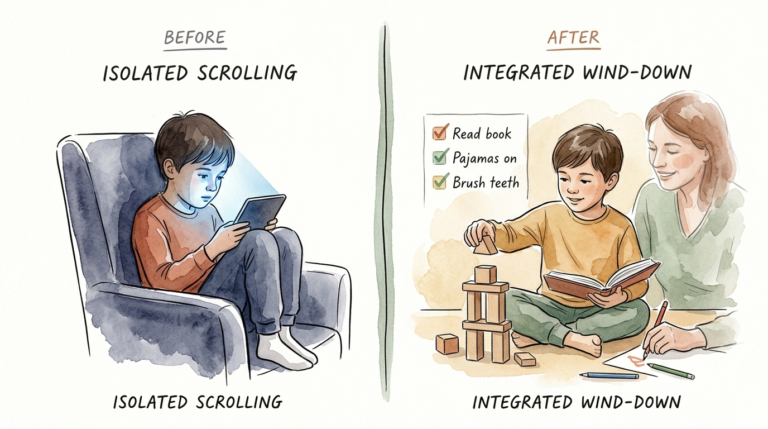
Implementing a “Digital Sunset” is the most effective way to protect your child’s melatonin. This doesn’t mean you have to live in a cave, but it does mean being intentional about the light you allow into their world after dark. Start by establishing a hard cutoff for all screens at least 60 to 90 minutes before sleep.
- Swap the Bulbs: Replace the cool-white LED bulbs in your child’s bedroom and the bathroom with warm-amber or red-toned bulbs. These do not trigger the ipRGCs and allow melatonin to rise naturally.
- The “Books Only” Rule: Replace the tablet with physical books or an e-reader that uses e-ink technology without a backlight. If you must use a backlit device, turn the brightness to the lowest possible setting and use a physical blue-light-blocking screen protector.
- Morning Sun Exposure: Curiously, the best way to ensure good sleep at night is to get bright, natural sunlight in the morning. This “anchors” the circadian rhythm, making the brain more sensitive to the rise of melatonin later in the evening.
- Dim the House: Lower the overall light levels in your home as dinner ends. Use floor lamps instead of overhead lights. This gradual dimming mimics the natural transition of the day and cues the child’s body that sleep is approaching.
Educate your child on why these rules exist. Instead of making it about “taking away their fun,” explain that their brain needs special “sleep fuel” (melatonin) that can only be made in the dark. Giving them agency over their own biological health can reduce the friction around screen limits.
Advanced Considerations for Sleep Health
Serious practitioners of sleep hygiene look beyond just the light spectrum and consider the Melanopic EDI (Equivalent Daylight Illuminance). This is a measurement of how much a light source stimulates the “stay awake” receptors. For the evening, you want a Melanopic EDI of less than 10 lux at the eye level. In contrast, daytime environments should be 250 lux or higher to promote alertness.
The role of the crystalline lens is another advanced factor. As we age, our lenses yellow, providing a natural filter for blue light. Children have “pure” lenses, which is why they are essentially hyper-sensitive to digital glare. This biological reality means that children need stricter light controls than their parents to achieve the same sleep quality.
Consider the timing of “social light.” Even if the light spectrum is perfect, the psychological engagement of social media or gaming can keep the brain in a high-cortisol state. Cortisol and melatonin are opposites; when one is high, the other is low. A truly optimized evening routine addresses both the light entering the eyes and the stress levels of the mind.
Real-World Example: The “Bedtime Battle” Scenario
Consider a 7-year-old named Leo. Leo usually plays games on a tablet until 8 PM for a 8:30 PM bedtime. Every night, Leo is “wired,” struggles to stay in bed, and eventually falls asleep at 10 PM, only to wake up groggy for school at 7 AM. His parents believe he just has “too much energy.”
In reality, Leo is suffering from a light-induced phase delay. The standard glare from his tablet has suppressed his melatonin, effectively moving his “internal 8 PM” to 10 PM. His body isn’t ready for sleep because the chemical signal hasn’t been sent. He is irritable because his brain is in a state of exhaustion-induced stress.
By moving the tablet time to after school and switching to precision light (amber lamps) after 6:30 PM, the parents allow Leo’s melatonin to rise on schedule. Within a week, Leo begins to feel naturally sleepy at 8:15 PM. He falls asleep within 15 minutes because his biology is finally aligned with his schedule. The “energy” problem wasn’t a personality trait—it was a lighting error.
Final Thoughts
Protecting a child’s sleep in a digital world requires a fundamental shift in how we view our home environment. We must stop seeing screens as harmless tools and start seeing them as powerful biological modulators. The light we feed our children is just as important as the food we give them, especially when the sun goes down.
By choosing precision light over standard glare, you are giving your child a massive developmental advantage. You are protecting their ability to learn, their emotional stability, and their long-term health. It is a simple change that yields profound results, turning bedtime from a battle into a natural, peaceful transition.
Start tonight by dimming one extra light and putting the tablets away an hour early. Observe the changes in your child’s mood and alertness over the next few days. You might find that the “difficult” behavior you’ve been struggling with was simply a brain waiting for the lights to finally go out.
Sources
1 northfloridasleepsolutions.com | 2 substack.com | 3 blockbluelight.com.au | 4 sleepfoundation.org | 5 nih.gov | 6 nih.gov | 7 thensf.org | 8 nih.gov