Signs Of Decreased Imagination In Screen-heavy Kids
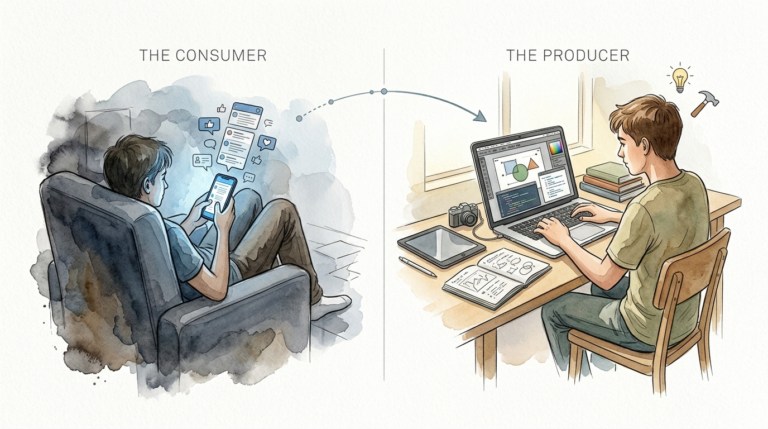
If your child doesn’t know what to do with a stick, the screen has already replaced their imagination. Apps are designed to tell your child exactly how to play, which means their brain never has to work to fill the silence. When a child crosses into overuse, they lose the ability to see a million possibilities in a single object. It’s time to trade the high-def pixels for high-concept play.

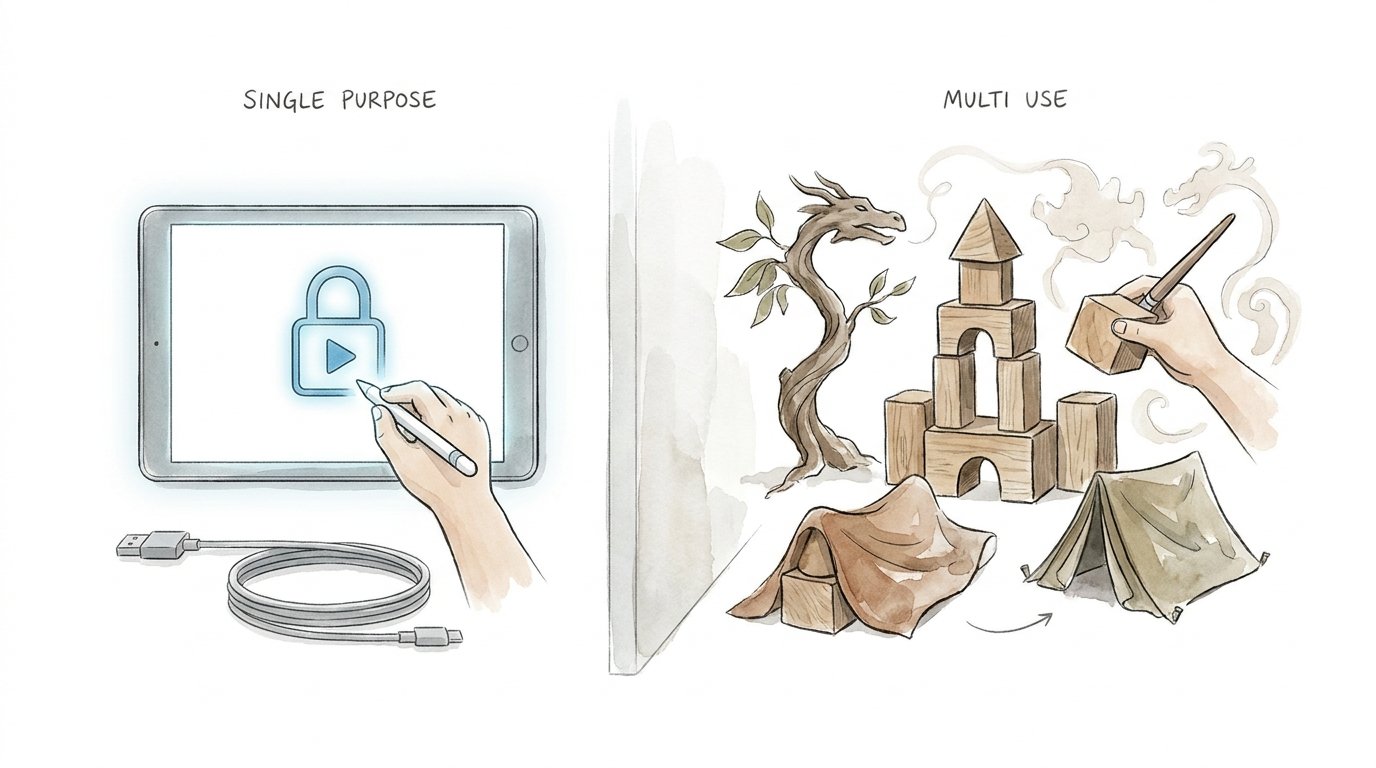
Every parent has been there. You buy the most expensive, voice-activated, light-up toy on the market, only for your child to spend the afternoon playing with the cardboard box it came in. We often laugh at this, but it is actually a profound display of cognitive health. That box is a multi-use tool that requires the brain to do the heavy lifting. In contrast, the high-tech toy is often single-purpose, doing the imagining for the child.

The digital world has accelerated this shift. While screens offer incredible convenience, they are built on “rule-bound” play. In a video game, you can only go where the code allows. In an app, a button does one specific thing. This constant stream of ready-made imagery can crowd out a child’s internal ability to visualize and create. Understanding how to navigate this balance is essential for raising resilient, creative, and independent thinkers.
Signs Of Decreased Imagination In Screen-heavy Kids
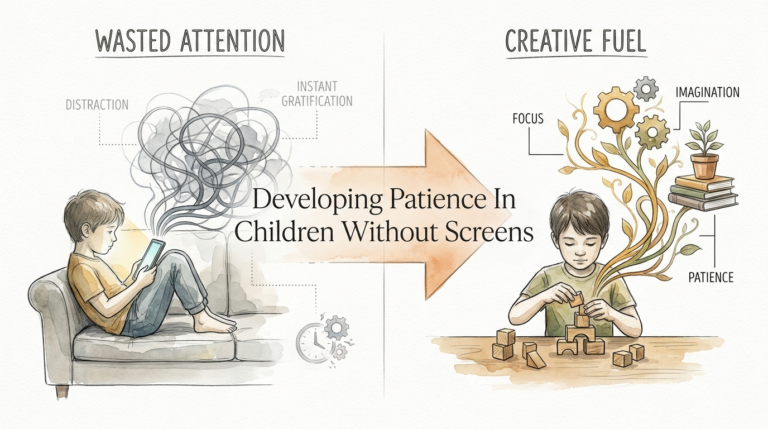
Detecting a decline in imagination isn’t always about what a child is doing; it is often about what they aren’t doing. When a child’s brain is conditioned to receive constant, fast-paced external stimulation, the “muscle” of internal visualization can begin to atrophy. They may struggle to initiate play without a digital prompt or a set of strict instructions.
One of the clearest signs is the “I’m bored” syndrome. While boredom is a natural state, children who are overexposed to screens often find it intolerable. Instead of using that quiet time to invent a game, they feel a sense of distress because their brain is waiting for an external “input” to tell them what to do next. This lack of self-directed play is a red flag for a weakening imagination.
Another common sign is “repetitive mimicry” play. You might notice your child only re-enacting scenes from a favorite show or YouTube video, word for word, without adding their own twists or characters. While some imitation is normal, a healthy imagination eventually takes those elements and transforms them into something new. If the play stays stuck in a digital loop, the screen is likely driving the narrative.
Physical signs can include a decreased attention span for slower-paced activities like drawing, building with plain blocks, or reading. If a child cannot sustain interest in an object unless it makes noise or flashes, they may be losing the ability to project their own ideas onto simple materials. In the classroom, this often manifests as a struggle with open-ended assignments or creative problem-solving.
The Science: How Screens and Play Impact the Brain
The human brain develops most rapidly before the age of five, forming up to one million neural connections every second. This growth is “experience-expectant,” meaning it requires real-world sensory input to build the architecture for complex thought. When a child engages in pretend play, they activate the prefrontal cortex, which is responsible for executive functions like self-regulation and flexible thinking.
Research indicates that excessive screen time can disrupt the “Default Mode Network” (DMN). This is the part of the brain that becomes active when we are at rest or daydreaming. It is the birthplace of creativity. Screens are designed to keep the brain in a state of high-stimulation “active focus,” which means the DMN rarely gets the chance to engage. Without this “downtime,” a child never learns how to generate their own mental imagery.
Furthermore, screens primarily engage the visual and auditory systems, often at the expense of other senses like touch and smell. Real-world play is multisensory. When a child plays in the mud, they are learning about texture, weight, and cause-and-effect in a way that no 4K display can replicate. This physical grounding is essential for cognitive “plasticity,” the brain’s ability to adapt and learn from its environment.
How to Transition from Screens to Imaginative Play
Moving a child away from high-stimulation screens to the “quiet” of imaginative play can be a challenge. It requires a strategic approach to avoid power struggles and help the brain recalibrate to a slower pace. You cannot simply take the tablet away and expect them to immediately start writing a play.
Use “Bridge Activities” to ease the transition. If your child has just finished watching a show about dinosaurs, don’t tell them to “go play.” Instead, bring out some clay or paper and invite them to draw or build their favorite dinosaur. This uses the momentum of the digital content to fuel a physical, creative action, making the shift feel less like a loss and more like a continuation.
The “Invitation to Play” is another powerful technique. Instead of keeping all toys in a bin, set out a few loose parts—like some blocks, a few toy animals, and a piece of blue fabric—on the floor before they even enter the room. This visual “prompt” sparks curiosity. When a child sees the setup, their brain naturally begins to wonder, “What could I do with this?”
The Power of Loose Parts
Loose parts are materials that can be moved, carried, combined, and taken apart. They have no “right” way to be used. Examples include:
- Cardboard boxes and tubes
- Stones, sticks, and pinecones
- Fabric scraps and old clothes
- Wooden blocks and planks
- Measuring cups and spoons
These items are the ultimate tools for the imagination because they are multi-use. A stick can be a wand today and a fishing pole tomorrow.
Benefits of Reclaiming the Imagination
When children are given the space to imagine, the benefits extend far beyond just being “creative.” They are building the foundation for life success. Imaginative play is a “metaphoric multivitamin” that strengthens nearly every cognitive system.
Improved Executive Function: In pretend play, children must follow the “rules” of the world they’ve created. If they are playing “restaurant,” they have to remember who is the chef and who is the customer. This builds working memory and self-control, skills that are better predictors of academic success than IQ scores.
Resilience and Emotional Regulation: Play is a safe laboratory for big feelings. A child might “play out” a scary doctor’s visit or a fight with a friend. By controlling the narrative in their play, they process their anxiety and develop the emotional tools to handle real-life stress.
Social Intelligence: When playing with others, children must negotiate, share ideas, and empathize. They have to understand that their friend might see the “spaceship” as a “boat” and find a way to compromise. This is the origin of advanced social communication and conflict resolution.
Challenges and Common Mistakes
The biggest challenge for parents is the initial “detox” period. When you reduce screen time, children will complain. They will say they are bored. They might even become more irritable. This happens because their brain is essentially “resetting” its dopamine baseline. The mistake many parents make is giving in too early to stop the whining.
Another common mistake is providing too much structure. We often feel the need to “entertain” our children or buy “educational” kits that have a specific end goal. If an activity has a “correct” result, it isn’t truly imaginative play. It is just another form of following instructions. The goal is to provide the opportunity for play, not the roadmap.
Avoid “hovering” during play. When adults jump in to suggest how to build the tower or what the characters should say, the child stops leading and starts following. To truly foster imagination, you must be comfortable with the “mess” and the “silence” that comes with unstructured time.
Limitations: When Screens Have a Place
It is unrealistic and unnecessary to eliminate screens entirely. Technology is a tool, and digital literacy is a vital skill. The issue isn’t the screen itself; it is the passive consumption that often comes with it. There are situations where screens can actually support imagination if used intentionally.
For example, a child using a digital art program to create an original character is engaged in “active” play. Similarly, watching a tutorial on how to build a complex LEGO structure can provide the “fodder” for future creative sessions. The key is to look for content that invites the child to do something in the real world once the screen is off.
Additionally, for some neurodivergent children, screens provide a predictable sensory environment that can be very regulating. In these cases, the goal isn’t necessarily a total “detox” but a balanced schedule where screen time is one of many “tools” in their sensory toolkit, rather than the only one.
Multi-Use vs. Single-Purpose Play
When selecting toys or activities, consider the “90/10 Rule”: The toy should do 10% of the work, and the child should do 90%. If the toy does 90% of the work (making noises, moving on its own), it is likely a single-purpose item with limited imaginative value.
| Factor | Single-Purpose (Screen/Electronic) | Multi-Use (Open-Ended) |
|---|---|---|
| Cognitive Load | Low (Passive) | High (Active) |
| Longevity | Short (Interest fades quickly) | Long (Grows with the child) |
| Problem Solving | Rule-based/Limited | Infinite possibilities |
| Social Value | Individual/Parallel | Collaborative/Narrative |
Practical Tips for a Screen-to-Play Pivot
If you are ready to reclaim your child’s imagination, start small and be consistent. You don’t need a complete lifestyle overhaul overnight. Use these strategies to make the transition easier for everyone.
- Establish “Boredom Zones”: Designate certain times of the day (like the car ride or the hour before dinner) as screen-free zones. This forces the brain to find its own entertainment.
- The “One-In, One-Out” Toy Rule: Rotate toys every few weeks. Having fewer options actually encourages deeper play with the items that are available.
- Model the Behavior: If you are always on your phone, your child will see the screen as the most valuable object in the house. Let them see you reading, drawing, or working with your hands.
- Keep “Prop Boxes”: Have a box of old hats, scarves, and “junk” mail available. These are the sparks for epic pretend scenarios.
Advanced Consideration: The Executive Function Connection
For parents of older children, it’s important to understand that imagination is the precursor to innovation. In a world where AI can handle routine tasks, the ability to think divergently—to find multiple solutions to a single problem—is the most valuable skill a person can have. This skill is built through hours of unstructured “Deep Play.”
Deep Play occurs when a child is so absorbed in their imaginary world that they lose track of time. This is the same “flow state” that top athletes and scientists experience. Screens, with their constant notifications and level-ups, often interrupt this process, preventing children from ever reaching that level of deep cognitive engagement. Protecting their “flow” is as important as protecting their sleep.
Scenario: The “Stick Test”
Imagine two children in a park. One has a tablet. They are focused on a game, their world limited to a 10-inch glass surface. They are quiet, but their brain is merely responding to prompts. When the battery dies, the “fun” ends.
The second child has nothing but a long, sturdy stick. First, it’s a horse. Then, it’s a staff that helps them climb a “mountain” (a small hill). Later, it’s used to draw a map in the dirt for a hidden treasure. This child is the director of their own experience. They are learning physics, narrative structure, and spatial awareness. Most importantly, their fun has no battery life—it is powered by an internal engine that they can take with them anywhere for the rest of their lives.
Final Thoughts
The decline of imagination in the digital age is not an inevitable fate; it is a result of the environments we create. Screens are powerful tools for information, but they are poor substitutes for the messy, unpredictable, and brilliant world of a child’s mind. By choosing multi-use materials over single-purpose apps, we give children the chance to develop the cognitive muscles they need for the future.
Reclaiming the imagination takes time, patience, and a willingness to embrace the quiet. It means allowing your child to be bored until that boredom turns into a spark of an idea. It means valuing the “stick” as much as the “screen.” When we step back and give them the space to fill the silence, we are giving them the greatest gift possible: the ability to build their own worlds.
Start today by putting away one device and providing one “loose part.” Watch what happens when the screen goes dark and the mind turns on. You might be surprised at the incredible things your child can create when they finally have to do the imagining themselves.
Sources
1 mybtoys.com | 2 mattersjournal.com | 3 dynseo.com | 4 parentcircle.com | 5 alliedacademies.org | 6 bunnyhopkinstoys.com | 7 bimontlab.com | 8 childrenandscreens.org | 9 wonderseekerssensoryplay.com.au | 10 theplaytherapycenter.com | 11 thesparkbook.ai | 12 harvard.edu | 13 wisecompass.com | 14 ummhealth.org | 15 playmatters.org.au | 16 happyflowerdaycare.com | 17 inspirechildren.com | 18 harvard.edu | 19 k12dive.com | 20 creativecontinuumaz.com | 21 cedars-sinai.org | 22 nih.gov | 23 independent.co.uk | 24 spring.org.uk | 25 parents-together.org