Importance Of Nature Play For Kids
Safety is important, but a lack of physical challenge creates a different kind of danger for the developing mind. Perfectly flat surfaces don’t teach balance. Predictable plastic doesn’t teach problem-solving. When we trade the wild for the urban, we often trade true growth for mere supervision. It’s time to let them back into the complex world.

Modern childhood has shifted from the woods to the living room. Research shows that children today spend nearly 27 percent of their time with electronic media and only one percent outdoors. This disconnect isn’t just about missing fresh air. It is about missing the fundamental sensory and cognitive inputs that build a resilient human being. Nature play provides the friction required for development. It offers the unpredictability that plastic playgrounds simply cannot replicate.

Importance Of Nature Play For Kids
Nature play is the practice of allowing children to engage in unstructured, child-led activities within natural environments. This includes climbing trees, digging in the dirt, or building forts out of fallen branches. Unlike traditional playgrounds with fixed equipment, natural spaces are open-ended. A stick can be a wand, a sword, or a lever. A rock can be a throne or a stepping stone. This versatility forces the brain to engage in constant creative processing.
This type of play matters because it targets the whole child. Physical strength is built through navigating uneven terrain. Cognitive flexibility is forged through solving the puzzles of the forest. Emotional resilience is earned every time a child scrapes a knee and decides to keep going. In real-world terms, nature play is the “software update” the human brain needs to function in a complex society.
Think of a traditional playground as a treadmill. It is efficient, safe, and serves a purpose. Nature, however, is a cross-country trail through the mountains. It requires constant adjustment, awareness, and adaptation. One teaches you how to move; the other teaches you how to survive and thrive.
How Nature Play Shapes the Developing Brain
Nature play works by engaging the sensory systems in ways that synthetic environments cannot. Two of the most critical systems involved are the vestibular and proprioceptive systems. These are the foundations of balance and body awareness.
The vestibular system is located in the inner ear. It tells the brain where the head is in relation to gravity. On a flat, rubberized playground surface, this system is rarely challenged. In nature, every step on a root or a loose stone requires the vestibular system to fire. Climbing a sloped hill or swinging from a low-hanging branch provides high-intensity input that sharpens a child’s balance.
The proprioceptive system involves receptors in the joints and muscles. It tells us how much force to use and where our limbs are. Natural “heavy work,” such as carrying large sticks or moving stones, provides deep pressure that calms the nervous system. This pairing of vestibular and proprioceptive input happens organically in the wild. It leads to children who are more organized, focused, and physically competent.
The Six Categories of Risky Play
Dr. Ellen Sandseter, a leading researcher, identified six specific types of risky play that children naturally crave. Understanding these helps adults step back and allow growth to happen.
- Great Heights: Climbing trees or boulders to get a bird’s-eye view. This helps kids face fears and judge distance.
- Rapid Speeds: Running down hills or swinging fast. This teaches them to handle high-intensity physical stimuli.
- Dangerous Tools: Using sticks, stones, or even supervised knives and saws. This builds fine motor skills and responsibility.
- Dangerous Elements: Playing near water, fire, or steep cliffs. This forces an acute awareness of environment.
- Rough and Tumble: Wrestling or play-fighting. This is essential for social boundaries and physical limits.
- Disappearing: Playing hide-and-seek or exploring alone. This builds independence and navigational skills.
Benefits of Reclaiming the Wild
The advantages of nature play are measurable and lifelong. Children who spend regular time in natural settings show significant improvements across every developmental domain. These benefits aren’t just “feel-good” metrics; they are essential survival skills for the 21st century.
Physical Resilience: Natural terrain is inherently “complex.” Running on grass, mud, and sand strengthens core muscles and improves coordination. Studies show that children who play on sloped, natural terrain have better balance and gross motor skills than those limited to flat playgrounds. They become less “accident-prone” because their brains have been mapped to handle instability.
Cognitive Mastery: Nature is the ultimate problem-solving lab. Building a bridge across a puddle requires an understanding of physics, weight, and materials. Because natural materials (loose parts) are not “fixed,” the child must invent the rules. This fosters “executive function,” which is the ability to plan, focus, and multitask.
Emotional Stability: Nature has a documented calming effect on the nervous system. Spending time in greenery lowers cortisol levels and reduces stress. It also provides a “safe” place to fail. Falling off a log is a lesson in gravity and persistence. Overcoming these small obstacles builds a deep sense of self-efficacy. They learn they are capable, which is the best defense against anxiety.
Social Intelligence: Nature play is often collaborative. Building a fort requires negotiation, leadership, and teamwork. In an unstructured environment, children must communicate to establish the “rules” of the game. This leads to more sophisticated social interactions compared to the repetitive nature of a slide or a swing set.
Challenges and Common Mistakes
The biggest hurdle to nature play isn’t the environment; it is adult anxiety. We live in a litigious, safety-obsessed culture. This often leads to “surplus safety,” where we remove every possible risk, inadvertently removing the opportunity for growth.
One common mistake is confusing a “hazard” with a “risk.” A hazard is something the child cannot see or manage, like a broken glass bottle in the sand. A risk is a challenge the child can see and choose to take, like climbing a tree. Removing hazards is essential. Removing risks is detrimental.
Another pitfall is the “Clean Clothes” expectation. Many parents and educators hesitate to allow mud or water play because of the cleanup involved. This mindset treats children like furniture that needs to stay pristine. Authentic nature play is messy. It involves dirt, grass stains, and wet socks. When we prioritize cleanliness over exploration, we signal to the child that the environment is something to be feared or avoided.
Finally, adults often intervene too quickly. We shout “Be careful!” the moment a child tries something new. This breaks their concentration and implants a sense of doubt. Constant adult intervention prevents the child from developing their own “internal compass” for safety.
Limitations and Environmental Constraints
Nature play is powerful, but it isn’t always easy to access. Urban environments often lack the “Complex Canopy” required for deep engagement. Densely built neighborhoods may only offer small, paved parks with limited vegetation. This creates “spatial inequality,” where the developmental benefits of nature are only available to those in affluent areas with private yards or large parks.
Weather is another realistic constraint. Extreme heat, cold, or storms can limit outdoor time. While many forest schools advocate for “no such thing as bad weather, only bad clothing,” there are genuine safety boundaries. Frostbite, heatstroke, and dangerous wind speeds are real factors that require adult judgment.
Allergies and local wildlife also present limitations. Some children have severe reactions to pollen or insect stings. In some regions, ticks, venomous snakes, or poisonous plants require a higher level of supervision and education. These factors don’t make nature play impossible, but they do require a more calculated approach to safety.
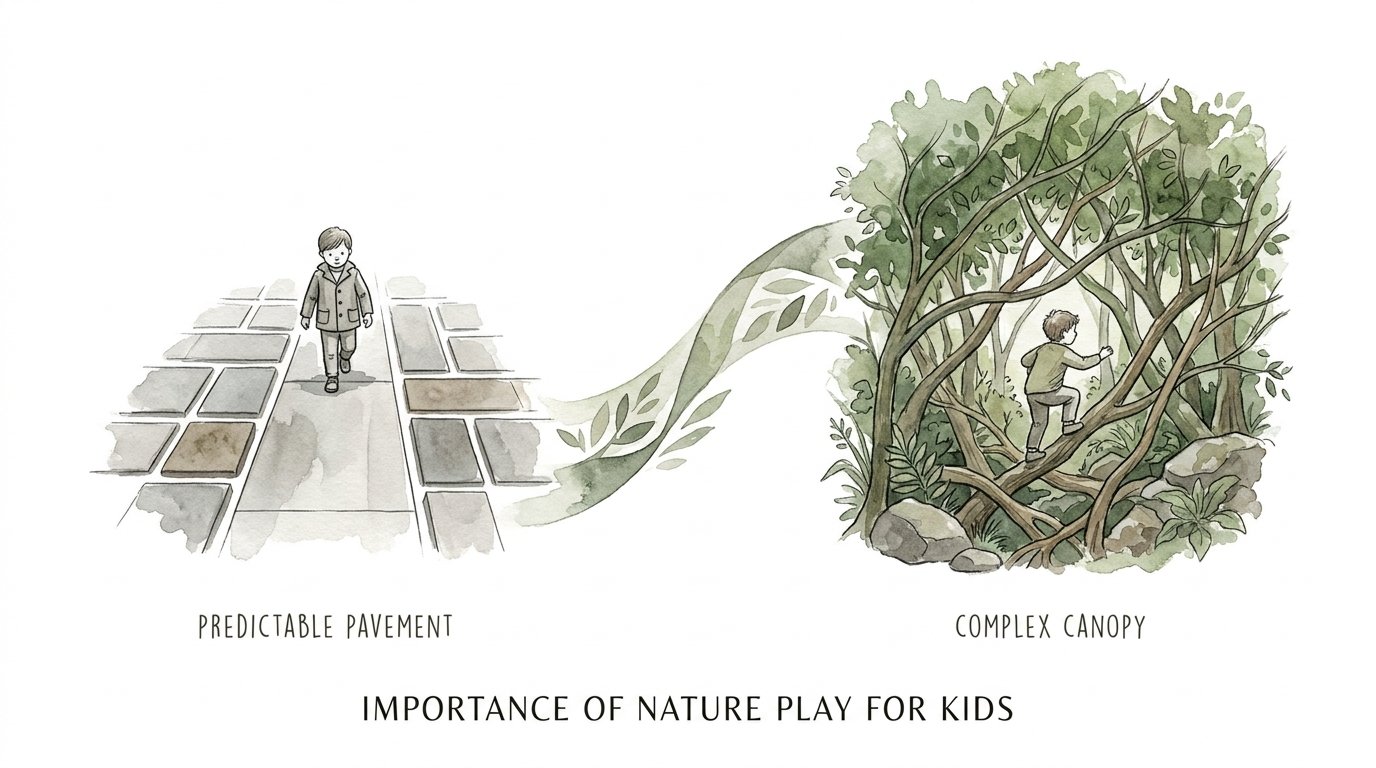
Predictable Pavement vs. Complex Canopy
Understanding the difference between urban “pavement” play and “canopy” play is vital for prioritizing your child’s time. Research indicates that tree-filled environments are significantly more favorable for child development than paved or even simple grassy surfaces.
| Feature | Predictable Pavement | Complex Canopy |
|---|---|---|
| Surface | Flat, synthetic, rubberized. | Uneven, organic, roots, rocks. |
| Sensory Input | Low. Repetitive and linear. | High. Dynamic and multi-sensory. |
| Cognitive Load | Low. Rules are predetermined. | High. Child must invent rules. |
| Safety Factor | Surplus safety. Low risk. | Managed risk. High growth. |
| Health Impact | Higher heat and noise pollution. | Mitigates heat, noise, and air pollution. |
Practical Tips for Parents and Educators
You don’t need a 100-acre forest to start nature play. You can begin in a backyard, a local park, or even a small balcony. The key is to introduce “loose parts” and allow for autonomy.
- Embrace Loose Parts: Provide materials that have no fixed purpose. Stones, logs, pinecones, and sticks are the best toys. Add a few buckets, ropes, and old sheets to encourage fort building.
- Say “I’m Here” Instead of “Be Careful”: If your child is taking a risk, stay close but stay quiet. Letting them know you are a “safety net” gives them the confidence to test their own limits.
- Create a “Yes” Space: Designate an area where the child is allowed to dig, get muddy, and move things around. Having a space where they don’t have to worry about “ruining” anything is liberating.
- Incorporate Water: Water is the ultimate sensory tool. A simple hose, a mud pit, or a bucket of water can keep a child engaged for hours. It teaches concepts of flow, erosion, and volume.
- Follow the Child’s Lead: Don’t try to “teach” nature play. Let them find the bug, climb the rock, or sit silently in the tall grass. Your role is to provide the time and the space.
Advanced Considerations for Serious Practitioners
For educators and designers, nature play goes beyond just “being outside.” It involves intentional “scaffolding” and ecological literacy. Advanced nature play spaces use topography to their advantage. Creating mounds, berms, and “secret” niches allows children to experience different perspectives and social dynamics.
Scaling is another consideration. For older children, the risks must scale with their abilities. This might involve supervised fire-building, using real woodworking tools, or navigating larger wilderness areas. The goal is to keep the child in the “Zone of Proximal Development”—the space where they are challenged but not overwhelmed.
Practitioners should also focus on “inclusive” nature play. Natural spaces can be difficult for children with mobility issues. Designing accessible pathways that still wind through trees or near water features ensures that every child gets the sensory benefits of the wild without feeling excluded by the terrain.
Examples of Nature Play in Practice
Consider the “Backyard River System.” A parent provides a steady drip from a hose at the top of a small dirt mound. The child is given shovels and rocks. Within minutes, the child is engineering dams, diverted channels, and “lakes.” They are learning about gravity and fluid dynamics through their fingertips. There is no manual, and no adult is directing the “curriculum.”
In a “Forest School” scenario, a group of five-year-olds finds a fallen tree. Initially, they simply walk across it like a balance beam. As they gain confidence, they decide to turn it into a “ship.” They collect “loose parts” to serve as the mast and the anchor. This transition from physical skill to imaginative collaboration is the hallmark of high-quality nature play. They aren’t just playing; they are building a society.
Final Thoughts
The modern world is designed for comfort and predictability. While this makes life easier, it often makes the developing mind softer. Nature play is the necessary antidote. It provides the “good stress” that builds a strong body and a sharp mind. By stepping back and letting children engage with the wild, we aren’t just letting them have fun; we are giving them the tools they need to navigate an uncertain future.
Do not be afraid of the mud, the height, or the scraped knees. These are the markers of a life being lived fully. Start small, stay consistent, and watch as your child transforms from a passive observer into an active participant in the natural world.
The wild is waiting. It is time to open the door and let them out. Experiment with a few “loose parts” this weekend and see how quickly the “Complex Canopy” replaces the “Predictable Pavement” in your child’s imagination.
Sources
1 leapccrr.org | 2 tandfonline.com | 3 nido.edu.au | 4 appi.org.au | 5 childrenshouse-montessori.com | 6 beginningsearlylearners.com.au | 7 aifs.gov.au | 8 bienenstockplaygrounds.com | 9 eartheasy.com | 10 thezoofamily.com | 11 natureplaysa.org.au | 12 treehouseschoolhouse.com | 13 bigleapsct.com | 14 playaustralia.org.au | 15 thriveoutside.net | 16 littletikescommercial.com | 17 sunnydaysboise.com | 18 gumeralearninghaven.com.au | 19 bienenstockplaygrounds.com | 20 nathab.com | 21 sciencedaily.com | 22 naeyc.org | 23 playcore.com