summer phone rules
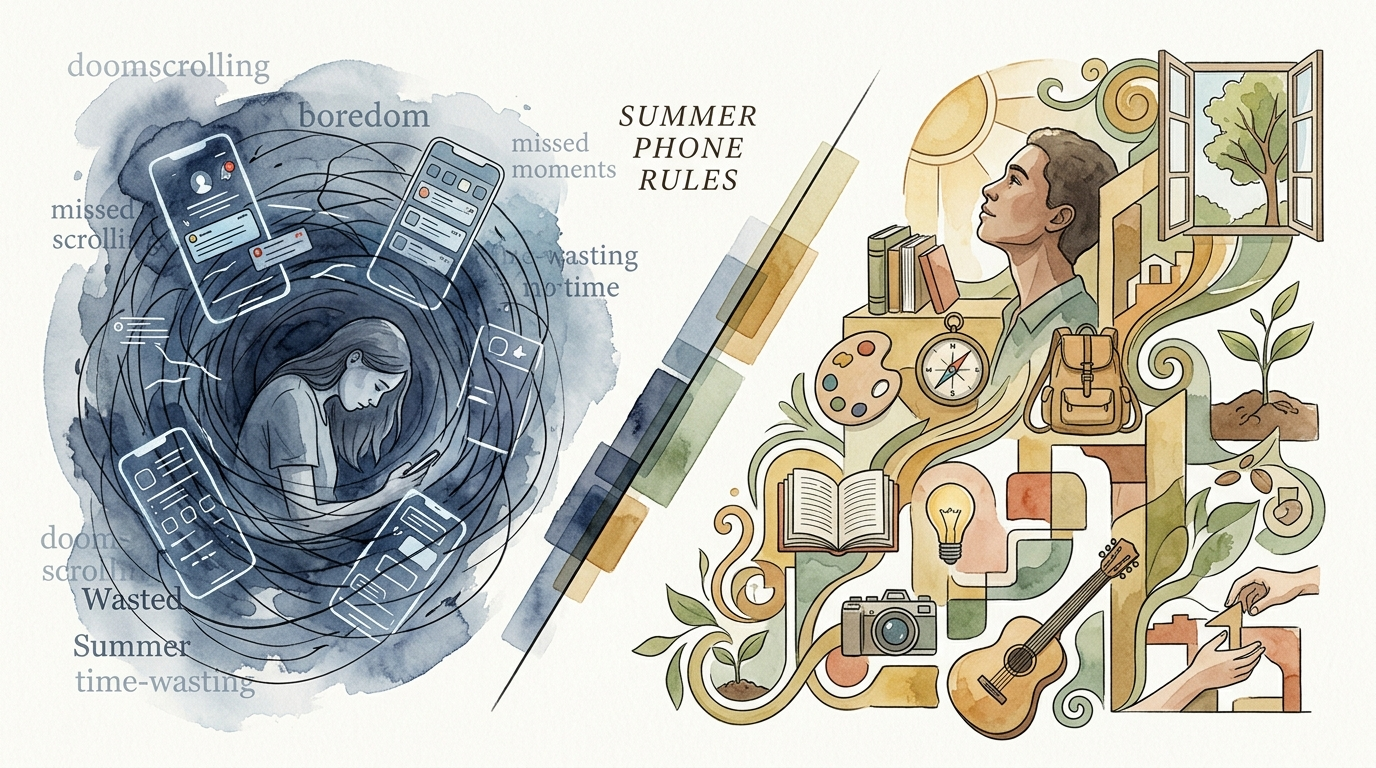
Stop the digital drain and turn this summer into a season of real-world skill-building. Don’t let your kids’ summer vanish into a 3-month scroll session. Turn ‘wasted’ screen time into ‘fuel’ for personal growth and resilience. Our non-negotiable summer phone rules help shift the focus from the digital void back to the physical world.
Summer should be a time for exploration, but for many families, it has become a long-form experiment in digital saturation. Without the structure of the school day, screen time naturally spikes as devices fill the gaps between activities. Recent data suggests that 68% of children see a significant increase in screen use during these months, often reaching between seven and nine hours a day.
This surge isn’t just about entertainment. It’s about what is being displaced. When a child spends the majority of their waking hours in a digital loop, they miss out on the critical “green time” and face-to-face social interactions that build emotional intelligence and physical resilience. By implementing clear, intentional boundaries, you can move from a state of “Wasted Summer Hours” toward “Fueled Summer Growth.”
summer phone rules
Summer phone rules are a set of pre-negotiated boundaries designed to govern how, when, and why digital devices are used during the school break. Unlike school-year rules, which often focus on getting homework done, summer rules are about protecting the brain from “the summer dip” and ensuring that technology remains a tool rather than a destination. These rules exist because, without them, the “path of least resistance” for a bored brain is always the dopamine-rich environment of a smartphone.
In the real world, these rules function as a “Family Tech Plan” or a “Shared Media Use Agreement.” They act as a roadmap for kids who may have lost the ability to self-regulate after a long, structured school year. Instead of a parent constantly “policing” devices, these rules provide a transparent framework so children know exactly what is expected of them before they ever tap a screen.
Think of these rules like a nutritional label for the summer. Just as you wouldn’t let a child eat junk food for three meals a day, these rules prevent “junk food screen time”—passive, endless scrolling—while allowing for “nutritious” digital use, like learning a new skill via video tutorial or staying connected with friends in a healthy way.
How to Implement a Summer Rhythm
The most effective systems don’t just ban phones; they create a rhythm that prioritizes real-world needs first. Implementation starts with a family meeting where everyone, including parents, discusses the “why” behind the limits. When children understand that excessive screen time is linked to higher cortisol levels and disrupted sleep, they are more likely to buy into the plan.
One of the most successful methods is the “Earn it” system. In this model, recreational screen time is a secondary activity that happens only after “non-negotiables” are completed. These non-negotiables typically include physical activity, reading, household chores, and a specific “growth skill.” By making the reward contingent on effort, you train the brain to value deep work over instant gratification.
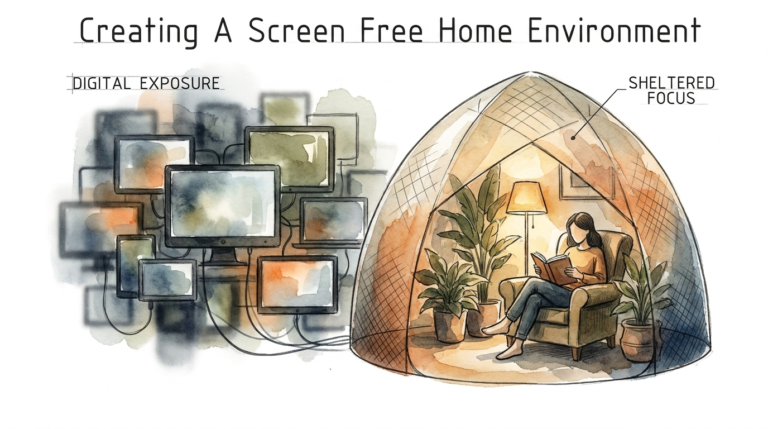
Another powerful technique is the “Screen-Free Zone” strategy. Designate specific areas of the home, such as the dining table and bedrooms, as tech-free environments. This prevents the “continuous partial attention” state where family members are physically present but mentally elsewhere. For teens, a “Phone Hotel”—a central charging station where phones stay from 9:00 PM until 9:00 AM—can dramatically improve sleep quality and morning focus.
Benefits of Digital Boundaries
The practical benefits of reducing screen time during the summer are measurable across multiple domains. First, there is the mental health boost. Taking a “digital detox” or even just reducing use has been shown to boost attention spans and strengthen interpersonal relationships. By stepping away from the “comparison culture” of social media, teens can lower their anxiety and rediscover their own offline identity.
Physical health also sees a massive upgrade. Replacing sedentary screen time with “green time”—time spent in nature—reduces blood pressure and boosts immune function. Just 20 minutes outdoors can decrease cortisol levels by 21%. Furthermore, following the “20-20-20 rule” (looking 20 feet away for 20 seconds every 20 minutes) can prevent the eye strain and “Computer Vision Syndrome” that often plague heavy device users.
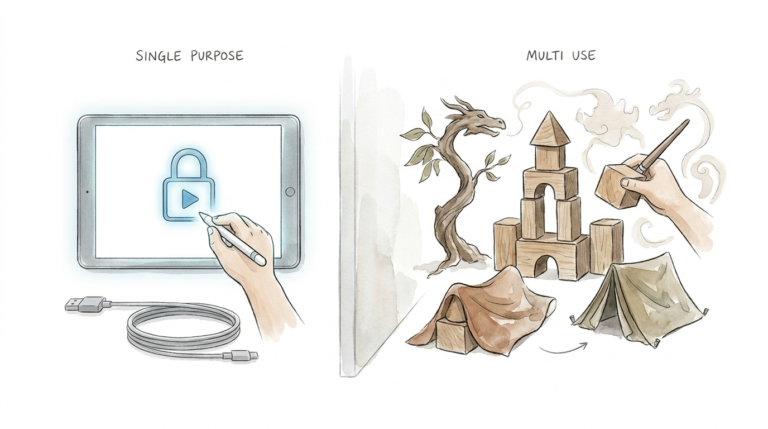
Finally, there is the advantage of “Fueled Summer Growth.” When the “digital drain” is plugged, children are forced to confront boredom. Boredom is actually a valuable catalyst; it drives kids to create, build, and learn. Whether it’s mastering a musical instrument, learning to cook, or starting a small backyard business, these real-world skills provide a sense of agency that a video game high never can.
Challenges and Common Mistakes
The biggest pitfall parents face is the “Inconsistency Trap.” If a rule is enforced on Monday but ignored on Wednesday because the parent is busy, the child learns that the rules are negotiable. Kids will naturally push boundaries to see where they break. Maintaining a firm, predictable routine is the only way to avoid the constant “nagging and bragging” cycle.
Another common mistake is “Parental Hypocrisy.” Children are far more likely to follow digital boundaries if they see their caregivers modeling the same behavior. If you tell your teen to put their phone away while you are scrolling through your own work emails at the dinner table, the rule loses all credibility. A successful summer plan must be a team effort where everyone commits to periods of being “unplugged.”
Lastly, many parents make the mistake of “Lowering the Boom” without providing alternatives. If you take away the phone but don’t provide a “Bored Board” of alternative activities, you are essentially inviting conflict. You cannot simply remove a high-dopamine activity; you must replace it with something that offers a different kind of engagement, such as a hands-on project or a social outing.
Limitations and Constraints
While summer phone rules are highly effective, they do have realistic constraints. For families with two working parents, devices often serve as a “stand-in babysitter” or a necessary tool for safety and communication. In these cases, a total ban is often impossible and impractical. The goal should be “intentionality” rather than perfection.
Neurodivergent children, such as those with ADHD, may find these transitions particularly difficult. For these kids, screens often provide a necessary form of regulation or social connection that is harder to find elsewhere. In these scenarios, rigid caps might be less effective than “collaborative limit setting,” where the child helps decide what is a “reasonable” amount of time for their specific needs.
Environmental factors also play a role. In regions with extreme summer heat or poor air quality, “green time” might be physically unsafe during peak afternoon hours. In these situations, the focus should shift to “Indoor Growth” activities like puzzles, reading, or creative crafts rather than defaulting back to the screen. Understanding these trade-offs helps create a plan that is resilient enough to last all summer.
Wasted Summer Hours vs Fueled Summer Growth
The difference between a “Wasted” summer and a “Fueled” summer comes down to how time is leveraged. When hours are spent in passive consumption, the result is “Digital Drain”—a state of irritability, poor sleep, and social withdrawal. Conversely, “Fueled Growth” occurs when technology is used as a tool for creation or when it is set aside entirely to build physical and mental resilience.
| Feature | Wasted Summer Hours | Fueled Summer Growth |
|---|---|---|
| Primary Activity | Passive scrolling / Gaming | Skill-building / Nature / Reading |
| Dopamine Source | Instant (Algorithms) | Delayed (Accomplishment) |
| Mental State | Partial Attention / Fatigue | Deep Focus / Flow State |
| Social Impact | Isolation / Comparison | Connection / Collaboration |
| Skill Outcome | Minimal / Temporary | High / Long-term Resilience |
Practical Tips and Best Practices
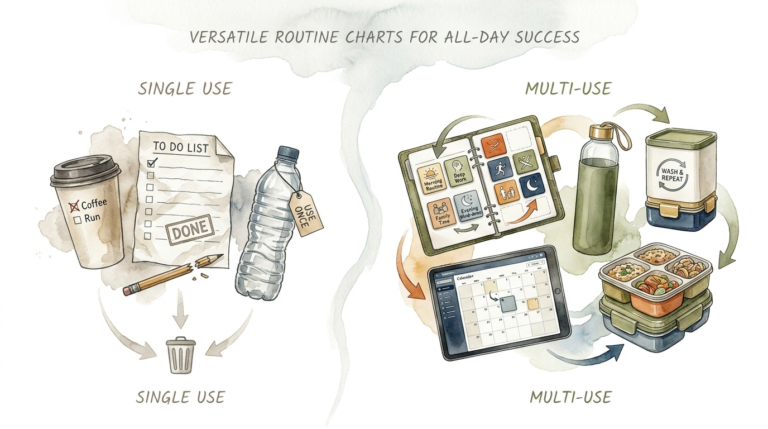
To make your summer phone rules stick, start by gamifying the process. Use a physical chart on the fridge where kids can check off their daily non-negotiables to “unlock” their tech time. This makes the system feel like a game rather than a punishment. If they respond better to praise, focus on the “earned” nature of the time rather than the “limit.”
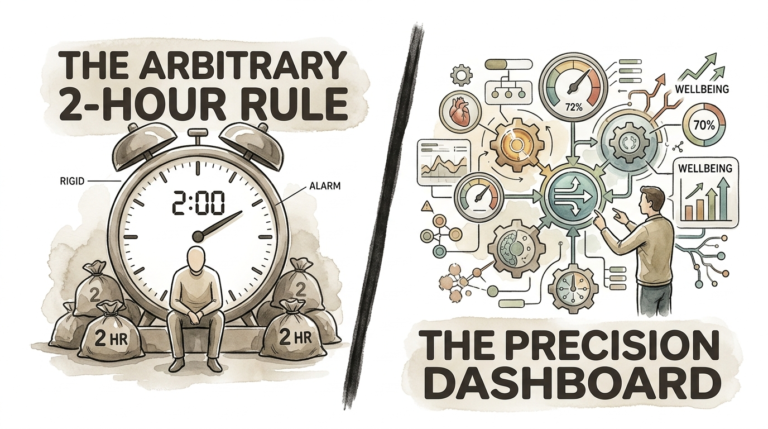
Use technology to manage technology. Built-in tools like “Screen Time” on iOS or “Digital Wellbeing” on Android allow you to set hard stops on specific apps. However, don’t rely solely on software. Physical barriers, like putting the phone in a drawer or a timed locker, are often more effective because they remove the “visual cue” that triggers the urge to scroll.
Create a “Bored Board” in a central location. This is a list of 50+ activities that require zero screens. Include things like “write a letter to a grandparent,” “wash the car,” “learn five words in a new language,” or “build a fort.” When the inevitable “I’m bored” comment arrives, the answer is always, “Check the board.”
Advanced Considerations for Long-Term Success
For those looking to go beyond basic limits, the goal is to foster intrinsic motivation. Instead of just “policing” the phone, teach your children how the apps are designed to be addictive. Explain concepts like “infinite scroll” and “variable rewards.” When kids understand how they are being “hacked” by developers, they often develop a healthy skepticism toward their devices.
Scaling these rules for older teens requires a transition from “management” to “mentorship.” Encourage them to set their own goals. A teen might decide they want to run a 5K or learn to code a basic website. Your role shifts to providing the resources—running shoes or a coding course—and helping them protect the time needed to reach those goals. This builds the personal agency they will need in college and beyond.
Consider the “Transition Phase” at the end of summer. Don’t wait until the night before school starts to re-implement school-year rules. Gradually tighten the boundaries over the last two weeks of August. This helps reset the internal circadian rhythm and ensures that the “brain fog” of a screen-heavy summer doesn’t follow them into the new academic year.
Example Scenarios
Let’s look at how the “One-for-One” rule works in practice. Suppose your 14-year-old wants to spend three hours playing video games on a Tuesday. Under the “Fueled Growth” framework, they must first complete three hours of “growth activities.” This could look like one hour of reading a novel, one hour of practicing the guitar, and one hour of helping with garden work. Only after these three “deposits” are made can they “withdraw” their three hours of screen time.
In another scenario, consider a “Morning Checklist” for a 10-year-old. Before the iPad is even touched, they must: get dressed, eat a healthy breakfast, spend 30 minutes outside, and finish one creative activity (like drawing or building with blocks). This ensures that the most productive hours of the morning—when the brain is freshest—are not wasted on passive consumption.
Final Thoughts
Reclaiming your family’s summer from the “digital drain” isn’t about being anti-technology. It’s about being pro-growth. By establishing clear summer phone rules, you provide your children with the structure they need to explore the physical world, develop new talents, and build lasting resilience. These boundaries don’t just “stop” bad habits; they “start” the process of turning wasted hours into fueled growth.
The true value of these rules isn’t found in the hours saved, but in the memories and skills created. When the school year returns, your kids won’t remember the TikToks they scrolled past, but they will remember the fort they built, the miles they ran, and the confidence they gained by mastering something difficult. Start today, stay consistent, and watch this summer become a season of real transformation.
Sources
1 teencamps-uk.com | 2 truthcenterhh.com | 3 mindfulpedsandteens.com | 4 northwestfamilyclinics.com | 5 luriechildrens.org | 6 collaborativeminds.net | 7 kinzoo.com | 8 medium.com | 9 wmchealth.org | 10 lookingglassoptical.com | 11 digitalwellnesslab.org | 12 additudemag.com