50.4%
Four hours or more
Reported at least four hours of screen time on a typical weekday, excluding schoolwork.
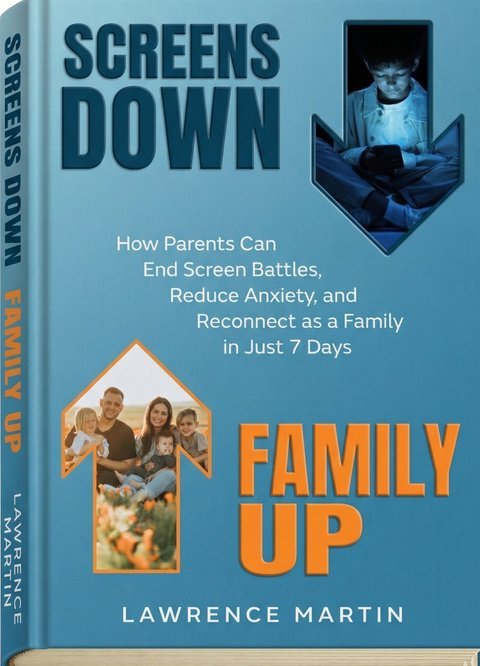
A practical 7-day plan to help you set clearer boundaries and make more room for family time. Get the words to say, activities to offer, and agreements to build on—without banning devices.The words that calm one child don't work on the other. This 7-day plan gives you the right words for each of your children — with their names in the scripts — without banning devices.
Made for your family: your family name on the cover, your children's names and ages inside. A real paperback, printed locally and posted to you in the UK, Ireland and the US.
“While we are still working on this, I have definitely noticed a decrease in screen time requests.”
What if the book that ends screen battles had your family's name on it?
Free preview · 5 seconds · nothing is saved
Free preview · nothing is saved
Most parenting advice gives one answer for every age. But the words that calm a 6-year-old make a 14-year-old roll their eyes — and a teenager's kind of deal goes straight over a 6-year-old's head. When the words don't fit the child, they don't get used.
Same moment, two ages — real lines from the book:
When the screen goes off · Emma, 6
Kneel down, calm and quiet: “You're really upset, Emma. It's hard to stop something fun. I'm right here. When your body calms down, we'll pick what's next — blocks or bikes?”
Short, calm, and a simple choice — what a young child can take in mid-meltdown.
When the rule kicks in · Mia, 14 — “This is SO unfair!”
“You're allowed to hate the rule. You don't have to like it for it to matter. … When you've cooled off, tell me which part feels most unfair — and at the weekly review, if something needs adjusting, we'll adjust it together.”
Respect and a real say — what a teenager needs before they'll listen.
Your copy does this for every child you list. Try it with yours:
Add each child's first name and age — nothing is saved.
Emma, 6ages 3–8
How a script reads in your copy — your child's name, in words that fit their age.
Example family shown — add your children above to see your own.
That's why this copy gets used, not left on the shelf: every page already fits the children at your table. See the editions ↓
In a US survey of teenagers aged 12–17, heavier screen use was associated with more reported anxiety and depression symptoms.
Reported at least four hours of screen time on a typical weekday, excluding schoolwork.
Reported by teenagers with four or more daily screen hours, compared with those below four hours.
The same comparison, for symptoms reported in the previous two weeks. The anxiety figures also cover this period.
Source: CDC/NCHS, US data from July 2021–December 2023; published October 2024. These are associations, not proof that screens caused the symptoms or that this book treats them.
Agree when screens go away, have something ready to do next, and prepare for the conversation when your child asks for five more minutes. That’s where this book comes in.
You set a limit. They ask for five more minutes. By bedtime, you’re negotiating again—and wondering how to make tomorrow different.
The 7-day reset brings three tools together, so you have something to turn to when a boundary meets resistance.
Have the words ready. Use the conversation scripts for familiar sticking points, from bedtime requests to “all my friends have it.”
Give them somewhere to go next. Choose an activity for their age, so switching off comes with an idea for what to do instead.
Make the plan easy to return to. Use the printable agreements and weekly planners to put expectations somewhere the family can see them.
The daily plan gives these tools a structure. You bring the knowledge of your child and adapt the approach to your home.
Get the complete resetSeven days gives you a place to start. The aim is a routine you can keep practising, with clearer expectations for everyone.
Put your screen time rules in writing, so everyone knows what you’ve agreed. The book includes a printable agreement for parents and children, plus a guide to the family meeting where you create it.
Use the agreement alongside the conversation scripts and activity ideas. You get both the written plan and help with the moments when following it is hard.
See the screen time agreement ↓Three actual pages from Screens Down, Family Up. Explore a conversation script, screen-free activities, and the printable family screen time agreement.
Select a page to enlarge it. No signup needed.
A complete script for “all my friends are allowed.”
PDF page 6 of 31Baking ideas by age, outdoor games, and a nature day plan.
PDF page 16 of 31A printable agreement for daily limits, screen-free zones, and shared commitments.
PDF page 9 of 31Your child says: “But ALL my friends are allowed! I'm going to be left out of everything!”
Don’t say: “I don't care what other families do.”
Say this instead:
“You're right — a lot of your friends do have more screen time, and I get why that feels unfair. Being left out is a real worry, and I'm not ignoring it. Here's what we'll do: your time with friends is protected — we'll make sure you never miss the things that matter to you. What we're changing is the scrolling-alone time. Can you help me figure out which parts matter most to you, so we protect those first?”
Excerpt from PDF page 6.
In your family's edition, scripts like this one are addressed to your children by name — the page images above show the standard edition.
“The conversation scripts were a lifesaver I could handle pushback without yelling or getting frustrated.”
Get the complete reset31-page PDF · Illustrated activities ebook included
“offers a realistic, no-guilt approach to tackling screen dependence with clear, step-by-step guidance that actually fits busy family life.”
“It doesn’t feel preachy or extreme, and it doesn’t ask families to eliminate screens entirely.”
“The suggestions are realistic and not preachy, making it easy for families to implement changes without feeling overwhelmed.”
Selected excerpts from Amazon.com reviews of the book, including Kindle and paperback editions. Individual experiences vary. Rating checked 11 September 2026: 5.0 out of 5 from 33 global ratings.

Lawrence Martin is a father of three who wanted more connection around his own dinner table. After months of trial and error at home, he developed the approach behind Screens Down, Family Up.
He writes about family connection and finding balance with technology. His kids still ask for more screen time. The goal is a better way to handle those conversations—and more time together.
Get the day-by-day plan, 12 scripts, printable templates, and the illustrated 50 Screen-Free Activities ebook in one purchase — as a paperback, or as your family's own edition with your children's names inside.
You give us the names and ages at checkout. Printed to order — allow 2–3 weeks.