Benefits Of Loose Parts Play
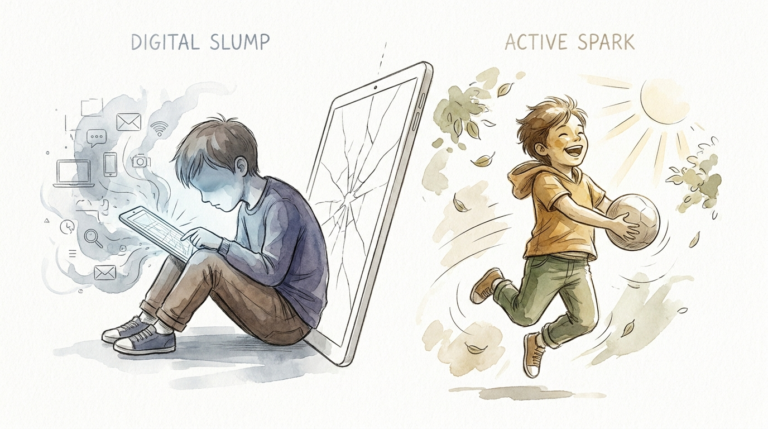
When a toy does everything, the child’s brain does nothing. Plastic playsets have a script. Loose parts have a story. Which one do you want your child’s brain to be writing today?
Welcome to the world of open-ended exploration. This is a space where a simple cardboard tube becomes a telescope, a pirate’s peg leg, or a futuristic laser cannon within seconds. Most parents feel the pressure to buy the latest electronic gadget that promises to teach the alphabet. However, the most profound learning often happens with the simplest, most “boring” items found in your recycling bin or back garden.
Loose parts play is not just a trend for trendy preschools. It is a foundational shift in how we view child development. It moves the child from being a passive consumer of a toy’s features to an active inventor of their own reality. This transition is essential for building the critical thinking skills required in the modern world. Let’s dive into how you can transform your environment into a laboratory of imagination.
Benefits Of Loose Parts Play
Loose parts are materials that can be moved, carried, combined, redesigned, lined up, and taken apart and put back together in multiple ways. They are materials with no specific set of directions. Simon Nicholson, an architect who coined the term “Theory of Loose Parts” in 1971, believed that we are all inherently creative. He argued that the degree of inventiveness in any environment is directly proportional to the kind of variables in it.
Recent research from 2024 and 2025 has highlighted that engaging with open-ended materials releases a hormone called BDNF (Brain-Derived Neurotrophic Factor). This substance acts like a fertilizer for the brain. It increases the speed of neural growth and helps form new connections. When a child decides that a pinecone is a tiny hedgehog, they are engaging in complex symbolic thinking. This process builds the cognitive flexibility needed for advanced mathematics and scientific reasoning later in life.
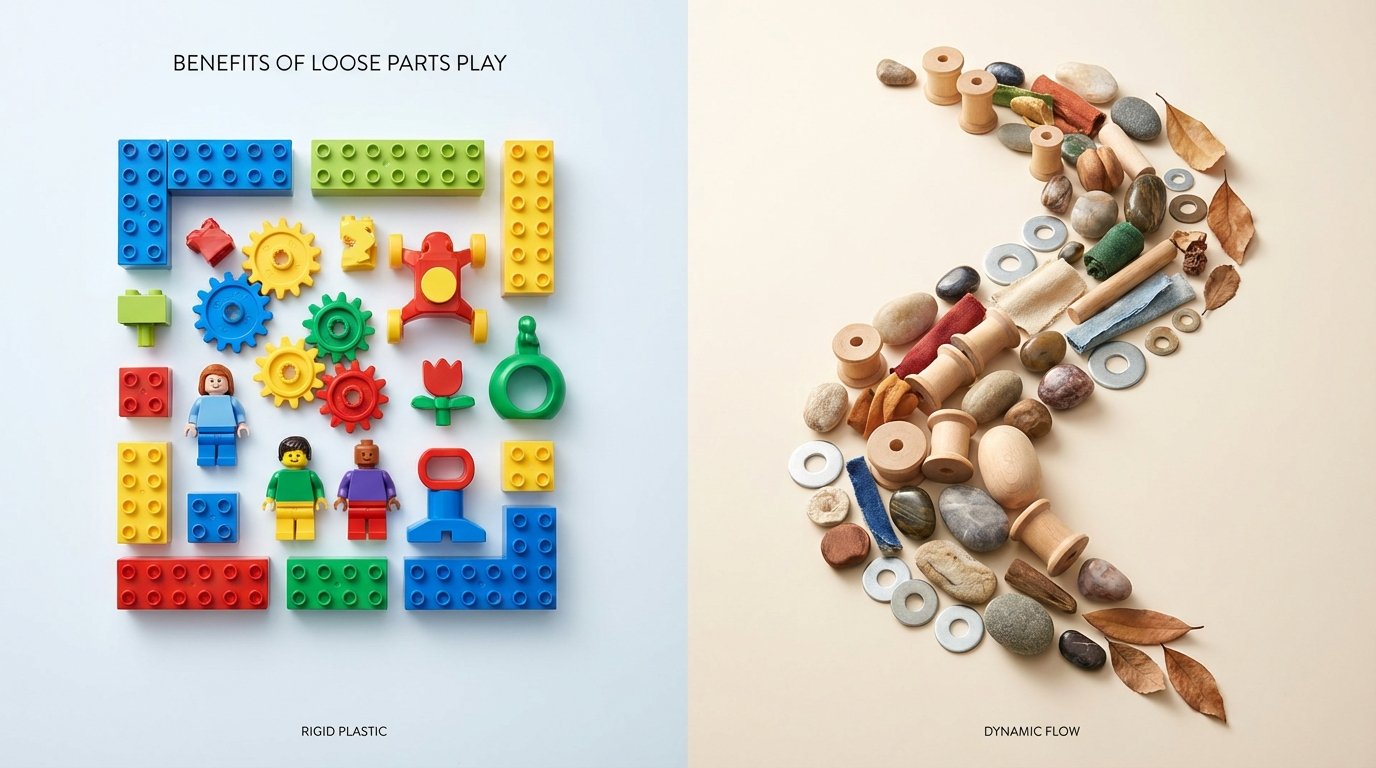
Unlike rigid plastic toys that perform one action, loose parts offer infinite possibilities. A plastic kitchen set will always be a kitchen set. A collection of crates, fabric scraps, and smooth stones could be a kitchen today, a spaceship tomorrow, and a hospital the day after. This versatility ensures the materials never become “boring.” As the child grows and their skills evolve, the materials adapt to their new level of complexity.
How To Implement Loose Parts Play Step-By-Step
Creating a loose parts environment does not require a large budget. It requires a shift in how you see “trash” and nature. You can begin building your collection today by looking at items through the lens of potential.
Step 1: Curate Your Collection
Start by gathering materials from different categories. Aim for a mix of textures, weights, and sizes.
- Natural Materials: Pinecones, smooth river stones, seashells, sticks, dried leaves, and seed pods.
- Upcycled Items: Cardboard tubes, bottle caps, corks, egg cartons, and clean yogurt containers.
- Hardware and Industrial: PVC pipe offcuts, wooden spools, metal washers, nuts, bolts, and old tires.
- Textiles: Fabric scraps, ribbons, old scarves, and pieces of felt.
Step 2: Prepare the Environment
Space is a silent teacher. Ensure there is enough floor area for “big” builds involving crates or planks. For smaller “tinkering” play, a low table or a large tray works best. Clear bins or baskets allow children to see exactly what is available. Labels with photos help even the youngest children understand where items belong, fostering independence during cleanup.
Step 3: Offer an “Invitation to Play”
Sometimes children are so used to being told how to play that they feel overwhelmed by a box of “stuff.” You can help by setting up a provocation. This is simply an intentional arrangement designed to spark curiosity. You might place a few smooth stones inside a mirrors-lined tray with some magnifying glasses. You do not need to say a word. The arrangement itself asks the question: “What can you do with this?”
Step 4: Step Back and Facilitate
The most important rule for the adult is to be a “lifeguard parent.” Stay close enough to ensure safety but far enough away to avoid interrupting the flow. If a child is struggling to balance a block, wait. Give them the chance to feel the frustration and find a solution. Your role is to observe, document their discoveries, and occasionally offer a new material that might extend their current line of thinking.
The Advantages Of Open-Ended Play Systems
The practical benefits of this approach extend far beyond simple entertainment. Because loose parts have no “right” way to be used, they eliminate the fear of failure. Every interaction is an experiment.
Mathematical Thinking: Children naturally begin to sort, count, and create patterns. They compare the weight of a stone to the weight of a cork. They learn about geometry through the 3D properties of boxes and tubes. These are not abstract concepts from a worksheet; they are physical realities the child is manipulating.
Social and Emotional Development: When a group of children plays with loose parts, they must negotiate. There is only one large blue crate, but three children want it. They have to communicate, compromise, and collaborate to build a shared vision. This builds social resilience and the ability to work in a team.
Physical Coordination: Manipulating small items like buttons or beads develops fine motor strength. Hauling heavy tires or balancing on wooden planks builds core strength and gross motor coordination. This physical engagement is a key contributor to early motor coordination, according to recent 2024 studies.
Resilience and Grit: Loose parts builds don’t always work the first time. A tower of yogurt containers might collapse five times before the child realizes they need a wider base. This trial-and-error process teaches persistence. It shows the child that “failure” is just a data point in the learning process.
Challenges And Common Mistakes To Avoid
While the benefits are immense, transitions to this style of play can hit some bumps. Understanding these pitfalls will help you maintain a sustainable system.
The “Overwhelm” Trap: Dumping a thousand bottle caps on the floor usually leads to chaos rather than creativity. If you provide too many materials at once, children may just throw them around. Start small. Introduce two or three types of items and see how the children engage before adding more.
The “Mess” Misunderstanding: Loose parts play is inherently messy. Materials will migrate. They will be “hidden” in pockets or tucked into corners. This is part of the “ecosystem” of play. Instead of fighting the mess, create a clear routine for tidying up. Turn the cleanup into a sorting game. Use clear, manageable bins so the task feels achievable for the child.
Safety Paranoia vs. Risk Assessment: It is easy to see a stick as a potential eye-poker. However, removing all “risk” also removes the opportunity for children to learn how to handle themselves safely. Perform a risk assessment. Ensure natural items are clean and free of sharp splinters. Use a “choke tube” to test small parts for children under three. Teach the “tool” rules: we use the stick for digging or building, not for hitting.
Adult Interference: The biggest mistake is the “teaching moment.” When an adult steps in to show the “correct” way to build a bridge, the child’s internal drive often shuts down. They stop being the inventor and start being the student. Practice the art of silence. If you must speak, ask open-ended questions like, “I wonder what would happen if…?” or “Can you tell me about what you’ve made?”
Limitations Of The Loose Parts Method
No single educational philosophy is a magic bullet for every situation. It is important to recognize where loose parts might need supplementation.
Environmental Constraints: In very small living spaces, large-scale loose parts like tires or wooden pallets are simply not practical. You may need to focus on “tabletop” loose parts like beads, buttons, and small stones. While these still offer cognitive benefits, the gross motor component will be missing.
Developmental Readiness: Very young infants primarily explore through their mouths. For this age group, the selection of loose parts must be extremely limited to items that are non-toxic, too large to swallow, and easy to clean. The complex “storytelling” aspect of loose parts usually doesn’t emerge until children develop more abstract thinking skills, typically around age three.
The Need for Some Structure: While unstructured play is vital, children also benefit from structured skill-building. Loose parts play won’t teach a child how to tie their shoes or use a pair of scissors safely. These specific functional skills still require direct instruction and focused practice. Think of loose parts as the “creative fuel,” but recognize that children still need the “mechanical tools” of formal learning.
Scripted Play vs. Dynamic Flow: A Comparison
Understanding the difference between traditional toys and loose parts can be simplified by looking at their core attributes.
| Feature | Scripted Toys (Rigid Plastic) | Dynamic Flow (Loose Parts) |
|---|---|---|
| Purpose | Predefined by the manufacturer. | Defined by the child’s imagination. |
| Complexity | Static; once mastered, the novelty fades. | Emergent; scales with the child’s age. |
| Mental State | Passive entertainment (Consumption). | Active problem-solving (Creation). |
| Sustainability | Often ends in a landfill when broken. | Recyclable, compostable, or upcycled. |
| Skill Focus | Rote memorization (ABC buttons). | Executive function and cognitive flexibility. |
Practical Tips For Success
Starting your journey into this play style doesn’t have to be overwhelming. These actionable tips will help you optimize your setup for maximum engagement.
- The “Rotation” Rule: Keep about half of your collection in storage. Every few weeks, swap out the seashells for the wooden spools. This “freshness” mimics the excitement of a new toy without the cost.
- Use Mirrors and Light: Placing loose parts on a mirror or a light table adds a new sensory dimension. It encourages children to explore symmetry, reflections, and transparency.
- Gather “Real” Tools: Supplement your loose parts with actual tools. Small tongs, measuring tapes, magnets, and magnifying glasses empower children to examine their materials like real scientists.
- Involve the Community: Reach out to local businesses. A local coffee shop might have burlap sacks. A cabinet maker might have wooden offcuts. These “scraps” are treasure in the world of play.
- Document the Play: Take photos of the elaborate structures your child builds before they are taken apart. Printing these photos and putting them in a “Book of Inventions” validates the child’s hard work and encourages them to reflect on their process.
Advanced Strategies For Serious Practitioners
For those who want to go deeper, the next level of loose parts play involves “intentional provocations” and “cross-pollination.”
Provocations should be based on your observations of the child’s current interests. If you notice a child is fascinated by “transporting” items from one side of the room to the other, don’t just give them more “stuff.” Give them specialized tools for transporting. Offer pulleys, buckets with handles, or small trolleys. This allows them to explore the physics of motion on a deeper level.
Cross-pollinating materials is another advanced technique. This involves purposefully mixing categories that don’t seem to belong together. What happens when you add dried lavender and small whisks to a tray of smooth stones? The play shifts from engineering to sensory and culinary role-play. Adding “translucent” items like glass pebbles to a “natural” setup of twigs and dirt encourages the child to think about light and shadow.
Scaling the complexity for older children (ages 7-10) involves introducing “risky” loose parts. This could include old electronics for “take-apart” sessions (ensuring batteries and capacitors are removed) or real building materials like hammers and nails. At this stage, loose parts play transitions into true “maker” culture, where children use their foundational creative skills to build functional objects.
Loose Parts Scenarios In Action
Let’s look at how this theory translates into a real afternoon of play. Imagine a classroom or a living room with a “Construction Zone.”
The Setup: An adult places four large cardboard boxes, a roll of masking tape, and a basket of plastic pipe connectors in the center of the room. No instructions are given.
The Action: Two children, ages 4 and 5, approach the boxes. Initially, they just climb inside. Then, the 5-year-old notices the tape. “Let’s make a tunnel!” They struggle to tape the boxes together; the tape keeps folding on itself. They have to work together—one child holding the box flap while the other applies the tape.
The Pivot: Halfway through, they realize the tunnel is too dark. They find the pipe connectors and decide these are “periscopes.” They poke holes in the cardboard to stick the pipes through. Now, their tunnel is a submarine. They spend the next hour “navigating” the living room floor, avoiding “shark” pillows.
The Result: In sixty minutes, these children practiced gross motor coordination, collaborative negotiation, structural engineering, and symbolic role-play. They didn’t need a $100 electronic toy. They needed “stuff” and the permission to use it.
Final Thoughts
Shifting to a loose parts philosophy is an investment in your child’s future cognitive health. By providing materials that require the brain to “do the work,” you are fostering a generation of thinkers who can look at a problem and see ten different solutions instead of just one. You are moving away from the “one-use” culture of plastic and toward a sustainable, creative ecosystem of discovery.
Start today with one simple change. Take that empty egg carton out of the recycling bin and place it on a tray with a handful of acorns or bottle caps. Step back, stay quiet, and watch. You might be surprised to see that when you provide the parts, your child provides the magic.
The journey from a “scripted” childhood to a “story-driven” one begins with the courage to let things get a little messy and the trust that children are the best architects of their own learning. Give them the loose parts, and let them write the story.
Sources
1 psu.edu (https://extension.psu.edu/programs/betterkidcare/early-care/tip-pages/all/loose-parts-what-does-this-mean) | 2 cpduk.co.uk (https://www.cpduk.co.uk/news/the-rise-of-loose-parts-as-a-substitute-for-plastic-toys-pros-and-cons-in-uk-baby-rooms) | 3 learningthroughplay.blog (https://learningthroughplay.blog/2025/09/14/transforming-play-benefits-of-loose-parts-in-early-childhood-education/) | 4 kindrednurseries.co.uk (https://kindrednurseries.co.uk/blog/2024/10/loose-parts) | 5 ncaeyc.org (http://ncaeyc.org/wp-content/uploads/2013/05/The-theory-of-loose-parts.pdf) | 6 myteachingcupboard.com (https://www.myteachingcupboard.com/blog/the-perfect-loose-parts-play-setup-for-early-childhood-classrooms) | 7 kodokids.com (https://kodokids.com/blogs/journal/loose-parts-for-all-ages) | 8 medium.com (https://medium.com/@juliejanis96/give-children-loose-parts-instead-of-toys-7351fc601294) | 9 lovelycommotion.com (https://lovelycommotion.com/tips-for-incorporating-loose-parts-in-preschool-play/) | 10 oac.edu.au (https://www.oac.edu.au/news-views/loose-parts-play/) | 11 lillio.com (https://www.lillio.com/blog/the-benefits-of-loose-parts-play-for-young-children) | 12 miriambeloglovsky.com (https://miriambeloglovsky.com/the-theory-of-loose-parts-revealed-a-comprehensive-guide-for-educators/) | 13 mortonmichel.com (https://www.mortonmichel.com/news/the-importance-of-loose-parts-play) | 14 kathybrodie.com (https://www.kathybrodie.com/articles/loose-parts-play/) | 15 aussiechildcarenetwork.com.au (https://aussiechildcarenetwork.com.au/articles/childcare-articles/loose-parts-materials-for-babies-toddlers-and-preschoolers) | 16 pre-kspot.com (https://pre-kspot.com/best-list-of-loose-parts/) | 17 earlyimpactlearning.com (https://earlyimpactlearning.com/materials-for-loose-parts-play-at-least-100-ideas/) | 18 waldorfeducation.org (https://www.waldorfeducation.org/the-essential-benefits-of-play-a-research-based-perspective/) | 19 sproutingknowledge.com (https://sproutingknowledge.com/strategies-for-successful-loose-parts-play/)